Safety of emergency endoscopic endonasal surgery in COVID-positive patients with hemorrhagic complications of pituitary region tumors: A case report and review of the literature.
Sabrina L Zeller, Michael G Kim, Fawaz Al-Mufti, Simon J Hanft, Matthew Kim, Jared M Pisapia
{"title":"Safety of emergency endoscopic endonasal surgery in COVID-positive patients with hemorrhagic complications of pituitary region tumors: A case report and review of the literature.","authors":"Sabrina L Zeller, Michael G Kim, Fawaz Al-Mufti, Simon J Hanft, Matthew Kim, Jared M Pisapia","doi":"10.25259/SNI_663_2024","DOIUrl":null,"url":null,"abstract":"<p><strong>Background: </strong>Pituitary apoplexy (PA) is a rare, life-threatening clinical syndrome that occurs in response to acute ischemic infarction or hemorrhage of a pituitary adenoma. We report two cases of sudden neurologic and visual decline in patients with pituitary region masses in coronavirus disease (COVID)-positive patients with a focus on potential pathophysiological mechanisms and a safe approach to treatment.</p><p><strong>Case description: </strong>Case one is a 58-year-old male presenting with sudden-onset headache and visual disturbance. He was febrile and tested positive for COVID-19. Magnetic resonance imaging (MRI) revealed a large sellarsuprasellar mass with intratumoral hemorrhagic components. He underwent endoscopic endonasal resection with subsequent improvement in vision and oculomotor function. Pathology was consistent with hemorrhagic pituitary adenoma. Case two is a 15-year-old male presenting with sudden-onset severe headache and acute visual loss. He also tested positive for COVID-19. MRI revealed a sellar-suprasellar mass with a regional mass effect. He underwent endoscopic endonasal resection with improvement in vision over time. Pathology was consistent with craniopharyngioma. There was no evidence of intraoperative COVID-19 transmission among members of the surgical team, who were monitored for 2 weeks after surgery.</p><p><strong>Conclusion: </strong>PA in the setting of severe acute respiratory syndrome coronavirus 2 infection should be considered in the differential diagnosis of a COVID-positive patient presenting with acute severe headache, visual loss, and/or ophthalmoplegia; we discuss proposed mechanisms related to inflammation, coagulability, and hypoxia. The absence of intraoperative COVID-19 transmission during transsphenoidal resection performed in an emergency setting suggests that the risk of exposure may be attenuated with safety precautions.</p>","PeriodicalId":94217,"journal":{"name":"Surgical neurology international","volume":"15 ","pages":"460"},"PeriodicalIF":0.0000,"publicationDate":"2024-12-13","publicationTypes":"Journal Article","fieldsOfStudy":null,"isOpenAccess":false,"openAccessPdf":"https://www.ncbi.nlm.nih.gov/pmc/articles/PMC11704428/pdf/","citationCount":"0","resultStr":null,"platform":"Semanticscholar","paperid":null,"PeriodicalName":"Surgical neurology international","FirstCategoryId":"1085","ListUrlMain":"https://doi.org/10.25259/SNI_663_2024","RegionNum":0,"RegionCategory":null,"ArticlePicture":[],"TitleCN":null,"AbstractTextCN":null,"PMCID":null,"EPubDate":"2024/1/1 0:00:00","PubModel":"eCollection","JCR":"","JCRName":"","Score":null,"Total":0}
引用次数: 0
Abstract
Background: Pituitary apoplexy (PA) is a rare, life-threatening clinical syndrome that occurs in response to acute ischemic infarction or hemorrhage of a pituitary adenoma. We report two cases of sudden neurologic and visual decline in patients with pituitary region masses in coronavirus disease (COVID)-positive patients with a focus on potential pathophysiological mechanisms and a safe approach to treatment.
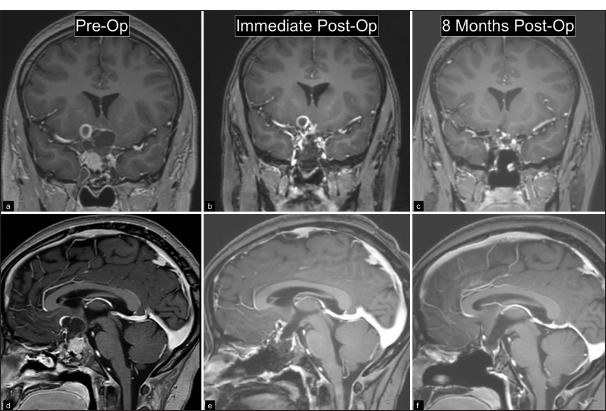
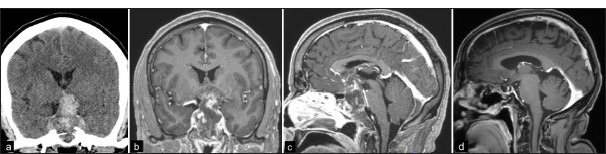
Case description: Case one is a 58-year-old male presenting with sudden-onset headache and visual disturbance. He was febrile and tested positive for COVID-19. Magnetic resonance imaging (MRI) revealed a large sellarsuprasellar mass with intratumoral hemorrhagic components. He underwent endoscopic endonasal resection with subsequent improvement in vision and oculomotor function. Pathology was consistent with hemorrhagic pituitary adenoma. Case two is a 15-year-old male presenting with sudden-onset severe headache and acute visual loss. He also tested positive for COVID-19. MRI revealed a sellar-suprasellar mass with a regional mass effect. He underwent endoscopic endonasal resection with improvement in vision over time. Pathology was consistent with craniopharyngioma. There was no evidence of intraoperative COVID-19 transmission among members of the surgical team, who were monitored for 2 weeks after surgery.
Conclusion: PA in the setting of severe acute respiratory syndrome coronavirus 2 infection should be considered in the differential diagnosis of a COVID-positive patient presenting with acute severe headache, visual loss, and/or ophthalmoplegia; we discuss proposed mechanisms related to inflammation, coagulability, and hypoxia. The absence of intraoperative COVID-19 transmission during transsphenoidal resection performed in an emergency setting suggests that the risk of exposure may be attenuated with safety precautions.




 京公网安备 11010802042870号
京ICP备2023020795号-1
京公网安备 11010802042870号
京ICP备2023020795号-1

 分享
分享

 求助内容:
求助内容: 应助结果提醒方式:
 扫码关注我们
