Weiqi Wang, Huanyu Du, Changhao Dai, Hongwenjie Ma, Shi Luo, Xuejun Wang, Mingquan Guo, Derong Kong and Dacheng Wei
{"title":"Amplification-free detection of Mycobacterium tuberculosis using CRISPR-Cas12a and graphene field-effect transistors†","authors":"Weiqi Wang, Huanyu Du, Changhao Dai, Hongwenjie Ma, Shi Luo, Xuejun Wang, Mingquan Guo, Derong Kong and Dacheng Wei","doi":"10.1039/D4NR03852E","DOIUrl":null,"url":null,"abstract":"<p >Current molecular tests for tuberculosis (TB), such as whole genome sequencing and Xpert <em>Mycobacterium tuberculosis</em>/rifampicin resistance assay, exhibit limited sensitivity and necessitate the pre-amplification step of target DNA. This limitation greatly increases detection time and poses an increased risk of infection. Here, we present a graphene field-effect transistor (GFET) based on the CRISPR/Cas system for detecting <em>Mycobacterium tuberculosis</em>. The CRISPR/Cas12a system has the ability to specifically recognize and cleave target DNA. By integrating the system onto the FET platform and utilizing its electrical amplification capability, we achieve rapid and sensitive detection without requiring sample pre-amplification, with a limit of detection (LoD) as low as 2.42 × 10<small><sup>−18</sup></small> M. Cas12a-GFET devices can differentiate 30 positive cases from 56 serum samples within 5 minutes. These findings highlight its immense potential in future biological analysis and clinical diagnosis.</p>","PeriodicalId":92,"journal":{"name":"Nanoscale","volume":" 8","pages":" 4603-4609"},"PeriodicalIF":5.1000,"publicationDate":"2025-01-11","publicationTypes":"Journal Article","fieldsOfStudy":null,"isOpenAccess":false,"openAccessPdf":"","citationCount":"0","resultStr":null,"platform":"Semanticscholar","paperid":null,"PeriodicalName":"Nanoscale","FirstCategoryId":"88","ListUrlMain":"https://pubs.rsc.org/en/content/articlelanding/2025/nr/d4nr03852e","RegionNum":3,"RegionCategory":"材料科学","ArticlePicture":[],"TitleCN":null,"AbstractTextCN":null,"PMCID":null,"EPubDate":"","PubModel":"","JCR":"Q1","JCRName":"CHEMISTRY, MULTIDISCIPLINARY","Score":null,"Total":0}
引用次数: 0
Abstract
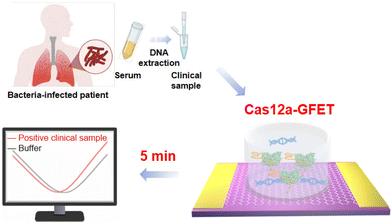
Current molecular tests for tuberculosis (TB), such as whole genome sequencing and Xpert Mycobacterium tuberculosis/rifampicin resistance assay, exhibit limited sensitivity and necessitate the pre-amplification step of target DNA. This limitation greatly increases detection time and poses an increased risk of infection. Here, we present a graphene field-effect transistor (GFET) based on the CRISPR/Cas system for detecting Mycobacterium tuberculosis. The CRISPR/Cas12a system has the ability to specifically recognize and cleave target DNA. By integrating the system onto the FET platform and utilizing its electrical amplification capability, we achieve rapid and sensitive detection without requiring sample pre-amplification, with a limit of detection (LoD) as low as 2.42 × 10⁻¹⁸ M. Cas12a-GFET devices can differentiate 30 positive cases from 56 serum samples within 5 minutes. These findings highlight its immense potential in future biological analysis and clinical diagnosis.
目前的结核病分子检测,如全基因组测序和Xpert结核分枝杆菌/利福平耐药性测定,灵敏度有限,需要靶DNA的预扩增步骤。这一限制大大增加了检测时间,并增加了感染的风险。在这里,我们提出了一种基于CRISPR/Cas系统的石墨烯场效应晶体管(GFET),用于检测结核分枝杆菌。CRISPR/Cas12a系统具有特异性识别和切割靶DNA的能力。通过将系统集成到FET平台并利用其电放大能力,我们实现了快速灵敏的检测,无需样品预扩增,检测限(LoD)低至2.42×10−18 M. Cas12a-GFET设备可以在5分钟内从56份血清样本中区分30例阳性病例。这些发现突出了其在未来生物学分析和临床诊断方面的巨大潜力。
期刊介绍:
Nanoscale is a high-impact international journal, publishing high-quality research across nanoscience and nanotechnology. Nanoscale publishes a full mix of research articles on experimental and theoretical work, including reviews, communications, and full papers.Highly interdisciplinary, this journal appeals to scientists, researchers and professionals interested in nanoscience and nanotechnology, quantum materials and quantum technology, including the areas of physics, chemistry, biology, medicine, materials, energy/environment, information technology, detection science, healthcare and drug discovery, and electronics.



 京公网安备 11010802042870号
京ICP备2023020795号-1
京公网安备 11010802042870号
京ICP备2023020795号-1

 分享
分享
 求助内容:
求助内容: 应助结果提醒方式:
 扫码关注我们
