{"title":"FingHV: Efficient Sharing and Fine-Grained Scheduling of Virtualized HPU Resources","authors":"Hui Wang;Zhiwen Yu;Zhuoli Ren;Yao Zhang;Jiaqi Liu;Liang Wang;Bin Guo","doi":"10.1109/TCYB.2024.3518569","DOIUrl":null,"url":null,"abstract":"While artificial intelligence (AI) technology has advanced in real-world applications, there is a strong motivation to develop hybrid systems where AI algorithms and humans collaborate, promoting more human-centered approaches in AI system design. This has led to the emergence of a novel human-machine computing (HMC) paradigm, which combines human cognitive abilities with machine computational power to create a collaborative computing framework that meets the demands of large-scale, complex tasks and enables human-machine symbiosis. Human processing units (HPUs) are crucial computing resources in HMC-oriented systems, and efficient HPU resource provisioning is key to boosting system performance. However, existing schemes often fail to assign tasks to the most suitable HPUs and optimize HPU utility, as they either cannot quantitatively measure skills or overlook utility concerns during task assignment and scheduling. To address these challenges, this article proposes a fine-grained HPU virtualization (FingHV) approach, which leverages virtualization techniques to improve flexibility, fairness, and utility in the provisioning process. The core idea is to use a tree-based skill model to precisely measure the levels and correlations of multiple skills within individual HPUs, and to apply a mixed time/event-based scheduling policy to maximize HPU utility. Specifically, we begin by proposing a hierarchical multiskill tree to model HPU skills and their correlations. Next, we formulate the HPU virtualization problem and present a fine-grained virtualization method, which includes a quality-driven HPU assignment process and a mixed time/event-based scheduling policy to improve resource-sharing efficiency. Finally, we evaluate FingHV on a synthetic dataset with varying task sizes and a real-world case. The results demonstrate that FingHV improves global matching quality by up to 39.7% and increases HPU utility by 11.2% compared to the baselines.","PeriodicalId":13112,"journal":{"name":"IEEE Transactions on Cybernetics","volume":"55 2","pages":"600-614"},"PeriodicalIF":10.5000,"publicationDate":"2025-01-10","publicationTypes":"Journal Article","fieldsOfStudy":null,"isOpenAccess":false,"openAccessPdf":"","citationCount":"0","resultStr":null,"platform":"Semanticscholar","paperid":null,"PeriodicalName":"IEEE Transactions on Cybernetics","FirstCategoryId":"94","ListUrlMain":"https://ieeexplore.ieee.org/document/10836978/","RegionNum":1,"RegionCategory":"计算机科学","ArticlePicture":[],"TitleCN":null,"AbstractTextCN":null,"PMCID":null,"EPubDate":"","PubModel":"","JCR":"Q1","JCRName":"AUTOMATION & CONTROL SYSTEMS","Score":null,"Total":0}
引用次数: 0
Abstract
While artificial intelligence (AI) technology has advanced in real-world applications, there is a strong motivation to develop hybrid systems where AI algorithms and humans collaborate, promoting more human-centered approaches in AI system design. This has led to the emergence of a novel human-machine computing (HMC) paradigm, which combines human cognitive abilities with machine computational power to create a collaborative computing framework that meets the demands of large-scale, complex tasks and enables human-machine symbiosis. Human processing units (HPUs) are crucial computing resources in HMC-oriented systems, and efficient HPU resource provisioning is key to boosting system performance. However, existing schemes often fail to assign tasks to the most suitable HPUs and optimize HPU utility, as they either cannot quantitatively measure skills or overlook utility concerns during task assignment and scheduling. To address these challenges, this article proposes a fine-grained HPU virtualization (FingHV) approach, which leverages virtualization techniques to improve flexibility, fairness, and utility in the provisioning process. The core idea is to use a tree-based skill model to precisely measure the levels and correlations of multiple skills within individual HPUs, and to apply a mixed time/event-based scheduling policy to maximize HPU utility. Specifically, we begin by proposing a hierarchical multiskill tree to model HPU skills and their correlations. Next, we formulate the HPU virtualization problem and present a fine-grained virtualization method, which includes a quality-driven HPU assignment process and a mixed time/event-based scheduling policy to improve resource-sharing efficiency. Finally, we evaluate FingHV on a synthetic dataset with varying task sizes and a real-world case. The results demonstrate that FingHV improves global matching quality by up to 39.7% and increases HPU utility by 11.2% compared to the baselines.
期刊介绍:
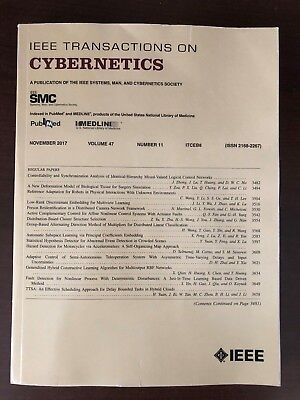
The scope of the IEEE Transactions on Cybernetics includes computational approaches to the field of cybernetics. Specifically, the transactions welcomes papers on communication and control across machines or machine, human, and organizations. The scope includes such areas as computational intelligence, computer vision, neural networks, genetic algorithms, machine learning, fuzzy systems, cognitive systems, decision making, and robotics, to the extent that they contribute to the theme of cybernetics or demonstrate an application of cybernetics principles.



 京公网安备 11010802042870号
京ICP备2023020795号-1
京公网安备 11010802042870号
京ICP备2023020795号-1

 分享
分享
 求助内容:
求助内容: 应助结果提醒方式:
 扫码关注我们
