Bo Li, Xin Lu, Xianshun Sun, Hongping Zhou, Yupeng Tian, Zijuan Hai and Dandan Li
{"title":"Fluorescence lifetime imaging-guided photodynamic therapy over two-photon responsive metal–organic frameworks†","authors":"Bo Li, Xin Lu, Xianshun Sun, Hongping Zhou, Yupeng Tian, Zijuan Hai and Dandan Li","doi":"10.1039/D4QI03014A","DOIUrl":null,"url":null,"abstract":"<p >In the realm of photodynamic therapy (PDT), the incorporation of real-time feedback through two-photon fluorescence lifetime imaging poses a significant challenge, primarily due to the intricate nature of photosensitizer design. In our investigation, we have effectively constructed a versatile platform labeled as <strong>ZTBH</strong> using a post-ligand modification approach, resulting in enhanced two-photon fluorescence capabilities and notable responsiveness of fluorescence lifetime to variations in the cellular microenvironment. The distinctive synergy between intersystem crossing and linker-to-cluster charge transfer within <strong>ZTBH</strong> empowers the generation of ample reactive oxygen species (<small><sup>1</sup></small>O<small><sub>2</sub></small> and O<small><sub>2</sub></small>˙<small><sup>−</sup></small>), thereby yielding remarkable efficiency in PDT. Moreover, the capping of hyaluronic acid (HA) through the coordination method confers cancer-specific targeting properties on <strong>ZTBH</strong>. Subsequently, with the aid of a two-photon fluorescence lifetime imaging microscope (TP-FLIM), <strong>ZTBH</strong> not only achieves successful two-photon photodynamic therapy but also enables real-time visualization of cellular microenvironment changes throughout the apoptosis process. This investigation underscores a viable approach for the creation of two-photon fluorescence lifetime photosensitizers for visualizing the PDT procedure.</p>","PeriodicalId":79,"journal":{"name":"Inorganic Chemistry Frontiers","volume":" 5","pages":" 1850-1856"},"PeriodicalIF":6.4000,"publicationDate":"2025-01-11","publicationTypes":"Journal Article","fieldsOfStudy":null,"isOpenAccess":false,"openAccessPdf":"","citationCount":"0","resultStr":null,"platform":"Semanticscholar","paperid":null,"PeriodicalName":"Inorganic Chemistry Frontiers","FirstCategoryId":"92","ListUrlMain":"https://pubs.rsc.org/en/content/articlelanding/2025/qi/d4qi03014a","RegionNum":1,"RegionCategory":"化学","ArticlePicture":[],"TitleCN":null,"AbstractTextCN":null,"PMCID":null,"EPubDate":"","PubModel":"","JCR":"Q1","JCRName":"CHEMISTRY, INORGANIC & NUCLEAR","Score":null,"Total":0}
引用次数: 0
Abstract
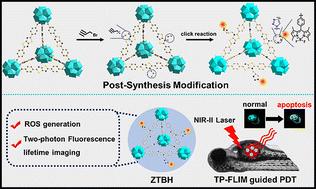
In the realm of photodynamic therapy (PDT), the incorporation of real-time feedback through two-photon fluorescence lifetime imaging poses a significant challenge, primarily due to the intricate nature of photosensitizer design. In our investigation, we have effectively constructed a versatile platform labeled as ZTBH using a post-ligand modification approach, resulting in enhanced two-photon fluorescence capabilities and notable responsiveness of fluorescence lifetime to variations in the cellular microenvironment. The distinctive synergy between intersystem crossing and linker-to-cluster charge transfer within ZTBH empowers the generation of ample reactive oxygen species (1O2 and O2˙−), thereby yielding remarkable efficiency in PDT. Moreover, the capping of hyaluronic acid (HA) through the coordination method confers cancer-specific targeting properties on ZTBH. Subsequently, with the aid of a two-photon fluorescence lifetime imaging microscope (TP-FLIM), ZTBH not only achieves successful two-photon photodynamic therapy but also enables real-time visualization of cellular microenvironment changes throughout the apoptosis process. This investigation underscores a viable approach for the creation of two-photon fluorescence lifetime photosensitizers for visualizing the PDT procedure.





 京公网安备 11010802042870号
京ICP备2023020795号-1
京公网安备 11010802042870号
京ICP备2023020795号-1

 分享
分享
 求助内容:
求助内容: 应助结果提醒方式:
 扫码关注我们
