Fungal effector genes involved in the suppression of chitin signaling as novel targets for the control of powdery mildew disease via a nontransgenic RNA interference approach

IF 3.8 1区 农林科学 Q1 AGRONOMY Pest Management Science Pub Date : 2025-01-11 DOI:10.1002/ps.8660
Nisrine Bakhat, Alejandro Jiménez-Sánchez, Laura Ruiz-Jiménez, Isabel Padilla-Roji, Leonardo Velasco, Alejandro Pérez-García, Dolores Fernández-Ortuño
{"title":"Fungal effector genes involved in the suppression of chitin signaling as novel targets for the control of powdery mildew disease via a nontransgenic RNA interference approach","authors":"Nisrine Bakhat,&nbsp;Alejandro Jiménez-Sánchez,&nbsp;Laura Ruiz-Jiménez,&nbsp;Isabel Padilla-Roji,&nbsp;Leonardo Velasco,&nbsp;Alejandro Pérez-García,&nbsp;Dolores Fernández-Ortuño","doi":"10.1002/ps.8660","DOIUrl":null,"url":null,"abstract":"<div>\n \n \n <section>\n \n <h3> BACKGROUND</h3>\n \n <p>Chitin is a crucial component of fungal cell walls and an effective elicitor of plant immunity; however, phytopathogenic fungi have developed virulence mechanisms to counteract the activation of this plant defensive response. In this study, the molecular mechanism of chitin-induced suppression through effectors involved in chitin deacetylases (CDAs) and their degradation (EWCAs) was investigated with the idea of developing novel dsRNA-biofungicides to control the cucurbit powdery mildew caused by <i>Podosphaera xanthii</i>.</p>\n </section>\n \n <section>\n \n <h3> RESULTS</h3>\n \n <p>The molecular mechanisms associated with the silencing effect of the <i>PxCDA</i> and <i>PxEWCAs</i> genes were first studied through dsRNA cotyledon infiltration assays, which revealed a ≈80% reduction in fungal biomass and a 50% decrease in gene expression. To assess the impact on powdery mildew disease control, <i>in vitro</i> and <i>in planta</i> assays were carried out in growth chamber and glasshouse experiments, with ≈50% reduction in disease symptoms after 8 days postinoculation (dpi) in leaf discs and 12 dpi in plants’ leaves, respectively. This control was extended for 21 days when the dsRNAs were protected on the carbon dot nanocarriers. Additionally, the uptake of the dsRNAs by fungal spores was observed 12 h postapplication via confocal microscopy, and efficient processing of dsRNAs into siRNAs by the melon RNAi machinery was observed 24 h postspraying through sRNA-seq.</p>\n </section>\n \n <section>\n \n <h3> CONCLUSIONS</h3>\n \n <p>This study highlights notable advancements in environmentally friendly disease management, and features the technological potential of RNA-based fungicides together with nanotechnology for cucurbit powdery mildew control. © 2025 Society of Chemical Industry.</p>\n </section>\n </div>","PeriodicalId":218,"journal":{"name":"Pest Management Science","volume":"81 7","pages":"3452-3463"},"PeriodicalIF":3.8000,"publicationDate":"2025-01-11","publicationTypes":"Journal Article","fieldsOfStudy":null,"isOpenAccess":false,"openAccessPdf":"","citationCount":"0","resultStr":null,"platform":"Semanticscholar","paperid":null,"PeriodicalName":"Pest Management Science","FirstCategoryId":"97","ListUrlMain":"https://scijournals.onlinelibrary.wiley.com/doi/10.1002/ps.8660","RegionNum":1,"RegionCategory":"农林科学","ArticlePicture":[],"TitleCN":null,"AbstractTextCN":null,"PMCID":null,"EPubDate":"","PubModel":"","JCR":"Q1","JCRName":"AGRONOMY","Score":null,"Total":0}
引用次数: 0

Abstract

BACKGROUND

Chitin is a crucial component of fungal cell walls and an effective elicitor of plant immunity; however, phytopathogenic fungi have developed virulence mechanisms to counteract the activation of this plant defensive response. In this study, the molecular mechanism of chitin-induced suppression through effectors involved in chitin deacetylases (CDAs) and their degradation (EWCAs) was investigated with the idea of developing novel dsRNA-biofungicides to control the cucurbit powdery mildew caused by Podosphaera xanthii.

RESULTS

The molecular mechanisms associated with the silencing effect of the PxCDA and PxEWCAs genes were first studied through dsRNA cotyledon infiltration assays, which revealed a ≈80% reduction in fungal biomass and a 50% decrease in gene expression. To assess the impact on powdery mildew disease control, in vitro and in planta assays were carried out in growth chamber and glasshouse experiments, with ≈50% reduction in disease symptoms after 8 days postinoculation (dpi) in leaf discs and 12 dpi in plants’ leaves, respectively. This control was extended for 21 days when the dsRNAs were protected on the carbon dot nanocarriers. Additionally, the uptake of the dsRNAs by fungal spores was observed 12 h postapplication via confocal microscopy, and efficient processing of dsRNAs into siRNAs by the melon RNAi machinery was observed 24 h postspraying through sRNA-seq.

CONCLUSIONS

This study highlights notable advancements in environmentally friendly disease management, and features the technological potential of RNA-based fungicides together with nanotechnology for cucurbit powdery mildew control. © 2025 Society of Chemical Industry.
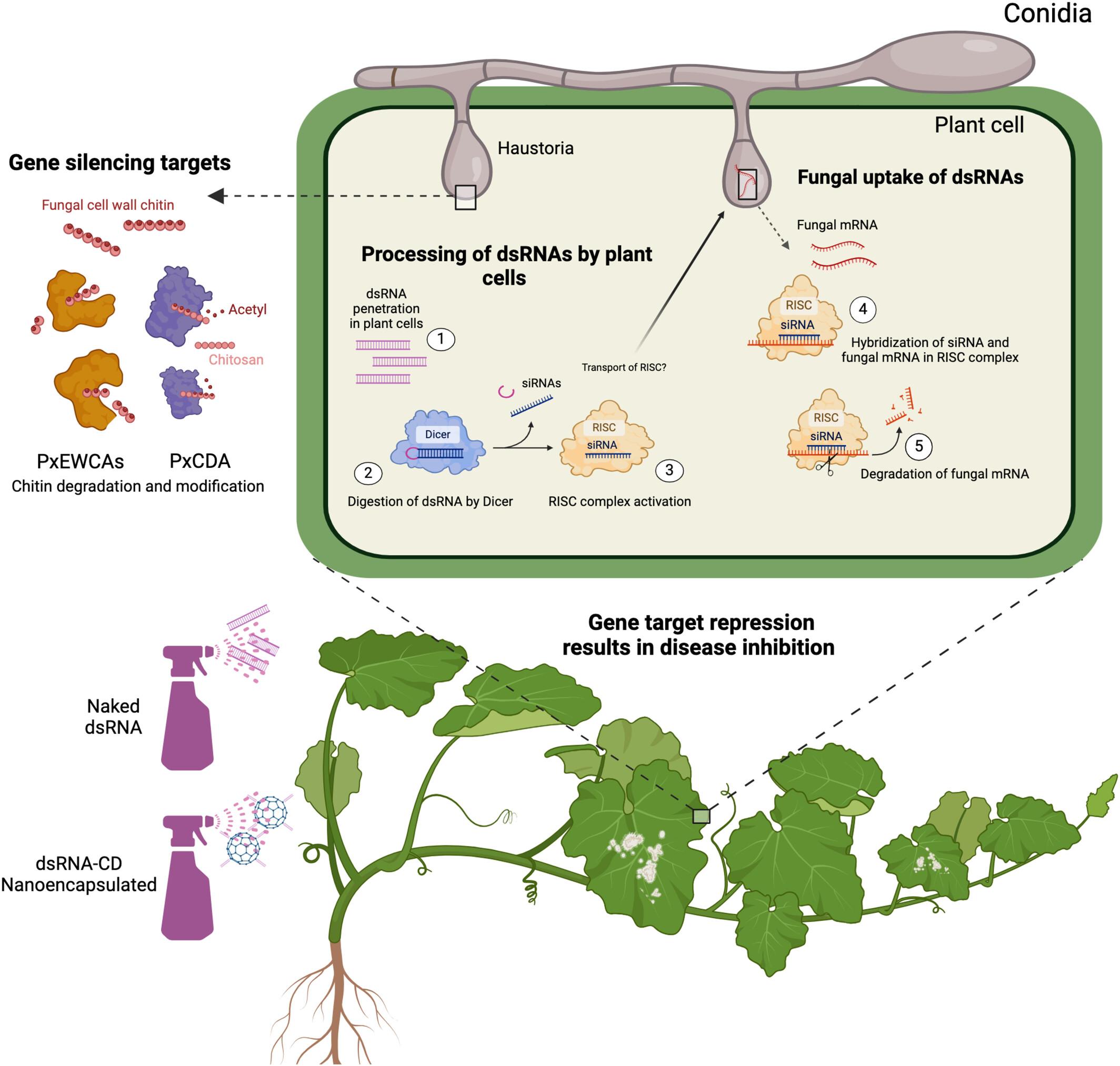
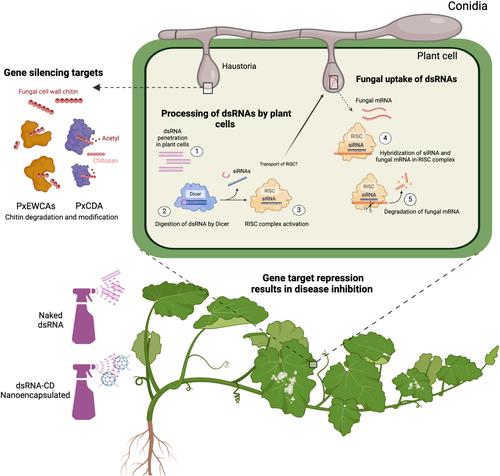
Abstract Image

Abstract Image

Abstract Image

Abstract Image

Abstract Image

查看原文
分享 分享
微信好友 朋友圈 QQ好友 复制链接
本刊更多论文
参与抑制几丁质信号传导的真菌效应基因通过非转基因RNA干扰方法作为控制白粉病的新靶点
几丁质是真菌细胞壁的重要组成部分,是植物免疫的有效激发剂;然而,植物病原真菌已经发展出毒力机制来抵消这种植物防御反应的激活。本研究旨在研究几丁质脱乙酰酶(CDAs)及其降解(EWCAs)效应物对几丁质诱导的抑制作用的分子机制,以期开发新型dsrna生物杀菌剂防治瓜白粉病(Podosphaera xanthii)。
本文章由计算机程序翻译,如有差异,请以英文原文为准。
求助全文
约1分钟内获得全文 去求助
来源期刊
Pest Management Science
Pest Management Science 农林科学-昆虫学
CiteScore
7.90
自引率
9.80%
发文量
553
审稿时长
4.8 months
期刊介绍: Pest Management Science is the international journal of research and development in crop protection and pest control. Since its launch in 1970, the journal has become the premier forum for papers on the discovery, application, and impact on the environment of products and strategies designed for pest management. Published for SCI by John Wiley & Sons Ltd.
期刊最新文献
Potential of endophytic Beauveria bassiana against Coraebus (Coleoptera: Buprestidae) oak borers. Artificial shelters as dual-purpose tools for monitoring natural enemies and providing microhabitats in orchards. Residue dynamics and metabolic pathways of sulfoxaflor in Cirsium japonicum var. maackii and Olea europaea L. Molecular co-assembly engineering towards natural tea saponin-based nanopesticides for synergistic enhanced foliar affinity. Cytochrome P450 and glutathione S-transferase may confer bensulfuron-methyl resistance in Cyperus iria.
×
引用
GB/T 7714-2015
复制
MLA
复制
APA
复制
导出至
BibTeX EndNote RefMan NoteFirst NoteExpress
×
×
提示
您的信息不完整,为了账户安全,请先补充。
现在去补充
×
提示
您因"违规操作"
具体请查看互助需知
我知道了
×
提示
现在去查看 取消
×
提示
确定
0
微信
客服QQ
Book学术公众号 扫码关注我们
反馈
×
意见反馈
请填写您的意见或建议
请填写您的手机或邮箱
已复制链接
已复制链接
快去分享给好友吧!
我知道了
×
扫码分享
扫码分享
Book学术官方微信
Book学术文献互助
Book学术文献互助群
群 号:604180095
Book学术
文献互助 智能选刊 最新文献 互助须知 联系我们:info@booksci.cn
Book学术提供免费学术资源搜索服务,方便国内外学者检索中英文文献。致力于提供最便捷和优质的服务体验。
Copyright © 2023 Book学术 All rights reserved.
ghs 京公网安备 11010802042870号 京ICP备2023020795号-1