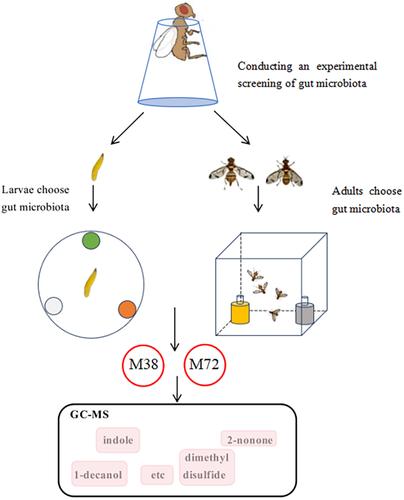
Bactrocera cucurbitae (Coquillett) is a distructive quarantine insect pest that causes significant economic losses on cucurbit crops. To explore a green control approach, we investigated the behavioral responses of B. cucurbitae larvae and adults to bacterial suspensions, sediments, and supernatants derived from eight gut microbial strains across four distinct genera. The proboscis extension response was used to evaluate the impact of these microbial strains. In addition, using food selection experiments, two-choice trap methods, and gas chromatography–mass spectrometry, we isolated and identified the predominant volatile compounds in the microbiota supernatants.
Among the tested gut microbial strains, Kluyvera, Morganella, and Providencia exhibited notable attraction toward B. cucurbitae. In particular, the supernatant of Providencia M38 revealed the most highly attractive effect on B. cucurbitae larvae, whereas the supernatant of Morganella M72 was highly attractive to B. cucurbitae adults. Primary components present in the supernatant of M38 and M72 were dimethyl disulfide, indole, 2-nonone, phenethyl alcohol, and 1-decanol.
Strains of M38 and M72 displayed remarkable attractive properties for B. cucurbitae larvae and adults, respectively, presenting promising potential for developing a novel attractant for this pest species. © 2025 Society of Chemical Industry.







 京公网安备 11010802042870号
京ICP备2023020795号-1
京公网安备 11010802042870号
京ICP备2023020795号-1

 分享
分享
 求助内容:
求助内容: 应助结果提醒方式:
 扫码关注我们
