Valentin Nicolae Varlas, Irina Bălescu, Roxana Georgiana Varlas, Al-Aloul Adnan, Alexandru George Filipescu, Nicolae Bacalbașa, Nicolae Suciu
{"title":"Complete Abdominal Evisceration After Open Hysterectomy: A Case Report and Evidence-Based Review.","authors":"Valentin Nicolae Varlas, Irina Bălescu, Roxana Georgiana Varlas, Al-Aloul Adnan, Alexandru George Filipescu, Nicolae Bacalbașa, Nicolae Suciu","doi":"10.3390/jcm14010262","DOIUrl":null,"url":null,"abstract":"<p><p><b>Background/Objectives:</b> Despite its low incidence, complete postoperative abdominal evisceration represents a complication requiring an urgent solution. We aimed to present a rare case of an abdominal evisceration of the omentum and small-bowel loops after a total abdominal hysterectomy and review the literature regarding this condition's diagnosis and therapeutic management. <b>Case report:</b> On the sixth postoperative day for a uterine fibroid, a 68-year-old patient presented with an abdominal evisceration of the omentum and small bowel that occurred two hours before. An emergency laparotomy was performed to correct the evisceration and restore the integrity of the abdominal wall structure. The literature review was carried out in the PubMed, Embase, and Web of Science databases using the terms \"abdominal wall dehiscence\", \"abdominal evisceration\", \"open abdomen\", \"burst abdomen\", \"abdominal fascial dehiscence\", \"abdominal dehiscence post-hysterectomy\", and \"hysterectomy complications\" by identifying all-time articles published in English. <b>Results:</b> Seven studies were included in this electronic search. The early diagnosis of abdominal evisceration, the identification of risk factors and comorbidities, followed by the choice of surgical technique, and postoperative follow-up were parts of the standard algorithm for managing this life-threatening case. <b>Conclusions:</b> Abdominal evisceration, as a surgical emergency, requires the diagnosis and treatment of this complication alongside the identification of the risk factors that can lead to its occurrence, as well as careful postoperative monitoring adapted to each case.</p>","PeriodicalId":15533,"journal":{"name":"Journal of Clinical Medicine","volume":"14 1","pages":""},"PeriodicalIF":2.9000,"publicationDate":"2025-01-05","publicationTypes":"Journal Article","fieldsOfStudy":null,"isOpenAccess":false,"openAccessPdf":"https://www.ncbi.nlm.nih.gov/pmc/articles/PMC11721390/pdf/","citationCount":"0","resultStr":null,"platform":"Semanticscholar","paperid":null,"PeriodicalName":"Journal of Clinical Medicine","FirstCategoryId":"3","ListUrlMain":"https://doi.org/10.3390/jcm14010262","RegionNum":3,"RegionCategory":"医学","ArticlePicture":[],"TitleCN":null,"AbstractTextCN":null,"PMCID":null,"EPubDate":"","PubModel":"","JCR":"Q1","JCRName":"MEDICINE, GENERAL & INTERNAL","Score":null,"Total":0}
引用次数: 0
Abstract
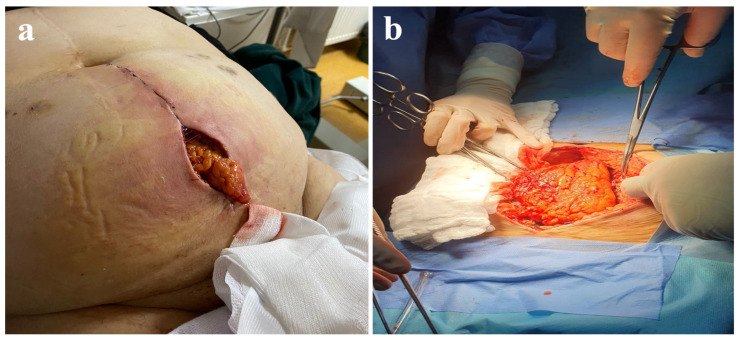
Background/Objectives: Despite its low incidence, complete postoperative abdominal evisceration represents a complication requiring an urgent solution. We aimed to present a rare case of an abdominal evisceration of the omentum and small-bowel loops after a total abdominal hysterectomy and review the literature regarding this condition's diagnosis and therapeutic management. Case report: On the sixth postoperative day for a uterine fibroid, a 68-year-old patient presented with an abdominal evisceration of the omentum and small bowel that occurred two hours before. An emergency laparotomy was performed to correct the evisceration and restore the integrity of the abdominal wall structure. The literature review was carried out in the PubMed, Embase, and Web of Science databases using the terms "abdominal wall dehiscence", "abdominal evisceration", "open abdomen", "burst abdomen", "abdominal fascial dehiscence", "abdominal dehiscence post-hysterectomy", and "hysterectomy complications" by identifying all-time articles published in English. Results: Seven studies were included in this electronic search. The early diagnosis of abdominal evisceration, the identification of risk factors and comorbidities, followed by the choice of surgical technique, and postoperative follow-up were parts of the standard algorithm for managing this life-threatening case. Conclusions: Abdominal evisceration, as a surgical emergency, requires the diagnosis and treatment of this complication alongside the identification of the risk factors that can lead to its occurrence, as well as careful postoperative monitoring adapted to each case.
背景/目的:尽管发生率低,但术后腹部全内脏取出是一种需要紧急解决的并发症。我们的目的是报告一例罕见的腹部子宫全切除术后腹腔网膜和小肠袢切除的病例,并回顾有关这种情况的诊断和治疗管理的文献。病例报告:在子宫肌瘤术后第六天,一位68岁的患者在两小时前出现腹部大网膜和小肠的内脏。采取紧急剖腹手术,以纠正内脏和恢复腹壁结构的完整性。文献综述在PubMed、Embase和Web of Science数据库中进行,检索词为“腹壁开裂”、“腹腔切开”、“腹裂”、“腹裂”、“腹膜开裂”、“子宫切除术后腹部开裂”和“子宫切除术并发症”,检索所有发表的英文文章。结果:本次电子检索纳入了7项研究。早期诊断腹部内脏切除,识别危险因素和合并症,随后选择手术技术,术后随访是处理这一危及生命病例的标准算法的一部分。结论:腹部内脏切除作为一种外科急诊,需要对该并发症进行诊断和治疗,同时确定可能导致其发生的危险因素,并针对每个病例进行仔细的术后监测。
期刊介绍:
Journal of Clinical Medicine (ISSN 2077-0383), is an international scientific open access journal, providing a platform for advances in health care/clinical practices, the study of direct observation of patients and general medical research. This multi-disciplinary journal is aimed at a wide audience of medical researchers and healthcare professionals.
Unique features of this journal:
manuscripts regarding original research and ideas will be particularly welcomed.JCM also accepts reviews, communications, and short notes.
There is no limit to publication length: our aim is to encourage scientists to publish their experimental and theoretical results in as much detail as possible.





 京公网安备 11010802042870号
京ICP备2023020795号-1
京公网安备 11010802042870号
京ICP备2023020795号-1

 分享
分享
 求助内容:
求助内容: 应助结果提醒方式:
 扫码关注我们
