Nuwanthaka P. Jayaweera, Shana Havenridge, Ashley R. Bielinski, Kihoon Kim, Niklas B. Thompson, Justin M. Hoffman, Amelia M. Wheaton, Prasenjit Sarkar, Rajesh Pathak, Jeffrey W. Elam, Cong Liu, Karen L. Mulfort, Alex B. F. Martinson
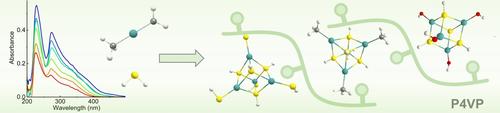
{"title":"Sequential Infiltration Synthesis of Cadmium Sulfide Discrete Atom Clusters","authors":"Nuwanthaka P. Jayaweera, Shana Havenridge, Ashley R. Bielinski, Kihoon Kim, Niklas B. Thompson, Justin M. Hoffman, Amelia M. Wheaton, Prasenjit Sarkar, Rajesh Pathak, Jeffrey W. Elam, Cong Liu, Karen L. Mulfort, Alex B. F. Martinson","doi":"10.1002/anie.202421259","DOIUrl":null,"url":null,"abstract":"<p>Exposure of soft material templates to alternating volatile chemical precursors can produce inorganic deposition <i>within</i> the permeable template (e.g. a polymer thin film) in a process akin to atomic layer deposition (ALD). While such sequential infiltration synthesis (SIS) processes have now been demonstrated for many metal oxides, we report an SIS process for a transition metal sulfide – CdS. Gas phase dimethyl cadmium and hydrogen sulfide precursors infiltrated into poly(4-vinylpyridine) thin films result in the 3D-nucleation of clusters consistent with a cubane-type Cd<sub>4</sub>S<sub>4</sub> core that are variably terminated with methyl, thiol and hydroxy capping ligands. First principles models and simulation of few-atom Cd-based clusters are consistent with electronic and vibrational spectroscopy and grazing-incidence total X-ray scattering measurements of 3D-cluster-arrays synthesized at 80 °C. The direct synthesis of few-atom transition metal sulfide clusters within polymer thin films will provide a versatile new route to precision architectures for light-absorbing materials including solar energy harvesting and conversion applications.</p>","PeriodicalId":125,"journal":{"name":"Angewandte Chemie International Edition","volume":"64 10","pages":""},"PeriodicalIF":16.9000,"publicationDate":"2025-01-13","publicationTypes":"Journal Article","fieldsOfStudy":null,"isOpenAccess":false,"openAccessPdf":"https://onlinelibrary.wiley.com/doi/epdf/10.1002/anie.202421259","citationCount":"0","resultStr":null,"platform":"Semanticscholar","paperid":null,"PeriodicalName":"Angewandte Chemie International Edition","FirstCategoryId":"92","ListUrlMain":"https://onlinelibrary.wiley.com/doi/10.1002/anie.202421259","RegionNum":1,"RegionCategory":"化学","ArticlePicture":[],"TitleCN":null,"AbstractTextCN":null,"PMCID":null,"EPubDate":"","PubModel":"","JCR":"Q1","JCRName":"CHEMISTRY, MULTIDISCIPLINARY","Score":null,"Total":0}
引用次数: 0
Abstract
Exposure of soft material templates to alternating volatile chemical precursors can produce inorganic deposition within the permeable template (e.g. a polymer thin film) in a process akin to atomic layer deposition (ALD). While such sequential infiltration synthesis (SIS) processes have now been demonstrated for many metal oxides, we report an SIS process for a transition metal sulfide – CdS. Gas phase dimethyl cadmium and hydrogen sulfide precursors infiltrated into poly(4-vinylpyridine) thin films result in the 3D-nucleation of clusters consistent with a cubane-type Cd4S4 core that are variably terminated with methyl, thiol and hydroxy capping ligands. First principles models and simulation of few-atom Cd-based clusters are consistent with electronic and vibrational spectroscopy and grazing-incidence total X-ray scattering measurements of 3D-cluster-arrays synthesized at 80 °C. The direct synthesis of few-atom transition metal sulfide clusters within polymer thin films will provide a versatile new route to precision architectures for light-absorbing materials including solar energy harvesting and conversion applications.
期刊介绍:
Angewandte Chemie, a journal of the German Chemical Society (GDCh), maintains a leading position among scholarly journals in general chemistry with an impressive Impact Factor of 16.6 (2022 Journal Citation Reports, Clarivate, 2023). Published weekly in a reader-friendly format, it features new articles almost every day. Established in 1887, Angewandte Chemie is a prominent chemistry journal, offering a dynamic blend of Review-type articles, Highlights, Communications, and Research Articles on a weekly basis, making it unique in the field.




 京公网安备 11010802042870号
京ICP备2023020795号-1
京公网安备 11010802042870号
京ICP备2023020795号-1

 分享
分享
 求助内容:
求助内容: 应助结果提醒方式:
 扫码关注我们
