{"title":"Single atom alloys aggregation in the presence of ligands†","authors":"Maya Salem and Giannis Mpourmpakis","doi":"10.1039/D4NR04202F","DOIUrl":null,"url":null,"abstract":"<p >Single atom alloys (SAAs) have gained tremendous attention as promising materials with unique physicochemical properties, particularly in catalysis. The stability of SAAs relies on the formation of a single active dopant on the surface of a metal host, quantified by the surface segregation and aggregation energy. Previous studies have investigated the surface segregation of non-ligated and ligated SAAs to reveal the driving forces underlying such phenomena. In this work we address another key factor dictating the stability in non-ligated and ligated SAAs: the aggregation energy (<em>E</em><small><sub>agg</sub></small>) of dopants. Specifically, we examine how thiols and amines, commonly found ligands in colloidal bimetallic nanoparticle synthesis, affect the aggregation of dopants (forming dimers and trimers) on the surface of a metal host. Utilizing Density Functional Theory (DFT) and machine learning (ML), we explore the stability patterns of SAAs through the energetics of low-index surfaces, such as (111) and (100), consisting of d<small><sup>8</sup></small>-(Pt, Pd, Ni) and d<small><sup>9</sup></small>-(Ag, Au, Cu) metals, both in the presence and absence of ligands. Collecting rich and accurate DFT data, we developed a four-feature support vector regression using the radial basis function (SVR RBF) to predict the <em>E</em><small><sub>agg</sub></small>. The model revealed important and easily accessible (tabulated) thermodynamic stability features that drive metal aggregation in SAAs, such as the bulk cohesive energy of the metal considering the exposed coordination environment on the surface, the charge transfer represented by the difference in electron affinities of metals and the radii of the metals describing strain effects. Additional incorporated features include adsorbate properties, such as the binding energy of the ligand on a single atom considering the coordination environment of the adsorbate. Through our study, we have revealed that stable SAAs are formed in Ni-, Pd-, Pt-based SAAs in the presence of ligands, while Ag-, Au-, Cu- doped with Ni-, Pd-, Pt- lead to aggregation. Finally, we tested our model against several experimental studies and demonstrated its robustness in predicting the formation of SAAs, enabling rapid screening across the vast materials space of SAAs. Additionally, we suggest criteria for stabilization of SAAs, guiding experimental efforts. Overall, our study advances the understanding of thermodynamic stability of colloidal SAAs, paving the way for rational SAA design.</p>","PeriodicalId":92,"journal":{"name":"Nanoscale","volume":" 5","pages":" 2830-2840"},"PeriodicalIF":5.1000,"publicationDate":"2025-01-13","publicationTypes":"Journal Article","fieldsOfStudy":null,"isOpenAccess":false,"openAccessPdf":"https://pubs.rsc.org/en/content/articlepdf/2025/nr/d4nr04202f?page=search","citationCount":"0","resultStr":null,"platform":"Semanticscholar","paperid":null,"PeriodicalName":"Nanoscale","FirstCategoryId":"88","ListUrlMain":"https://pubs.rsc.org/en/content/articlelanding/2025/nr/d4nr04202f","RegionNum":3,"RegionCategory":"材料科学","ArticlePicture":[],"TitleCN":null,"AbstractTextCN":null,"PMCID":null,"EPubDate":"","PubModel":"","JCR":"Q1","JCRName":"CHEMISTRY, MULTIDISCIPLINARY","Score":null,"Total":0}
引用次数: 0
Abstract
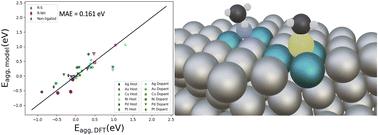
Single atom alloys (SAAs) have gained tremendous attention as promising materials with unique physicochemical properties, particularly in catalysis. The stability of SAAs relies on the formation of a single active dopant on the surface of a metal host, quantified by the surface segregation and aggregation energy. Previous studies have investigated the surface segregation of non-ligated and ligated SAAs to reveal the driving forces underlying such phenomena. In this work we address another key factor dictating the stability in non-ligated and ligated SAAs: the aggregation energy (Eagg) of dopants. Specifically, we examine how thiols and amines, commonly found ligands in colloidal bimetallic nanoparticle synthesis, affect the aggregation of dopants (forming dimers and trimers) on the surface of a metal host. Utilizing Density Functional Theory (DFT) and machine learning (ML), we explore the stability patterns of SAAs through the energetics of low-index surfaces, such as (111) and (100), consisting of d8-(Pt, Pd, Ni) and d9-(Ag, Au, Cu) metals, both in the presence and absence of ligands. Collecting rich and accurate DFT data, we developed a four-feature support vector regression using the radial basis function (SVR RBF) to predict the Eagg. The model revealed important and easily accessible (tabulated) thermodynamic stability features that drive metal aggregation in SAAs, such as the bulk cohesive energy of the metal considering the exposed coordination environment on the surface, the charge transfer represented by the difference in electron affinities of metals and the radii of the metals describing strain effects. Additional incorporated features include adsorbate properties, such as the binding energy of the ligand on a single atom considering the coordination environment of the adsorbate. Through our study, we have revealed that stable SAAs are formed in Ni-, Pd-, Pt-based SAAs in the presence of ligands, while Ag-, Au-, Cu- doped with Ni-, Pd-, Pt- lead to aggregation. Finally, we tested our model against several experimental studies and demonstrated its robustness in predicting the formation of SAAs, enabling rapid screening across the vast materials space of SAAs. Additionally, we suggest criteria for stabilization of SAAs, guiding experimental efforts. Overall, our study advances the understanding of thermodynamic stability of colloidal SAAs, paving the way for rational SAA design.
期刊介绍:
Nanoscale is a high-impact international journal, publishing high-quality research across nanoscience and nanotechnology. Nanoscale publishes a full mix of research articles on experimental and theoretical work, including reviews, communications, and full papers.Highly interdisciplinary, this journal appeals to scientists, researchers and professionals interested in nanoscience and nanotechnology, quantum materials and quantum technology, including the areas of physics, chemistry, biology, medicine, materials, energy/environment, information technology, detection science, healthcare and drug discovery, and electronics.



 京公网安备 11010802042870号
京ICP备2023020795号-1
京公网安备 11010802042870号
京ICP备2023020795号-1

 分享
分享
 求助内容:
求助内容: 应助结果提醒方式:
 扫码关注我们
