Yasamin Ghahramani , Seyedeh Sara Tabibi , Mohammad Mizanur Rahman Khan , Alireza Asadi , Elaheh Mohammadi , Ehsan Khaksar , Erfan Khaksar , Masoomeh Yari Kalashgrani , Mohammed M. Rahman , Wei-Hung Chiang , Seyyed Mojtaba Mousavi
{"title":"Recent advances in bioactive materials: Future perspectives and opportunities in oral cancer biosensing","authors":"Yasamin Ghahramani , Seyedeh Sara Tabibi , Mohammad Mizanur Rahman Khan , Alireza Asadi , Elaheh Mohammadi , Ehsan Khaksar , Erfan Khaksar , Masoomeh Yari Kalashgrani , Mohammed M. Rahman , Wei-Hung Chiang , Seyyed Mojtaba Mousavi","doi":"10.1016/j.talanta.2024.127494","DOIUrl":null,"url":null,"abstract":"<div><div>Bioactive materials and biosensing technologies are emerging as pivotal tools in the early detection and management of oral cancer, a disease characterized by high morbidity and mortality rates. Recent advancements in nanotechnology have facilitated the development of innovative biosensors that utilize bioactive materials for non-invasive diagnostics, particularly through salivary analysis. These biosensors, including electrochemical, optical, and molecular types, target specific biomarkers such as DNA, RNA, and proteins associated with oral cancer. For instance, metal oxide nanoparticles and gold nanoparticles have shown promise in enhancing the sensitivity and specificity of these diagnostic tools. The integration of these nanomaterials allows for real-time monitoring of biomarker levels in saliva, providing a rapid and accurate means of detecting oral cancer at its nascent stages. Furthermore, the utilization of biosensors can circumvent the limitations of traditional biopsy methods, which are often invasive and time-consuming. By focusing on salivary diagnostics, researchers aim to develop point-of-care testing devices that can be used in various settings, thus improving accessibility to early screening for at-risk populations. This innovative approach not only enhances diagnostic accuracy but also holds potential for personalized treatment strategies by enabling continuous monitoring of disease progression and response to therapy. As research continues to evolve, the combination of bioactive materials with advanced biosensing technologies promises to revolutionize oral cancer diagnostics, ultimately leading to improved patient outcomes through earlier intervention and tailored therapeutic approaches.</div></div>","PeriodicalId":435,"journal":{"name":"Talanta","volume":"286 ","pages":"Article 127494"},"PeriodicalIF":6.1000,"publicationDate":"2024-12-31","publicationTypes":"Journal Article","fieldsOfStudy":null,"isOpenAccess":false,"openAccessPdf":"","citationCount":"0","resultStr":null,"platform":"Semanticscholar","paperid":null,"PeriodicalName":"Talanta","FirstCategoryId":"92","ListUrlMain":"https://www.sciencedirect.com/science/article/pii/S0039914024018769","RegionNum":1,"RegionCategory":"化学","ArticlePicture":[],"TitleCN":null,"AbstractTextCN":null,"PMCID":null,"EPubDate":"","PubModel":"","JCR":"Q1","JCRName":"CHEMISTRY, ANALYTICAL","Score":null,"Total":0}
引用次数: 0
Abstract
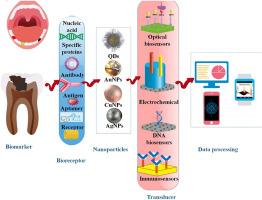
Bioactive materials and biosensing technologies are emerging as pivotal tools in the early detection and management of oral cancer, a disease characterized by high morbidity and mortality rates. Recent advancements in nanotechnology have facilitated the development of innovative biosensors that utilize bioactive materials for non-invasive diagnostics, particularly through salivary analysis. These biosensors, including electrochemical, optical, and molecular types, target specific biomarkers such as DNA, RNA, and proteins associated with oral cancer. For instance, metal oxide nanoparticles and gold nanoparticles have shown promise in enhancing the sensitivity and specificity of these diagnostic tools. The integration of these nanomaterials allows for real-time monitoring of biomarker levels in saliva, providing a rapid and accurate means of detecting oral cancer at its nascent stages. Furthermore, the utilization of biosensors can circumvent the limitations of traditional biopsy methods, which are often invasive and time-consuming. By focusing on salivary diagnostics, researchers aim to develop point-of-care testing devices that can be used in various settings, thus improving accessibility to early screening for at-risk populations. This innovative approach not only enhances diagnostic accuracy but also holds potential for personalized treatment strategies by enabling continuous monitoring of disease progression and response to therapy. As research continues to evolve, the combination of bioactive materials with advanced biosensing technologies promises to revolutionize oral cancer diagnostics, ultimately leading to improved patient outcomes through earlier intervention and tailored therapeutic approaches.
期刊介绍:
Talanta provides a forum for the publication of original research papers, short communications, and critical reviews in all branches of pure and applied analytical chemistry. Papers are evaluated based on established guidelines, including the fundamental nature of the study, scientific novelty, substantial improvement or advantage over existing technology or methods, and demonstrated analytical applicability. Original research papers on fundamental studies, and on novel sensor and instrumentation developments, are encouraged. Novel or improved applications in areas such as clinical and biological chemistry, environmental analysis, geochemistry, materials science and engineering, and analytical platforms for omics development are welcome.
Analytical performance of methods should be determined, including interference and matrix effects, and methods should be validated by comparison with a standard method, or analysis of a certified reference material. Simple spiking recoveries may not be sufficient. The developed method should especially comprise information on selectivity, sensitivity, detection limits, accuracy, and reliability. However, applying official validation or robustness studies to a routine method or technique does not necessarily constitute novelty. Proper statistical treatment of the data should be provided. Relevant literature should be cited, including related publications by the authors, and authors should discuss how their proposed methodology compares with previously reported methods.



 京公网安备 11010802042870号
京ICP备2023020795号-1
京公网安备 11010802042870号
京ICP备2023020795号-1

 分享
分享
 求助内容:
求助内容: 应助结果提醒方式:
 扫码关注我们
