Joseph J. Matthews, Jade V. Creighton, James Donaldson, Paul A. Swinton, Ioannis Kyrou, Srikanth Bellary, Iskandar Idris, Lívia Santos, Mark D. Turner, Craig L. Doig, Kirsty J. Elliott-Sale, Craig Sale
{"title":"β-alanine supplementation in adults with overweight and obesity: a randomized controlled feasibility trial","authors":"Joseph J. Matthews, Jade V. Creighton, James Donaldson, Paul A. Swinton, Ioannis Kyrou, Srikanth Bellary, Iskandar Idris, Lívia Santos, Mark D. Turner, Craig L. Doig, Kirsty J. Elliott-Sale, Craig Sale","doi":"10.1002/oby.24204","DOIUrl":null,"url":null,"abstract":"<div>\n \n \n <section>\n \n <h3> Objective</h3>\n \n <p>Overweight and obesity are characterized by excess adiposity and systemic, chronic, low-grade inflammation, which is associated with several metabolic disorders. The aim of this study was to assess the feasibility and tolerability of β-alanine supplementation and to explore the effects on cardiometabolic health and cardiovascular, hepatic, and renal function in adults with overweight and obesity.</p>\n </section>\n \n <section>\n \n <h3> Methods</h3>\n \n <p>A total of 27 adults (44% female; mean [SD], age: 58 [10] years, BMI: 31.1 [2.9] kg/m<sup>2</sup>, hemoglobin A1c: 39.8 [4.3] mmol/mol) received β-alanine (4.8 g/day) or a matched placebo for 3 months. Feasibility and tolerability outcomes included adherence, side effects, recruitment, attrition, and blinding, and exploratory outcomes included biochemical markers, blood pressures, and transthoracic echocardiography parameters. Data were analyzed using a Bayesian approach presented with 95% credible intervals (CrI).</p>\n </section>\n \n <section>\n \n <h3> Results</h3>\n \n <p>β-alanine was well tolerated and adhered to (adherence: placebo, 0.91 [95% CrI: 0.84–0.95]; β-alanine, 0.92 [95% CrI: 0.85–0.95]), and side effects remained at or below baseline throughout. The probability that β-alanine supplementation affected cardiometabolic, cardiovascular, or clinical biochemical outcomes was low.</p>\n </section>\n \n <section>\n \n <h3> Conclusions</h3>\n \n <p>Sustained-release β-alanine supplementation is well tolerated and adhered to in adults with overweight and obesity. Future research should consider more advanced metabolic conditions, which may benefit from longer duration supplementation.</p>\n </section>\n </div>","PeriodicalId":215,"journal":{"name":"Obesity","volume":"33 2","pages":"278-288"},"PeriodicalIF":4.7000,"publicationDate":"2025-01-12","publicationTypes":"Journal Article","fieldsOfStudy":null,"isOpenAccess":false,"openAccessPdf":"https://www.ncbi.nlm.nih.gov/pmc/articles/PMC11774002/pdf/","citationCount":"0","resultStr":null,"platform":"Semanticscholar","paperid":null,"PeriodicalName":"Obesity","FirstCategoryId":"3","ListUrlMain":"https://onlinelibrary.wiley.com/doi/10.1002/oby.24204","RegionNum":2,"RegionCategory":"医学","ArticlePicture":[],"TitleCN":null,"AbstractTextCN":null,"PMCID":null,"EPubDate":"","PubModel":"","JCR":"Q1","JCRName":"ENDOCRINOLOGY & METABOLISM","Score":null,"Total":0}
引用次数: 0
Abstract
Objective
Overweight and obesity are characterized by excess adiposity and systemic, chronic, low-grade inflammation, which is associated with several metabolic disorders. The aim of this study was to assess the feasibility and tolerability of β-alanine supplementation and to explore the effects on cardiometabolic health and cardiovascular, hepatic, and renal function in adults with overweight and obesity.
Methods
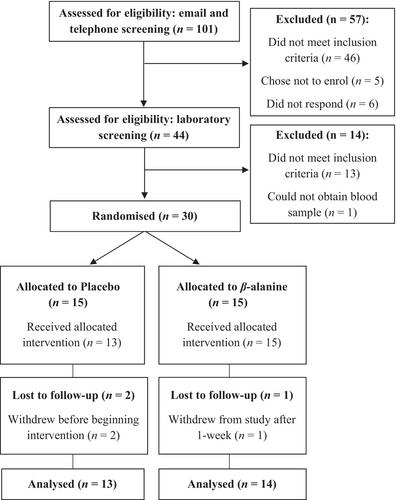
A total of 27 adults (44% female; mean [SD], age: 58 [10] years, BMI: 31.1 [2.9] kg/m2, hemoglobin A1c: 39.8 [4.3] mmol/mol) received β-alanine (4.8 g/day) or a matched placebo for 3 months. Feasibility and tolerability outcomes included adherence, side effects, recruitment, attrition, and blinding, and exploratory outcomes included biochemical markers, blood pressures, and transthoracic echocardiography parameters. Data were analyzed using a Bayesian approach presented with 95% credible intervals (CrI).
Results
β-alanine was well tolerated and adhered to (adherence: placebo, 0.91 [95% CrI: 0.84–0.95]; β-alanine, 0.92 [95% CrI: 0.85–0.95]), and side effects remained at or below baseline throughout. The probability that β-alanine supplementation affected cardiometabolic, cardiovascular, or clinical biochemical outcomes was low.
Conclusions
Sustained-release β-alanine supplementation is well tolerated and adhered to in adults with overweight and obesity. Future research should consider more advanced metabolic conditions, which may benefit from longer duration supplementation.
期刊介绍:
Obesity is the official journal of The Obesity Society and is the premier source of information for increasing knowledge, fostering translational research from basic to population science, and promoting better treatment for people with obesity. Obesity publishes important peer-reviewed research and cutting-edge reviews, commentaries, and public health and medical developments.