Maria Eleni Karakatsani, Daniil Nozdriukhin, Savannah Tiemann, Hikari A. I. Yoshihara, Rafael Storz, Markus Belau, Ruiqing Ni, Daniel Razansky, Xosé Luís Deán-Ben
{"title":"Multimodal imaging of murine cerebrovascular dynamics induced by transcranial pulse stimulation","authors":"Maria Eleni Karakatsani, Daniil Nozdriukhin, Savannah Tiemann, Hikari A. I. Yoshihara, Rafael Storz, Markus Belau, Ruiqing Ni, Daniel Razansky, Xosé Luís Deán-Ben","doi":"10.1002/alz.14511","DOIUrl":null,"url":null,"abstract":"<div>\n \n \n <section>\n \n <h3> INTRODUCTION</h3>\n \n <p>Transcranial pulse stimulation (TPS) is increasingly being investigated as a promising potential treatment for Alzheimer's disease (AD). Although the safety and preliminary clinical efficacy of TPS short pulses have been supported by neuropsychological scores in treated AD patients, its fundamental mechanisms are uncharted.</p>\n </section>\n \n <section>\n \n <h3> METHODS</h3>\n \n <p>Herein, we used a multi-modal preclinical imaging platform combining real-time volumetric optoacoustic tomography, contrast-enhanced magnetic resonance imaging, and ex vivo immunofluorescence to comprehensively analyze structural and hemodynamic effects induced by TPS. Cohorts of healthy and AD transgenic mice were imaged during and after TPS exposure at various per-pulse energy levels.</p>\n </section>\n \n <section>\n \n <h3> RESULTS</h3>\n \n <p>TPS enhanced the microvascular network, whereas the blood–brain barrier remained intact following the procedure. Notably, higher pulse energies were necessary to induce hemodynamic changes in AD mice, arguably due to their impacted vessels.</p>\n </section>\n \n <section>\n \n <h3> DISCUSSION</h3>\n \n <p>These findings shed light on cerebrovascular dynamics induced by TPS treatment, and hence are expected to assist improving safety and therapeutic outcomes.</p>\n </section>\n \n <section>\n \n <h3> Highlights</h3>\n \n <div>\n <ul>\n \n <li><span>· </span>Transcranial pulse stimulation (TPS) facilitates transcranial wave propagation using short pulses to avoid tissue heating.</li>\n \n <li><span>· </span>Preclinical multi-modal imaging combines real-time volumetric optoacoustic (OA) tomography, contrast-enhanced magnetic resonance imaging (CE-MRI), and ex vivo immunofluorescence to comprehensively analyze structural and hemodynamic effects induced by TPS.</li>\n \n <li><span>· </span>Blood volume enhancement in microvascular networks was reproducibly observed with real-time OA imaging during TPS stimulation.</li>\n \n <li><span>· </span>CE-MRI and gross pathology further confirmed that the brain architecture was maintained intact without blood–brain barrier (BBB) opening after TPS exposure, thus validating the safety of the procedure.</li>\n \n <li><span>· </span>Higher pulse energies were necessary to induce hemodynamic changes in AD compared to wild-type animals, arguably due to their pathological vessels.</li>\n </ul>\n </div>\n </section>\n </div>","PeriodicalId":7471,"journal":{"name":"Alzheimer's & Dementia","volume":"21 2","pages":""},"PeriodicalIF":11.1000,"publicationDate":"2025-01-14","publicationTypes":"Journal Article","fieldsOfStudy":null,"isOpenAccess":false,"openAccessPdf":"https://onlinelibrary.wiley.com/doi/epdf/10.1002/alz.14511","citationCount":"0","resultStr":null,"platform":"Semanticscholar","paperid":null,"PeriodicalName":"Alzheimer's & Dementia","FirstCategoryId":"3","ListUrlMain":"https://alz-journals.onlinelibrary.wiley.com/doi/10.1002/alz.14511","RegionNum":1,"RegionCategory":"医学","ArticlePicture":[],"TitleCN":null,"AbstractTextCN":null,"PMCID":null,"EPubDate":"","PubModel":"","JCR":"Q1","JCRName":"CLINICAL NEUROLOGY","Score":null,"Total":0}
引用次数: 0
Abstract
INTRODUCTION
Transcranial pulse stimulation (TPS) is increasingly being investigated as a promising potential treatment for Alzheimer's disease (AD). Although the safety and preliminary clinical efficacy of TPS short pulses have been supported by neuropsychological scores in treated AD patients, its fundamental mechanisms are uncharted.
METHODS
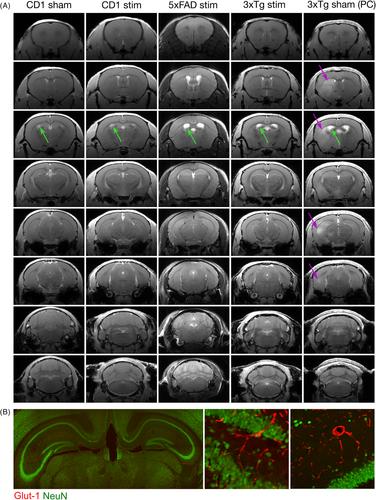
Herein, we used a multi-modal preclinical imaging platform combining real-time volumetric optoacoustic tomography, contrast-enhanced magnetic resonance imaging, and ex vivo immunofluorescence to comprehensively analyze structural and hemodynamic effects induced by TPS. Cohorts of healthy and AD transgenic mice were imaged during and after TPS exposure at various per-pulse energy levels.
RESULTS
TPS enhanced the microvascular network, whereas the blood–brain barrier remained intact following the procedure. Notably, higher pulse energies were necessary to induce hemodynamic changes in AD mice, arguably due to their impacted vessels.
DISCUSSION
These findings shed light on cerebrovascular dynamics induced by TPS treatment, and hence are expected to assist improving safety and therapeutic outcomes.
Highlights
· Transcranial pulse stimulation (TPS) facilitates transcranial wave propagation using short pulses to avoid tissue heating.
· Preclinical multi-modal imaging combines real-time volumetric optoacoustic (OA) tomography, contrast-enhanced magnetic resonance imaging (CE-MRI), and ex vivo immunofluorescence to comprehensively analyze structural and hemodynamic effects induced by TPS.
· Blood volume enhancement in microvascular networks was reproducibly observed with real-time OA imaging during TPS stimulation.
· CE-MRI and gross pathology further confirmed that the brain architecture was maintained intact without blood–brain barrier (BBB) opening after TPS exposure, thus validating the safety of the procedure.
· Higher pulse energies were necessary to induce hemodynamic changes in AD compared to wild-type animals, arguably due to their pathological vessels.
期刊介绍:
Alzheimer's & Dementia is a peer-reviewed journal that aims to bridge knowledge gaps in dementia research by covering the entire spectrum, from basic science to clinical trials to social and behavioral investigations. It provides a platform for rapid communication of new findings and ideas, optimal translation of research into practical applications, increasing knowledge across diverse disciplines for early detection, diagnosis, and intervention, and identifying promising new research directions. In July 2008, Alzheimer's & Dementia was accepted for indexing by MEDLINE, recognizing its scientific merit and contribution to Alzheimer's research.






 京公网安备 11010802042870号
京ICP备2023020795号-1
京公网安备 11010802042870号
京ICP备2023020795号-1

 分享
分享
 求助内容:
求助内容: 应助结果提醒方式:
 扫码关注我们
