Guoliang Wang, Zhikang Bao, Yuanan Li, Yabing Wang, Xuejiao Cui, Haochong Zhong, Wenjuan Fang and Jianguo Wang
{"title":"Self-assembled SnO2/COF catalysts for improved electro-synthesis of hydrogen peroxide†","authors":"Guoliang Wang, Zhikang Bao, Yuanan Li, Yabing Wang, Xuejiao Cui, Haochong Zhong, Wenjuan Fang and Jianguo Wang","doi":"10.1039/D4TA08190K","DOIUrl":null,"url":null,"abstract":"<p >The electrochemical oxygen reduction reaction (ORR) <em>via</em> a two-electron pathway offers a sustainable route for on-site hydrogen peroxide (H<small><sub>2</sub></small>O<small><sub>2</sub></small>) production. However, achieving stable H<small><sub>2</sub></small>O<small><sub>2</sub></small> production at industrial-scale current densities continues to pose significant challenges. In this study, 10% SnO<small><sub>2</sub></small>/COF catalysts synthesized <em>via</em> the self-assembly approach exhibited both high performance and robust stability. In a neutral solution, a yield of 11 873 mg L<small><sup>−1</sup></small> h<small><sup>−1</sup></small> could be achieved at a high current density of 125 mA cm<small><sup>−2</sup></small>, with a Faraday efficiency exceeding 80% maintained throughout a 60 hour stability test. Through a series of experiments and <em>in situ</em> tests, it was concluded that the hierarchical porous structure of a COF enhances the mass transfer of oxygen, while the strong interaction between SnO<small><sub>2</sub></small> nanoparticles and the COF promotes the 2-electron (2e<small><sup>−</sup></small>) reaction pathway. This interaction also accelerates the desorption of hydrogen peroxide and enhances its accumulation rate. This research provides a method to design efficient catalysts for production of H<small><sub>2</sub></small>O<small><sub>2</sub></small><em>via</em> the electrochemical 2e<small><sup>−</sup></small> ORR.</p>","PeriodicalId":82,"journal":{"name":"Journal of Materials Chemistry A","volume":" 8","pages":" 6059-6066"},"PeriodicalIF":9.2000,"publicationDate":"2025-01-14","publicationTypes":"Journal Article","fieldsOfStudy":null,"isOpenAccess":false,"openAccessPdf":"","citationCount":"0","resultStr":null,"platform":"Semanticscholar","paperid":null,"PeriodicalName":"Journal of Materials Chemistry A","FirstCategoryId":"88","ListUrlMain":"https://pubs.rsc.org/en/content/articlelanding/2025/ta/d4ta08190k","RegionNum":2,"RegionCategory":"材料科学","ArticlePicture":[],"TitleCN":null,"AbstractTextCN":null,"PMCID":null,"EPubDate":"","PubModel":"","JCR":"Q1","JCRName":"CHEMISTRY, PHYSICAL","Score":null,"Total":0}
引用次数: 0
Abstract
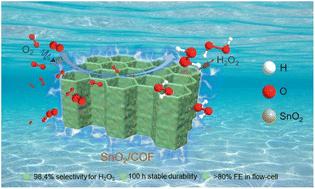
The electrochemical oxygen reduction reaction (ORR) via a two-electron pathway offers a sustainable route for on-site hydrogen peroxide (H2O2) production. However, achieving stable H2O2 production at industrial-scale current densities continues to pose significant challenges. In this study, 10% SnO2/COF catalysts synthesized via the self-assembly approach exhibited both high performance and robust stability. In a neutral solution, a yield of 11 873 mg L−1 h−1 could be achieved at a high current density of 125 mA cm−2, with a Faraday efficiency exceeding 80% maintained throughout a 60 hour stability test. Through a series of experiments and in situ tests, it was concluded that the hierarchical porous structure of a COF enhances the mass transfer of oxygen, while the strong interaction between SnO2 nanoparticles and the COF promotes the 2-electron (2e−) reaction pathway. This interaction also accelerates the desorption of hydrogen peroxide and enhances its accumulation rate. This research provides a method to design efficient catalysts for production of H2O2via the electrochemical 2e− ORR.
期刊介绍:
The Journal of Materials Chemistry A, B & C covers a wide range of high-quality studies in the field of materials chemistry, with each section focusing on specific applications of the materials studied. Journal of Materials Chemistry A emphasizes applications in energy and sustainability, including topics such as artificial photosynthesis, batteries, and fuel cells. Journal of Materials Chemistry B focuses on applications in biology and medicine, while Journal of Materials Chemistry C covers applications in optical, magnetic, and electronic devices. Example topic areas within the scope of Journal of Materials Chemistry A include catalysis, green/sustainable materials, sensors, and water treatment, among others.




 京公网安备 11010802042870号
京ICP备2023020795号-1
京公网安备 11010802042870号
京ICP备2023020795号-1

 分享
分享
 求助内容:
求助内容: 应助结果提醒方式:
 扫码关注我们
