Comparison of 4-factor fixed-dose versus 4-factor weight-based-dose prothrombin complex concentrate for emergent warfarin reversal: a systematic review and meta-analysis.
Mohammed Alrashed, Norah Alabdulkarim, Jana Alaskah, Shrooq Alsoket, Renad Almotairi, Majed Al Yami, Shmeylan Al Harbi, Abdulkareem M Albekairy, Abdulrahman Alshaya, Tariq Alqahtani, Abdulmajeed Alshehri, Abdullah Alshammari, Mohammed A Alnuhait, Ahmed Aljabri
{"title":"Comparison of 4-factor fixed-dose versus 4-factor weight-based-dose prothrombin complex concentrate for emergent warfarin reversal: a systematic review and meta-analysis.","authors":"Mohammed Alrashed, Norah Alabdulkarim, Jana Alaskah, Shrooq Alsoket, Renad Almotairi, Majed Al Yami, Shmeylan Al Harbi, Abdulkareem M Albekairy, Abdulrahman Alshaya, Tariq Alqahtani, Abdulmajeed Alshehri, Abdullah Alshammari, Mohammed A Alnuhait, Ahmed Aljabri","doi":"10.15441/ceem.24.265","DOIUrl":null,"url":null,"abstract":"<p><strong>Objective: </strong>The Objective of this systematic review and meta-analysis is to evaluate the efficacy, safety, time to international normalized ratio (INR) reversal, and total volume of four-factor prothrombin complex concentrate (4-PCC) administered using fixed-dose versus weight-based dosing strategies in patients requiring urgent warfarin reversal, with specific focus on clinical outcomes of hemostatic efficacy, thromboembolic events, and mortality rates.</p><p><strong>Methods: </strong>A comprehensive systematic review was conducted using the PubMed, Embase, and Cochrane databases from inception through October 2023. We searched for randomized clinical trials or observational studies that compared efficacy or safety outcomes of fixed versus variable 4-PCC dose in adult patients.</p><p><strong>Results: </strong>In the 14 included studies, the overall use of fixed-dose 4-PCC was associated with a lower likelihood of reaching the INR goal (risk ratio [RR], 0.84; 95% confidence interval [CI], 0.80-0.89) compared to the variable-dose group. In addition, a significantly larger proportion of patients (169 of 651, 26%) required an additional dose of 4-PCC. The rates of mortality (RR, 0.85; 95% CI, 0.70-1.03) and thromboembolic events (RR, 1.27; 95% CI, 0.65-2.45) were similar between the two treatment groups.</p><p><strong>Conclusion: </strong>This systematic review and meta-analysis showed that variable dosing of 4-PCC more successfully achieves the target INR for warfarin reversal compared to fixed dosing. However, the dosing strategies have similar mortality and thromboembolic rates. While fixed dosing offers a simpler approach, it may require additional administration. Future studies should focus on optimizing dosing strategies to balance efficacy, safety, and practicality in various clinical scenarios.</p>","PeriodicalId":10325,"journal":{"name":"Clinical and Experimental Emergency Medicine","volume":" ","pages":"212-222"},"PeriodicalIF":2.3000,"publicationDate":"2025-09-01","publicationTypes":"Journal Article","fieldsOfStudy":null,"isOpenAccess":false,"openAccessPdf":"https://www.ncbi.nlm.nih.gov/pmc/articles/PMC12541527/pdf/","citationCount":"0","resultStr":null,"platform":"Semanticscholar","paperid":null,"PeriodicalName":"Clinical and Experimental Emergency Medicine","FirstCategoryId":"1085","ListUrlMain":"https://doi.org/10.15441/ceem.24.265","RegionNum":0,"RegionCategory":null,"ArticlePicture":[],"TitleCN":null,"AbstractTextCN":null,"PMCID":null,"EPubDate":"2025/1/14 0:00:00","PubModel":"Epub","JCR":"Q2","JCRName":"EMERGENCY MEDICINE","Score":null,"Total":0}
引用次数: 0
Abstract
Objective: The Objective of this systematic review and meta-analysis is to evaluate the efficacy, safety, time to international normalized ratio (INR) reversal, and total volume of four-factor prothrombin complex concentrate (4-PCC) administered using fixed-dose versus weight-based dosing strategies in patients requiring urgent warfarin reversal, with specific focus on clinical outcomes of hemostatic efficacy, thromboembolic events, and mortality rates.
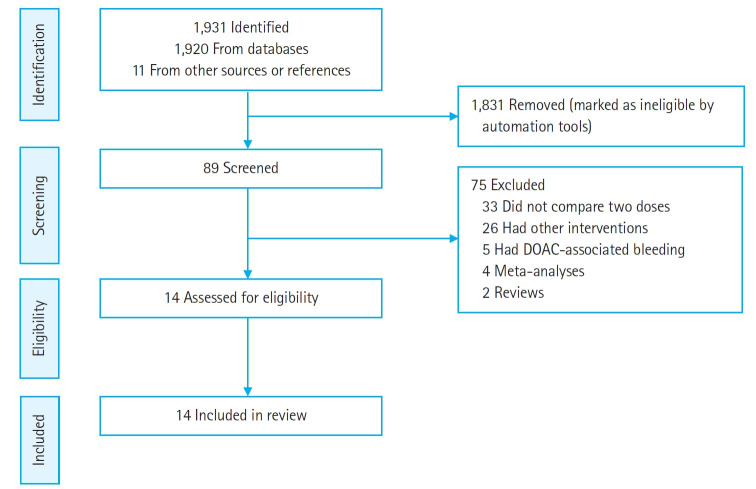
Methods: A comprehensive systematic review was conducted using the PubMed, Embase, and Cochrane databases from inception through October 2023. We searched for randomized clinical trials or observational studies that compared efficacy or safety outcomes of fixed versus variable 4-PCC dose in adult patients.
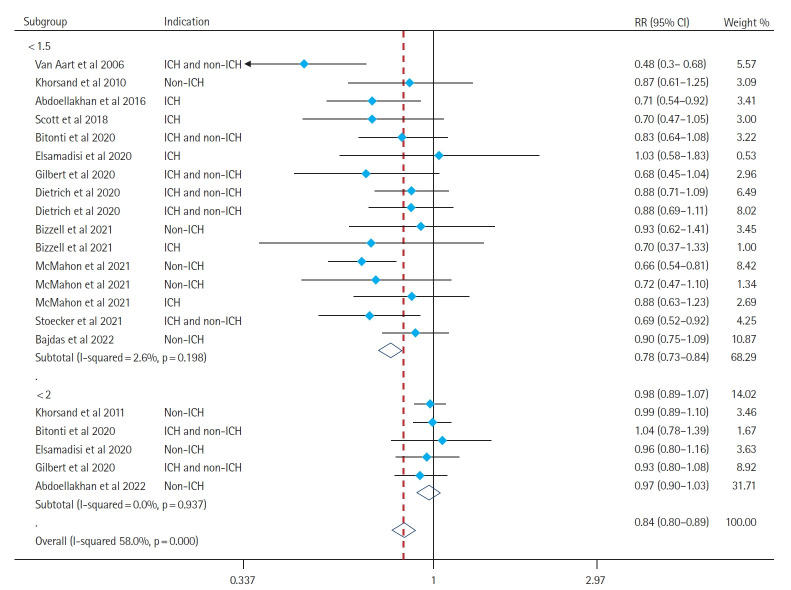
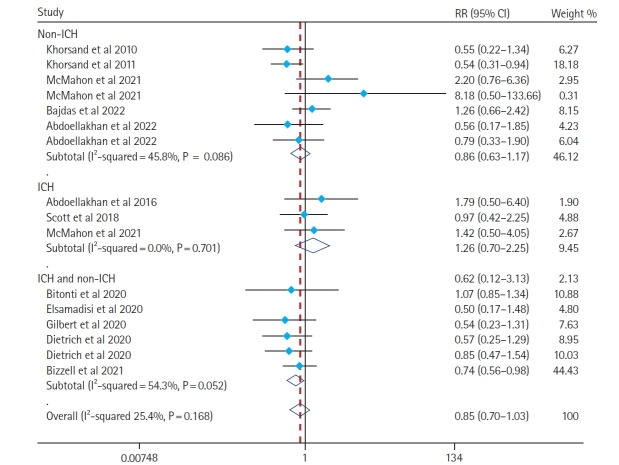
Results: In the 14 included studies, the overall use of fixed-dose 4-PCC was associated with a lower likelihood of reaching the INR goal (risk ratio [RR], 0.84; 95% confidence interval [CI], 0.80-0.89) compared to the variable-dose group. In addition, a significantly larger proportion of patients (169 of 651, 26%) required an additional dose of 4-PCC. The rates of mortality (RR, 0.85; 95% CI, 0.70-1.03) and thromboembolic events (RR, 1.27; 95% CI, 0.65-2.45) were similar between the two treatment groups.
Conclusion: This systematic review and meta-analysis showed that variable dosing of 4-PCC more successfully achieves the target INR for warfarin reversal compared to fixed dosing. However, the dosing strategies have similar mortality and thromboembolic rates. While fixed dosing offers a simpler approach, it may require additional administration. Future studies should focus on optimizing dosing strategies to balance efficacy, safety, and practicality in various clinical scenarios.




 京公网安备 11010802042870号
京ICP备2023020795号-1
京公网安备 11010802042870号
京ICP备2023020795号-1

 分享
分享
 求助内容:
求助内容: 应助结果提醒方式:
 扫码关注我们
