Jin-Soo Park, Hyun-Jeong Park, Young-Min Kim, Hyun-Seok Chai, Gwan Jin Park, Sang-Chul Kim, Gyeong-Gyu Yu, Suk-Woo Lee, Hoon Kim
{"title":"The long-term influences of age at injury on neuroinflammation and neuronal apoptosis following traumatic brain injury in pediatric and adult mice.","authors":"Jin-Soo Park, Hyun-Jeong Park, Young-Min Kim, Hyun-Seok Chai, Gwan Jin Park, Sang-Chul Kim, Gyeong-Gyu Yu, Suk-Woo Lee, Hoon Kim","doi":"10.15441/ceem.24.266","DOIUrl":null,"url":null,"abstract":"<p><strong>Objective: </strong>The study explores the long-term impacts of traumatic brain injury (TBI) on neuroinflammation and neuronal apoptosis in pediatric and adult mice, focusing on how age at injury influences these processes.</p><p><strong>Methods: </strong>Controlled cortical impacts were used to induce TBI in pediatric (21-25 days old) and adult (8-12 weeks old) C57BL/6 male mice. Neuroinflammation was evaluated by measuring immunoreactivity for allograft inflammatory factor 1 (AIF-1)/ionized calcium-binding adaptor molecule 1 (Iba-1) and glial fibrillary acidic protein (GFAP), while apoptosis was assessed using markers such as B-cell lymphoma 2 (Bcl-2)-associated X protein (Bax), Bcl-2, and procaspase-3. Additionally, heat shock protein 70 (HSP70) expression was measured to understand the stress response.</p><p><strong>Results: </strong>Following controlled cortical impacts, pediatric mice exhibited a significant reduction in expression of neuronal nuclei (P<0.001), and significant increases in expression of GFAP (P<0.01) and AIF-1/Iba-1 (P<0.05) at 3 days post-injury (DPI) compared with sham controls. In contrast, adult mice exhibited no significant change in AIF-1/Iba-1 expression and a less pronounced increase in GFAP (P<0.05) at 3 DPI compared with sham controls. A more significant increase in Bax/Bcl-2 ratio at 7 DPI (P<0.01) was seen in pediatric mice, while a weak but significant increase in Bax/Bcl-2 ratio at 7 DPI (P<0.05) was evident in adults. Both age groups showed a significant but transient increase in HSP70 levels at 7 DPI, which normalized by 90 DPI.</p><p><strong>Conclusion: </strong>Pediatric and adult mice exhibited significant time-dependent differences in neuroinflammation and apoptosis following TBI, with pediatric mice showing more intense early responses indicative of age-specific vulnerabilities in post-injury outcomes. Both age groups showed a significant but transient increase in HSP70 expression, suggesting an acute response to stress post-injury.</p>","PeriodicalId":10325,"journal":{"name":"Clinical and Experimental Emergency Medicine","volume":" ","pages":"267-279"},"PeriodicalIF":2.3000,"publicationDate":"2025-09-01","publicationTypes":"Journal Article","fieldsOfStudy":null,"isOpenAccess":false,"openAccessPdf":"https://www.ncbi.nlm.nih.gov/pmc/articles/PMC12541517/pdf/","citationCount":"0","resultStr":null,"platform":"Semanticscholar","paperid":null,"PeriodicalName":"Clinical and Experimental Emergency Medicine","FirstCategoryId":"1085","ListUrlMain":"https://doi.org/10.15441/ceem.24.266","RegionNum":0,"RegionCategory":null,"ArticlePicture":[],"TitleCN":null,"AbstractTextCN":null,"PMCID":null,"EPubDate":"2025/1/14 0:00:00","PubModel":"Epub","JCR":"Q2","JCRName":"EMERGENCY MEDICINE","Score":null,"Total":0}
引用次数: 0
Abstract
Objective: The study explores the long-term impacts of traumatic brain injury (TBI) on neuroinflammation and neuronal apoptosis in pediatric and adult mice, focusing on how age at injury influences these processes.
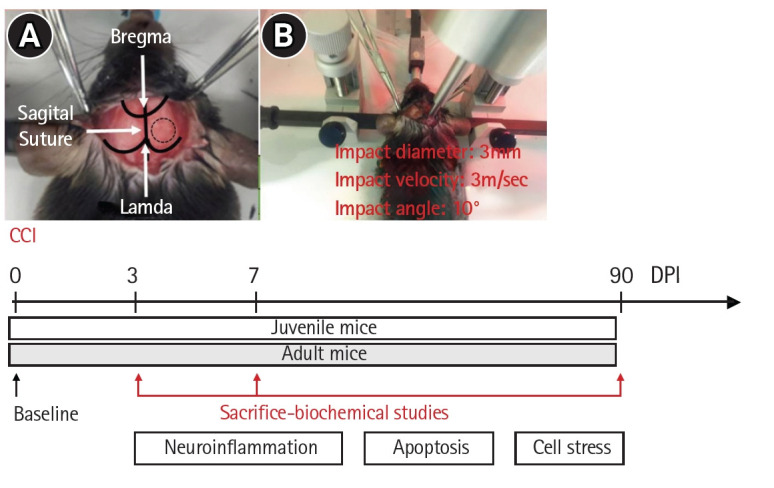
Methods: Controlled cortical impacts were used to induce TBI in pediatric (21-25 days old) and adult (8-12 weeks old) C57BL/6 male mice. Neuroinflammation was evaluated by measuring immunoreactivity for allograft inflammatory factor 1 (AIF-1)/ionized calcium-binding adaptor molecule 1 (Iba-1) and glial fibrillary acidic protein (GFAP), while apoptosis was assessed using markers such as B-cell lymphoma 2 (Bcl-2)-associated X protein (Bax), Bcl-2, and procaspase-3. Additionally, heat shock protein 70 (HSP70) expression was measured to understand the stress response.
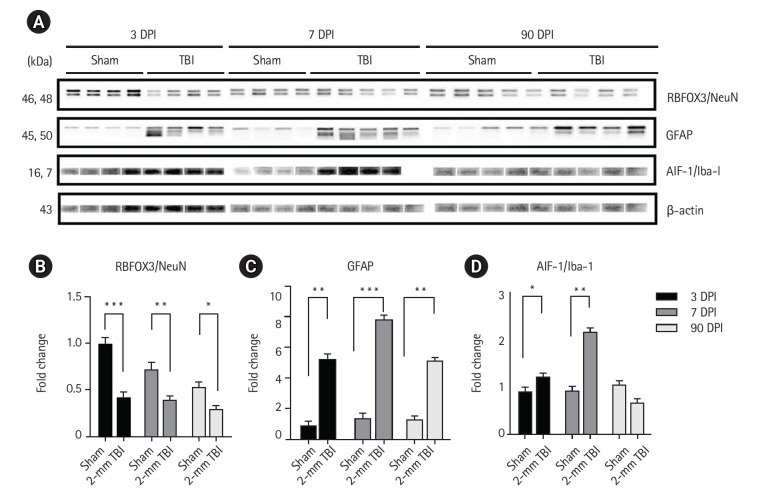
Results: Following controlled cortical impacts, pediatric mice exhibited a significant reduction in expression of neuronal nuclei (P<0.001), and significant increases in expression of GFAP (P<0.01) and AIF-1/Iba-1 (P<0.05) at 3 days post-injury (DPI) compared with sham controls. In contrast, adult mice exhibited no significant change in AIF-1/Iba-1 expression and a less pronounced increase in GFAP (P<0.05) at 3 DPI compared with sham controls. A more significant increase in Bax/Bcl-2 ratio at 7 DPI (P<0.01) was seen in pediatric mice, while a weak but significant increase in Bax/Bcl-2 ratio at 7 DPI (P<0.05) was evident in adults. Both age groups showed a significant but transient increase in HSP70 levels at 7 DPI, which normalized by 90 DPI.
Conclusion: Pediatric and adult mice exhibited significant time-dependent differences in neuroinflammation and apoptosis following TBI, with pediatric mice showing more intense early responses indicative of age-specific vulnerabilities in post-injury outcomes. Both age groups showed a significant but transient increase in HSP70 expression, suggesting an acute response to stress post-injury.




 京公网安备 11010802042870号
京ICP备2023020795号-1
京公网安备 11010802042870号
京ICP备2023020795号-1

 分享
分享
 求助内容:
求助内容: 应助结果提醒方式:
 扫码关注我们
