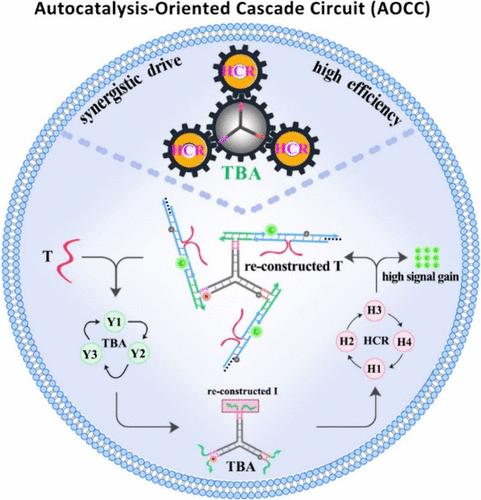
{"title":"A High-Efficiency Autocatalysis-Oriented Cascade Circuit via Reciprocal Hug-Amplification for Assay-to-Treat Application","authors":"Chunli Yang, Yuqing Zhang, Zhaorong Mo, Jiayang He, Zhihan Zhang, Yaqin Chai, Ruo Yuan, Wenju Xu","doi":"10.1021/acs.analchem.4c05701","DOIUrl":null,"url":null,"abstract":"Developing a DNA autocatalysis-oriented cascade circuit (AOCC) via reciprocal navigation of two enzyme-free hug-amplifiers might be desirable for constructing a rapid, efficient, and sensitive assay-to-treat platform. In response to a specific trigger (<b>T</b>), seven functional DNA hairpins were designed to execute three-branched assembly (TBA) and three isotropic hybridization chain reaction (3HCR) events for operating the AOCC. This was because three new inducers were reconstructed in TBA arms to initiate 3HCR (TBA-to-3HCR) and periodic <b>T</b> repeats were resultantly reassembled in the tandem nicks of polymeric nanowires to rapidly activate TBA in the opposite direction (3HCR-to-TBA) without steric hindrance, thereby cooperatively manipulating sustainable AOCC progress for exponential hug-amplification (1:3<i>N</i><sup>n</sup>). Our experimental verifications manifested that the <b>T</b>-dependent AOCC amplifier achieved fast input transduction and efficient fluorescence readout. As predicted, the flexible programming of reactive hairpin species endowed the repeating nicks in productive 3HCR nanowires with great possibilities and accessibilities to graft tailored modular elements, such as G-rich AS1411 aptamers capable of adopting G-quadruplex conformations (G4) that readily facilitated the embedding of zinc(II) protoporphyrin IX (ZnPPIX), a kind of heme oxygenase-1 enzyme inhibitor. Thus, the cascading ZnPPIX/G4 entities acted as fluorescent signal reporters, photosensitizers and anticancer drugs, thereby creating an updated AOCC-based assay-to-treat platform for ultrasensitive biosensing, discernible cell imaging and efficient photodynamic therapy of cancer cells. This would offer a new paradigm to advance the rational integration of dynamic DNA assembly and amplifiable recycling circuits for applicable bioassay and theranostics.","PeriodicalId":27,"journal":{"name":"Analytical Chemistry","volume":"4 1","pages":""},"PeriodicalIF":6.7000,"publicationDate":"2025-01-15","publicationTypes":"Journal Article","fieldsOfStudy":null,"isOpenAccess":false,"openAccessPdf":"","citationCount":"0","resultStr":null,"platform":"Semanticscholar","paperid":null,"PeriodicalName":"Analytical Chemistry","FirstCategoryId":"92","ListUrlMain":"https://doi.org/10.1021/acs.analchem.4c05701","RegionNum":1,"RegionCategory":"化学","ArticlePicture":[],"TitleCN":null,"AbstractTextCN":null,"PMCID":null,"EPubDate":"","PubModel":"","JCR":"Q1","JCRName":"CHEMISTRY, ANALYTICAL","Score":null,"Total":0}
引用次数: 0
Abstract
Developing a DNA autocatalysis-oriented cascade circuit (AOCC) via reciprocal navigation of two enzyme-free hug-amplifiers might be desirable for constructing a rapid, efficient, and sensitive assay-to-treat platform. In response to a specific trigger (T), seven functional DNA hairpins were designed to execute three-branched assembly (TBA) and three isotropic hybridization chain reaction (3HCR) events for operating the AOCC. This was because three new inducers were reconstructed in TBA arms to initiate 3HCR (TBA-to-3HCR) and periodic T repeats were resultantly reassembled in the tandem nicks of polymeric nanowires to rapidly activate TBA in the opposite direction (3HCR-to-TBA) without steric hindrance, thereby cooperatively manipulating sustainable AOCC progress for exponential hug-amplification (1:3Nn). Our experimental verifications manifested that the T-dependent AOCC amplifier achieved fast input transduction and efficient fluorescence readout. As predicted, the flexible programming of reactive hairpin species endowed the repeating nicks in productive 3HCR nanowires with great possibilities and accessibilities to graft tailored modular elements, such as G-rich AS1411 aptamers capable of adopting G-quadruplex conformations (G4) that readily facilitated the embedding of zinc(II) protoporphyrin IX (ZnPPIX), a kind of heme oxygenase-1 enzyme inhibitor. Thus, the cascading ZnPPIX/G4 entities acted as fluorescent signal reporters, photosensitizers and anticancer drugs, thereby creating an updated AOCC-based assay-to-treat platform for ultrasensitive biosensing, discernible cell imaging and efficient photodynamic therapy of cancer cells. This would offer a new paradigm to advance the rational integration of dynamic DNA assembly and amplifiable recycling circuits for applicable bioassay and theranostics.
期刊介绍:
Analytical Chemistry, a peer-reviewed research journal, focuses on disseminating new and original knowledge across all branches of analytical chemistry. Fundamental articles may explore general principles of chemical measurement science and need not directly address existing or potential analytical methodology. They can be entirely theoretical or report experimental results. Contributions may cover various phases of analytical operations, including sampling, bioanalysis, electrochemistry, mass spectrometry, microscale and nanoscale systems, environmental analysis, separations, spectroscopy, chemical reactions and selectivity, instrumentation, imaging, surface analysis, and data processing. Papers discussing known analytical methods should present a significant, original application of the method, a notable improvement, or results on an important analyte.




 京公网安备 11010802042870号
京ICP备2023020795号-1
京公网安备 11010802042870号
京ICP备2023020795号-1

 分享
分享
 求助内容:
求助内容: 应助结果提醒方式:
 扫码关注我们
