Shubhanshu Agarwal, Kiruba Catherine Vincent and Rakesh Agrawal
{"title":"From synthesis to application: a review of BaZrS3 chalcogenide perovskites","authors":"Shubhanshu Agarwal, Kiruba Catherine Vincent and Rakesh Agrawal","doi":"10.1039/D4NR03880K","DOIUrl":null,"url":null,"abstract":"<p >Chalcogenide perovskites are gaining prominence as earth-abundant and non-toxic solar absorber materials, crystallizing in a distorted perovskite structure. Among these, BaZrS<small><sub>3</sub></small> has attracted the most attention due to its optimal bandgap and its ability to be synthesized at relatively low temperatures. BaZrS<small><sub>3</sub></small> exhibits a high light absorption coefficient, excellent stability under exposure to air, moisture, and heat, and is composed of earth-abundant elements. These properties collectively position BaZrS<small><sub>3</sub></small> as a promising candidate for a wide range of applications, although traditional high-temperature synthesis has primarily been a significant challenge. In this review, we provide a critical discussion of the various synthesis methods employed to fabricate BaZrS<small><sub>3</sub></small>, including solid-state synthesis, nanoparticle synthesis, and vacuum-based as well as solution-based approaches to synthesize thin films. We also comprehensively examine the experimentally measured and theoretically calculated optical, optoelectronic, electronic, and defect properties of BaZrS<small><sub>3</sub></small>. Furthermore, this review highlights the functional devices based on BaZrS<small><sub>3</sub></small>, showcasing applications spanning photovoltaics, photodetection, thermoelectrics, photoelectrochemical water splitting, piezoelectricity, and spintronics. Lastly, we propose a future roadmap to maximize the potential of this material. Additionally, this review extends its focus to BaHfS<small><sub>3</sub></small> and BaTiS<small><sub>3</sub></small>, discussing their synthesis methods, properties, and explored applications, thereby offering a comparative perspective on this emerging family of chalcogenide perovskites.</p>","PeriodicalId":92,"journal":{"name":"Nanoscale","volume":" 8","pages":" 4250-4300"},"PeriodicalIF":5.1000,"publicationDate":"2025-01-15","publicationTypes":"Journal Article","fieldsOfStudy":null,"isOpenAccess":false,"openAccessPdf":"https://pubs.rsc.org/en/content/articlepdf/2025/nr/d4nr03880k?page=search","citationCount":"0","resultStr":null,"platform":"Semanticscholar","paperid":null,"PeriodicalName":"Nanoscale","FirstCategoryId":"88","ListUrlMain":"https://pubs.rsc.org/en/content/articlelanding/2025/nr/d4nr03880k","RegionNum":3,"RegionCategory":"材料科学","ArticlePicture":[],"TitleCN":null,"AbstractTextCN":null,"PMCID":null,"EPubDate":"","PubModel":"","JCR":"Q1","JCRName":"CHEMISTRY, MULTIDISCIPLINARY","Score":null,"Total":0}
引用次数: 0
Abstract
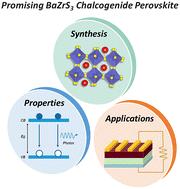
Chalcogenide perovskites are gaining prominence as earth-abundant and non-toxic solar absorber materials, crystallizing in a distorted perovskite structure. Among these, BaZrS3 has attracted the most attention due to its optimal bandgap and its ability to be synthesized at relatively low temperatures. BaZrS3 exhibits a high light absorption coefficient, excellent stability under exposure to air, moisture, and heat, and is composed of earth-abundant elements. These properties collectively position BaZrS3 as a promising candidate for a wide range of applications, although traditional high-temperature synthesis has primarily been a significant challenge. In this review, we provide a critical discussion of the various synthesis methods employed to fabricate BaZrS3, including solid-state synthesis, nanoparticle synthesis, and vacuum-based as well as solution-based approaches to synthesize thin films. We also comprehensively examine the experimentally measured and theoretically calculated optical, optoelectronic, electronic, and defect properties of BaZrS3. Furthermore, this review highlights the functional devices based on BaZrS3, showcasing applications spanning photovoltaics, photodetection, thermoelectrics, photoelectrochemical water splitting, piezoelectricity, and spintronics. Lastly, we propose a future roadmap to maximize the potential of this material. Additionally, this review extends its focus to BaHfS3 and BaTiS3, discussing their synthesis methods, properties, and explored applications, thereby offering a comparative perspective on this emerging family of chalcogenide perovskites.
期刊介绍:
Nanoscale is a high-impact international journal, publishing high-quality research across nanoscience and nanotechnology. Nanoscale publishes a full mix of research articles on experimental and theoretical work, including reviews, communications, and full papers.Highly interdisciplinary, this journal appeals to scientists, researchers and professionals interested in nanoscience and nanotechnology, quantum materials and quantum technology, including the areas of physics, chemistry, biology, medicine, materials, energy/environment, information technology, detection science, healthcare and drug discovery, and electronics.





 京公网安备 11010802042870号
京ICP备2023020795号-1
京公网安备 11010802042870号
京ICP备2023020795号-1

 分享
分享
 求助内容:
求助内容: 应助结果提醒方式:
 扫码关注我们
