Local Inflammation Precedes Diaphragm Wasting and Fibrotic Remodelling in a Mouse Model of Pancreatic Cancer

IF 9.1 1区 医学 Q1 GERIATRICS & GERONTOLOGY Journal of Cachexia Sarcopenia and Muscle Pub Date : 2025-01-15 DOI:10.1002/jcsm.13668
Daria Neyroud, Andrew C. D'Lugos, Enrique J. Trevino, Chandler S. Callaway, Jacqueline Lamm, Orlando Laitano, Brittney Poole, Michael R. Deyhle, Justina Brantley, Lam Le, Andrew R. Judge, Sarah M. Judge
{"title":"Local Inflammation Precedes Diaphragm Wasting and Fibrotic Remodelling in a Mouse Model of Pancreatic Cancer","authors":"Daria Neyroud,&nbsp;Andrew C. D'Lugos,&nbsp;Enrique J. Trevino,&nbsp;Chandler S. Callaway,&nbsp;Jacqueline Lamm,&nbsp;Orlando Laitano,&nbsp;Brittney Poole,&nbsp;Michael R. Deyhle,&nbsp;Justina Brantley,&nbsp;Lam Le,&nbsp;Andrew R. Judge,&nbsp;Sarah M. Judge","doi":"10.1002/jcsm.13668","DOIUrl":null,"url":null,"abstract":"<div>\n \n \n <section>\n \n <h3> Background</h3>\n \n <p>Cancer cachexia represents a debilitating muscle wasting condition that is highly prevalent in gastrointestinal cancers, including pancreatic ductal adenocarcinoma (PDAC). Cachexia is estimated to contribute to ~30% of cancer-related deaths, with deterioration of respiratory muscles suspected to be a key contributor to cachexia-associated morbidity and mortality. In recent studies, we identified fibrotic remodelling of respiratory accessory muscles as a key feature of human PDAC cachexia.</p>\n </section>\n \n <section>\n \n <h3> Methods</h3>\n \n <p>To gain insight into mechanisms driving respiratory muscle wasting and fibrotic remodelling in response to PDAC, we conducted temporal histological and transcriptomic analyses on diaphragm muscles harvested from mice-bearing orthotopic murine pancreatic (KPC) tumours at time points reflective of precachexia (D8 and D10), mild–moderate cachexia (D12 and D14) and advanced cachexia (endpoint).</p>\n </section>\n \n <section>\n \n <h3> Results</h3>\n \n <p>During the precachexia phase, diaphragms showed significant leukocyte infiltration (+3-fold to +13-fold; D8—endpoint vs. Sham, <i>p</i> &lt; 0.05) and transcriptomic enrichment of inflammatory processes associated with tissue injury that remained increased through endpoint. Diaphragm inflammation was followed by increases in PDGFR-ɑ<sup>+</sup> fibroadipogenic progenitors (+2.5 to +3.8-fold; D10—endpoint vs. Sham, <i>p</i> &lt; 0.05), fibre atrophy (−16% to −24%, D12 to endpoint vs. Sham, <i>p</i> &lt; 0.05), ECM expansion (+1.5 to +1.8-fold; D14—endpoint vs. Sham, <i>p</i> &lt; 0.05), collagen accumulation (+3.8-fold; endpoint vs. Sham, <i>p</i> = 0.0013) and reductions in breathing frequency (−55%, <i>p</i> = 0.0074) and diaphragm excursion (−43%, <i>p</i> = 0.0006). These biological processes were supported by changes in the diaphragm transcriptome. Ingenuity pathway analysis predicted factors involved in inflammatory responses to tissue injury, including TGF-β1, angiotensin and PDGF BB, as top upstream regulators activated in diaphragms prior to and throughout cachexia progression, while PGC-1α and the insulin receptor were among the top upstream regulators predicted to be suppressed. The transcriptomic dataset further revealed progressive disturbances to networks involved in lipid, glucose and oxidative metabolism, activation of the unfolded protein response and neuromuscular junction remodelling associated with denervation.</p>\n </section>\n \n <section>\n \n <h3> Conclusions</h3>\n \n <p>In summary, our data support leukocyte infiltration and expansion of PDGFRα mesenchymal progenitors as early events that precede wasting and fibrotic remodelling of the diaphragm in response to PDAC that may also underlie metabolic disturbances, weakness and respiratory complications.</p>\n </section>\n </div>","PeriodicalId":48911,"journal":{"name":"Journal of Cachexia Sarcopenia and Muscle","volume":"16 1","pages":""},"PeriodicalIF":9.1000,"publicationDate":"2025-01-15","publicationTypes":"Journal Article","fieldsOfStudy":null,"isOpenAccess":false,"openAccessPdf":"https://onlinelibrary.wiley.com/doi/epdf/10.1002/jcsm.13668","citationCount":"0","resultStr":null,"platform":"Semanticscholar","paperid":null,"PeriodicalName":"Journal of Cachexia Sarcopenia and Muscle","FirstCategoryId":"3","ListUrlMain":"https://onlinelibrary.wiley.com/doi/10.1002/jcsm.13668","RegionNum":1,"RegionCategory":"医学","ArticlePicture":[],"TitleCN":null,"AbstractTextCN":null,"PMCID":null,"EPubDate":"","PubModel":"","JCR":"Q1","JCRName":"GERIATRICS & GERONTOLOGY","Score":null,"Total":0}
引用次数: 0

Abstract

Background

Cancer cachexia represents a debilitating muscle wasting condition that is highly prevalent in gastrointestinal cancers, including pancreatic ductal adenocarcinoma (PDAC). Cachexia is estimated to contribute to ~30% of cancer-related deaths, with deterioration of respiratory muscles suspected to be a key contributor to cachexia-associated morbidity and mortality. In recent studies, we identified fibrotic remodelling of respiratory accessory muscles as a key feature of human PDAC cachexia.

Methods

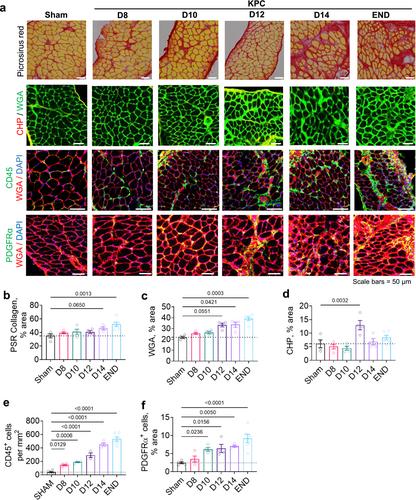
To gain insight into mechanisms driving respiratory muscle wasting and fibrotic remodelling in response to PDAC, we conducted temporal histological and transcriptomic analyses on diaphragm muscles harvested from mice-bearing orthotopic murine pancreatic (KPC) tumours at time points reflective of precachexia (D8 and D10), mild–moderate cachexia (D12 and D14) and advanced cachexia (endpoint).

Results

During the precachexia phase, diaphragms showed significant leukocyte infiltration (+3-fold to +13-fold; D8—endpoint vs. Sham, p < 0.05) and transcriptomic enrichment of inflammatory processes associated with tissue injury that remained increased through endpoint. Diaphragm inflammation was followed by increases in PDGFR-ɑ+ fibroadipogenic progenitors (+2.5 to +3.8-fold; D10—endpoint vs. Sham, p < 0.05), fibre atrophy (−16% to −24%, D12 to endpoint vs. Sham, p < 0.05), ECM expansion (+1.5 to +1.8-fold; D14—endpoint vs. Sham, p < 0.05), collagen accumulation (+3.8-fold; endpoint vs. Sham, p = 0.0013) and reductions in breathing frequency (−55%, p = 0.0074) and diaphragm excursion (−43%, p = 0.0006). These biological processes were supported by changes in the diaphragm transcriptome. Ingenuity pathway analysis predicted factors involved in inflammatory responses to tissue injury, including TGF-β1, angiotensin and PDGF BB, as top upstream regulators activated in diaphragms prior to and throughout cachexia progression, while PGC-1α and the insulin receptor were among the top upstream regulators predicted to be suppressed. The transcriptomic dataset further revealed progressive disturbances to networks involved in lipid, glucose and oxidative metabolism, activation of the unfolded protein response and neuromuscular junction remodelling associated with denervation.

Conclusions

In summary, our data support leukocyte infiltration and expansion of PDGFRα mesenchymal progenitors as early events that precede wasting and fibrotic remodelling of the diaphragm in response to PDAC that may also underlie metabolic disturbances, weakness and respiratory complications.
Abstract Image

查看原文
分享 分享
微信好友 朋友圈 QQ好友 复制链接
本刊更多论文
在胰腺癌小鼠模型中,局部炎症先于膈肌萎缩和纤维化重构
癌症恶病质代表了一种衰弱的肌肉萎缩状态,在胃肠道癌症中非常普遍,包括胰腺导管腺癌(PDAC)。据估计,恶病质导致约30%的癌症相关死亡,而呼吸肌的恶化被怀疑是恶病质相关发病率和死亡率的关键因素。在最近的研究中,我们发现呼吸副肌的纤维化重构是人类PDAC恶病质的一个关键特征。
本文章由计算机程序翻译,如有差异,请以英文原文为准。
求助全文
约1分钟内获得全文 去求助
来源期刊
Journal of Cachexia Sarcopenia and Muscle
Journal of Cachexia Sarcopenia and Muscle MEDICINE, GENERAL & INTERNAL-
CiteScore
13.30
自引率
12.40%
发文量
234
审稿时长
16 weeks
期刊介绍: The Journal of Cachexia, Sarcopenia and Muscle is a peer-reviewed international journal dedicated to publishing materials related to cachexia and sarcopenia, as well as body composition and its physiological and pathophysiological changes across the lifespan and in response to various illnesses from all fields of life sciences. The journal aims to provide a reliable resource for professionals interested in related research or involved in the clinical care of affected patients, such as those suffering from AIDS, cancer, chronic heart failure, chronic lung disease, liver cirrhosis, chronic kidney failure, rheumatoid arthritis, or sepsis.
期刊最新文献
Mitochondrial Adaptations in Skeletal Muscle Following Incretin-Based Therapies: In Vitro Impaired Adipose Anabolism in Pancreatic Cancer Cachexia Is Reversed by HuR Inhibition Inhibition of N-Terminal Acetyltransferase C Mitigates Endoplasmic Reticulum Stress–Mediated Muscle Atrophy in Cancer Cachexia Effects of Diactive-1–Supported Progressive Resistance Training on Body Composition in Youth With Type 1 Diabetes Multi-Parametric MRI Approach at 3 T and 7 T for Assessing Skeletal Muscle Pathology in Myofibrillar Myopathies: A Pilot Study
×
引用
GB/T 7714-2015
复制
MLA
复制
APA
复制
导出至
BibTeX EndNote RefMan NoteFirst NoteExpress
×
×
提示
您的信息不完整,为了账户安全,请先补充。
现在去补充
×
提示
您因"违规操作"
具体请查看互助需知
我知道了
×
提示
现在去查看 取消
×
提示
确定
0
微信
客服QQ
Book学术公众号 扫码关注我们
反馈
×
意见反馈
请填写您的意见或建议
请填写您的手机或邮箱
已复制链接
已复制链接
快去分享给好友吧!
我知道了
×
扫码分享
扫码分享
Book学术官方微信
Book学术文献互助
Book学术文献互助群
群 号:604180095
Book学术
文献互助 智能选刊 最新文献 互助须知 联系我们:info@booksci.cn
Book学术提供免费学术资源搜索服务,方便国内外学者检索中英文文献。致力于提供最便捷和优质的服务体验。
Copyright © 2023 Book学术 All rights reserved.
ghs 京公网安备 11010802042870号 京ICP备2023020795号-1





