Volatile cues of enhanced attractiveness to Parapanteles hyposidrae (Wilkinson) wasps mediated by jasmonic and salicylic acid pathways synergism in tea plant

IF 3.8 1区 农林科学 Q1 AGRONOMY Pest Management Science Pub Date : 2025-01-15 DOI:10.1002/ps.8651
Long Jiao, Yingxin Mao, Yingjie Zhao, Lei Bian, Zongxiu Luo, Zhaoqun Li, Chunli Xiu, Nanxia Fu, Xiaoming Cai, Zongmao Chen
{"title":"Volatile cues of enhanced attractiveness to Parapanteles hyposidrae (Wilkinson) wasps mediated by jasmonic and salicylic acid pathways synergism in tea plant","authors":"Long Jiao,&nbsp;Yingxin Mao,&nbsp;Yingjie Zhao,&nbsp;Lei Bian,&nbsp;Zongxiu Luo,&nbsp;Zhaoqun Li,&nbsp;Chunli Xiu,&nbsp;Nanxia Fu,&nbsp;Xiaoming Cai,&nbsp;Zongmao Chen","doi":"10.1002/ps.8651","DOIUrl":null,"url":null,"abstract":"<div>\n \n \n <section>\n \n <h3> BACKGROUND</h3>\n \n <p>The jasmonic acid (JA) and salicylic acid (SA) pathways are often thought to interact antagonistically in plants when mediating anti-herbivore resistance. However, we previously found that the two pathways in tea plant interact synergistically when treated with 1.5 mmol/L methyl jasmonate (MeJA) and 20 mmol/L SA at 12 h intervals (MeJA+SA treatment). Here, we investigated how and why JA-SA synergism in tea plants affected chemotaxis of <i>Parapanteles hyposidrae</i> (Wilkinson) wasps, the parasite of tea geometers.</p>\n </section>\n \n <section>\n \n <h3> RESULTS</h3>\n \n <p>Wasp attractiveness of MeJA+SA-treated plants was 1.3-fold higher than MeJA-treated plants, although SA-treated plants could not attract more wasps. Five attractive compounds, including (<i>Z</i>)-3-hexenyl acetate, linalool, (<i>E</i>)-4,8-dimethyl-1,3,7-nonatriene (DMNT), indole and (<i>E</i>,<i>E</i>)-<i>α</i>-farnesene, were emitted more by MeJA+SA-treated than MeJA-treated plants. Based on the difference in volatiles induced by MeJA and MeJA+SA treatments, five attractive components were separately added to artificial MeJA-induced volatiles (MV) or taken out from artificial MeJA+SA-induced volatiles (MSV). The attractiveness of MV to wasps was enhanced when DMNT or indole was added, whereas the attractiveness of MSV decreased when DMNT, indole or linalool was taken out. When DMNT and indole were both added into MV, the attractiveness of volatile blend to wasps became similar to MSV.</p>\n </section>\n \n <section>\n \n <h3> CONCLUSION</h3>\n \n <p>Increased DMNT and indole emissions are the key cues causing volatiles mediated by JA-SA synergism to be more attractive to <i>P. hyposidrae</i> wasps than those mediated by JA pathway alone. This provides new insights into the phytohormone pathway networks in tea plants and the development of natural enemy attractants. © 2025 Society of Chemical Industry.</p>\n </section>\n </div>","PeriodicalId":218,"journal":{"name":"Pest Management Science","volume":"81 6","pages":"2847-2856"},"PeriodicalIF":3.8000,"publicationDate":"2025-01-15","publicationTypes":"Journal Article","fieldsOfStudy":null,"isOpenAccess":false,"openAccessPdf":"","citationCount":"0","resultStr":null,"platform":"Semanticscholar","paperid":null,"PeriodicalName":"Pest Management Science","FirstCategoryId":"97","ListUrlMain":"https://scijournals.onlinelibrary.wiley.com/doi/10.1002/ps.8651","RegionNum":1,"RegionCategory":"农林科学","ArticlePicture":[],"TitleCN":null,"AbstractTextCN":null,"PMCID":null,"EPubDate":"","PubModel":"","JCR":"Q1","JCRName":"AGRONOMY","Score":null,"Total":0}
引用次数: 0

Abstract

BACKGROUND

The jasmonic acid (JA) and salicylic acid (SA) pathways are often thought to interact antagonistically in plants when mediating anti-herbivore resistance. However, we previously found that the two pathways in tea plant interact synergistically when treated with 1.5 mmol/L methyl jasmonate (MeJA) and 20 mmol/L SA at 12 h intervals (MeJA+SA treatment). Here, we investigated how and why JA-SA synergism in tea plants affected chemotaxis of Parapanteles hyposidrae (Wilkinson) wasps, the parasite of tea geometers.

RESULTS

Wasp attractiveness of MeJA+SA-treated plants was 1.3-fold higher than MeJA-treated plants, although SA-treated plants could not attract more wasps. Five attractive compounds, including (Z)-3-hexenyl acetate, linalool, (E)-4,8-dimethyl-1,3,7-nonatriene (DMNT), indole and (E,E)-α-farnesene, were emitted more by MeJA+SA-treated than MeJA-treated plants. Based on the difference in volatiles induced by MeJA and MeJA+SA treatments, five attractive components were separately added to artificial MeJA-induced volatiles (MV) or taken out from artificial MeJA+SA-induced volatiles (MSV). The attractiveness of MV to wasps was enhanced when DMNT or indole was added, whereas the attractiveness of MSV decreased when DMNT, indole or linalool was taken out. When DMNT and indole were both added into MV, the attractiveness of volatile blend to wasps became similar to MSV.

CONCLUSION

Increased DMNT and indole emissions are the key cues causing volatiles mediated by JA-SA synergism to be more attractive to P. hyposidrae wasps than those mediated by JA pathway alone. This provides new insights into the phytohormone pathway networks in tea plants and the development of natural enemy attractants. © 2025 Society of Chemical Industry.
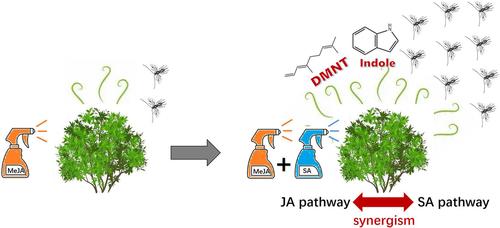
Abstract Image

查看原文
分享 分享
微信好友 朋友圈 QQ好友 复制链接
本刊更多论文
茉莉酸和水杨酸途径介导的茶树对小黄蜂吸引力增强的挥发性线索
茉莉酸(jasmonic acid, JA)和水杨酸(salicylic acid, SA)途径通常被认为在介导植物抗草食动物抗性时具有拮抗作用。然而,我们之前发现,当1.5 mmol/L茉莉酸甲酯(MeJA)和20 mmol/L SA (MeJA+SA处理,间隔12 h)处理茶树时,这两条途径具有协同作用。在这里,我们研究了JA-SA在茶树中的协同作用如何以及为什么影响了茶几何虫的寄生虫Parapanteles hyposidrae (Wilkinson)黄蜂的趋化性。
本文章由计算机程序翻译,如有差异,请以英文原文为准。
求助全文
约1分钟内获得全文 去求助
来源期刊
Pest Management Science
Pest Management Science 农林科学-昆虫学
CiteScore
7.90
自引率
9.80%
发文量
553
审稿时长
4.8 months
期刊介绍: Pest Management Science is the international journal of research and development in crop protection and pest control. Since its launch in 1970, the journal has become the premier forum for papers on the discovery, application, and impact on the environment of products and strategies designed for pest management. Published for SCI by John Wiley & Sons Ltd.
期刊最新文献
Potential of endophytic Beauveria bassiana against Coraebus (Coleoptera: Buprestidae) oak borers. Artificial shelters as dual-purpose tools for monitoring natural enemies and providing microhabitats in orchards. Residue dynamics and metabolic pathways of sulfoxaflor in Cirsium japonicum var. maackii and Olea europaea L. Molecular co-assembly engineering towards natural tea saponin-based nanopesticides for synergistic enhanced foliar affinity. Cytochrome P450 and glutathione S-transferase may confer bensulfuron-methyl resistance in Cyperus iria.
×
引用
GB/T 7714-2015
复制
MLA
复制
APA
复制
导出至
BibTeX EndNote RefMan NoteFirst NoteExpress
×
×
提示
您的信息不完整,为了账户安全,请先补充。
现在去补充
×
提示
您因"违规操作"
具体请查看互助需知
我知道了
×
提示
现在去查看 取消
×
提示
确定
0
微信
客服QQ
Book学术公众号 扫码关注我们
反馈
×
意见反馈
请填写您的意见或建议
请填写您的手机或邮箱
已复制链接
已复制链接
快去分享给好友吧!
我知道了
×
扫码分享
扫码分享
Book学术官方微信
Book学术文献互助
Book学术文献互助群
群 号:604180095
Book学术
文献互助 智能选刊 最新文献 互助须知 联系我们:info@booksci.cn
Book学术提供免费学术资源搜索服务,方便国内外学者检索中英文文献。致力于提供最便捷和优质的服务体验。
Copyright © 2023 Book学术 All rights reserved.
ghs 京公网安备 11010802042870号 京ICP备2023020795号-1





