Wenxian Zhao, Yiwei Sun, Laiyu Che, Haifang Wang, Aoneng Cao
{"title":"Conformational Engineering of Flexible Protein Fragments on the Surface of Different Nanoparticles: The Surface-Atom Mobility Rules","authors":"Wenxian Zhao, Yiwei Sun, Laiyu Che, Haifang Wang, Aoneng Cao","doi":"10.1002/cmdc.202400832","DOIUrl":null,"url":null,"abstract":"<p>As a newly emerging technology, conformational engineering (CE) has been gradually displaying the power of producing protein-like nanoparticles (NPs) by tuning flexible protein fragments into their original native conformation on NPs. But apparently, not all types of NPs can serve as scaffolds for CE. To expedite the CE technology on a broader variety of NPs, the essential characteristic of NPs as scaffolds for CE needs to be identified. Herein, we investigate the potential of two distinct types of NPs as scaffolds for CE: CdSe/ZnS quantum dots (QDs), an ionic compound NP, and palladium NPs (PdNPs), a metal NP. The results demonstrate that while QDs cannot support the restoration of the native conformation and function of the complementary-determining region (CDR) fragments of antibodies, PdNPs can. The notably disparate outcomes unequivocally show that the mobility of the surface atoms/adatoms of the NPs or the mobility of the conjugating bonds to the NPs is essential for CE, which allows the conjugated peptides to undergo a conformational change from their initial random conformation to their most stable native conformation under the constraints mimicking the native long-range interactions in the original proteins. This discovery opens the door for CE on more NPs in the future.</p>","PeriodicalId":147,"journal":{"name":"ChemMedChem","volume":"20 8","pages":""},"PeriodicalIF":3.4000,"publicationDate":"2025-01-14","publicationTypes":"Journal Article","fieldsOfStudy":null,"isOpenAccess":false,"openAccessPdf":"","citationCount":"0","resultStr":null,"platform":"Semanticscholar","paperid":null,"PeriodicalName":"ChemMedChem","FirstCategoryId":"3","ListUrlMain":"https://chemistry-europe.onlinelibrary.wiley.com/doi/10.1002/cmdc.202400832","RegionNum":4,"RegionCategory":"医学","ArticlePicture":[],"TitleCN":null,"AbstractTextCN":null,"PMCID":null,"EPubDate":"","PubModel":"","JCR":"Q2","JCRName":"CHEMISTRY, MEDICINAL","Score":null,"Total":0}
引用次数: 0
Abstract
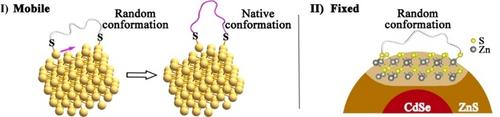
As a newly emerging technology, conformational engineering (CE) has been gradually displaying the power of producing protein-like nanoparticles (NPs) by tuning flexible protein fragments into their original native conformation on NPs. But apparently, not all types of NPs can serve as scaffolds for CE. To expedite the CE technology on a broader variety of NPs, the essential characteristic of NPs as scaffolds for CE needs to be identified. Herein, we investigate the potential of two distinct types of NPs as scaffolds for CE: CdSe/ZnS quantum dots (QDs), an ionic compound NP, and palladium NPs (PdNPs), a metal NP. The results demonstrate that while QDs cannot support the restoration of the native conformation and function of the complementary-determining region (CDR) fragments of antibodies, PdNPs can. The notably disparate outcomes unequivocally show that the mobility of the surface atoms/adatoms of the NPs or the mobility of the conjugating bonds to the NPs is essential for CE, which allows the conjugated peptides to undergo a conformational change from their initial random conformation to their most stable native conformation under the constraints mimicking the native long-range interactions in the original proteins. This discovery opens the door for CE on more NPs in the future.
期刊介绍:
Quality research. Outstanding publications. With an impact factor of 3.124 (2019), ChemMedChem is a top journal for research at the interface of chemistry, biology and medicine. It is published on behalf of Chemistry Europe, an association of 16 European chemical societies.
ChemMedChem publishes primary as well as critical secondary and tertiary information from authors across and for the world. Its mission is to integrate the wide and flourishing field of medicinal and pharmaceutical sciences, ranging from drug design and discovery to drug development and delivery, from molecular modeling to combinatorial chemistry, from target validation to lead generation and ADMET studies. ChemMedChem typically covers topics on small molecules, therapeutic macromolecules, peptides, peptidomimetics, and aptamers, protein-drug conjugates, nucleic acid therapies, and beginning 2017, nanomedicine, particularly 1) targeted nanodelivery, 2) theranostic nanoparticles, and 3) nanodrugs.
Contents
ChemMedChem publishes an attractive mixture of:
Full Papers and Communications
Reviews and Minireviews
Patent Reviews
Highlights and Concepts
Book and Multimedia Reviews.





 京公网安备 11010802042870号
京ICP备2023020795号-1
京公网安备 11010802042870号
京ICP备2023020795号-1

 分享
分享
 求助内容:
求助内容: 应助结果提醒方式:
 扫码关注我们
