Paulina Erwardt, Bartosz Szymczak, Marek Wiśniewski, Bartosz Maciejewski, Michał Świdziński, Janusz Strzelecki, Wiesław Nowak, Katarzyna Roszek
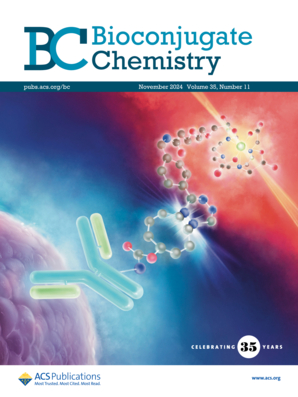
{"title":"l-Asparaginase Immobilized on Nanographene Oxide as an Efficient Nanobiocatalytic Tool for Asparagine Depletion in Leukemia Cells.","authors":"Paulina Erwardt, Bartosz Szymczak, Marek Wiśniewski, Bartosz Maciejewski, Michał Świdziński, Janusz Strzelecki, Wiesław Nowak, Katarzyna Roszek","doi":"10.1021/acs.bioconjchem.4c00518","DOIUrl":null,"url":null,"abstract":"<p><p>l-Asparaginase (l-ASNase) catalyzes the hydrolysis of l-asparagine, leading to its depletion and subsequent effects on the cellular proliferation and survival. In contrast to normal cells, malignant cells that lack asparagine synthase are extremely susceptible to asparagine deficiency. l-ASNase has been successfully employed in treating pediatric leukemias and non-Hodgkin lymphomas; however, its usage in adult patients and other types of cancer is limited due to significant side effects and drug resistance. Recent research has explored alternative formulations and delivery methods to enhance its efficacy and minimize adverse effects. One promising approach involves the immobilization of l-ASNase onto nanostructured materials, offering improved enzymatic activity and biocompatibility of the support. We harnessed an <i>E. coli</i> l-ASNase type II preparation to develop a novel strategy of enzyme immobilization on graphene oxide (GO)-based support. We compared GO and nanographene oxide (nGO) in terms of their biocompatibility and influence on enzyme parameters. The obtained l-ASNase on the nGO nanobiocatalyst maintains enzymatic activity and increases its stability, selectively acting on K562 leukemia cells without cytotoxic influence on normal endothelial cells. In the case of treated K562 cells, we confirmed enlargement in the cell and nucleus size, disturbance in the cell cycle (interphase and metaphase), and increased apoptosis rate. The potential therapeutic possibilities of immobilized l-ASNase on leukemia cell damage are also discussed, highlighting the importance of further research in this area for advancing cancer therapy.</p>","PeriodicalId":29,"journal":{"name":"Bioconjugate Chemistry","volume":" ","pages":"253-262"},"PeriodicalIF":3.9000,"publicationDate":"2025-02-19","publicationTypes":"Journal Article","fieldsOfStudy":null,"isOpenAccess":false,"openAccessPdf":"https://www.ncbi.nlm.nih.gov/pmc/articles/PMC11843607/pdf/","citationCount":"0","resultStr":null,"platform":"Semanticscholar","paperid":null,"PeriodicalName":"Bioconjugate Chemistry","FirstCategoryId":"1","ListUrlMain":"https://doi.org/10.1021/acs.bioconjchem.4c00518","RegionNum":2,"RegionCategory":"化学","ArticlePicture":[],"TitleCN":null,"AbstractTextCN":null,"PMCID":null,"EPubDate":"2025/1/14 0:00:00","PubModel":"Epub","JCR":"Q1","JCRName":"BIOCHEMICAL RESEARCH METHODS","Score":null,"Total":0}
引用次数: 0
Abstract
l-Asparaginase (l-ASNase) catalyzes the hydrolysis of l-asparagine, leading to its depletion and subsequent effects on the cellular proliferation and survival. In contrast to normal cells, malignant cells that lack asparagine synthase are extremely susceptible to asparagine deficiency. l-ASNase has been successfully employed in treating pediatric leukemias and non-Hodgkin lymphomas; however, its usage in adult patients and other types of cancer is limited due to significant side effects and drug resistance. Recent research has explored alternative formulations and delivery methods to enhance its efficacy and minimize adverse effects. One promising approach involves the immobilization of l-ASNase onto nanostructured materials, offering improved enzymatic activity and biocompatibility of the support. We harnessed an E. coli l-ASNase type II preparation to develop a novel strategy of enzyme immobilization on graphene oxide (GO)-based support. We compared GO and nanographene oxide (nGO) in terms of their biocompatibility and influence on enzyme parameters. The obtained l-ASNase on the nGO nanobiocatalyst maintains enzymatic activity and increases its stability, selectively acting on K562 leukemia cells without cytotoxic influence on normal endothelial cells. In the case of treated K562 cells, we confirmed enlargement in the cell and nucleus size, disturbance in the cell cycle (interphase and metaphase), and increased apoptosis rate. The potential therapeutic possibilities of immobilized l-ASNase on leukemia cell damage are also discussed, highlighting the importance of further research in this area for advancing cancer therapy.
期刊介绍:
Bioconjugate Chemistry invites original contributions on all research at the interface between man-made and biological materials. The mission of the journal is to communicate to advances in fields including therapeutic delivery, imaging, bionanotechnology, and synthetic biology. Bioconjugate Chemistry is intended to provide a forum for presentation of research relevant to all aspects of bioconjugates, including the preparation, properties and applications of biomolecular conjugates.



 京公网安备 11010802042870号
京ICP备2023020795号-1
京公网安备 11010802042870号
京ICP备2023020795号-1

 分享
分享
 求助内容:
求助内容: 应助结果提醒方式:
 扫码关注我们
