{"title":"Engineering Cascade Bio-Solar Cells Inspired by the Z-Scheme of Oxygenic Photosynthesis: Layered Chlorophyll and Bacterio-Chlorophyll Derivatives","authors":"Shengnan Duan, Teng Gu, Chiasa Uragami, Shin-ichi Sasaki, Yuanqi Zhou, Ruohan Tao, Xianju Zhou, Chunbao Feng, Hitoshi Tamiaki, Xiao-Feng Wang, Zeyun Xiao, Hideki Hashimoto","doi":"10.1002/cssc.202402588","DOIUrl":null,"url":null,"abstract":"<p>The natural Z-scheme of oxygenic photosynthesis efficiently drives electron transfer from photosystem II (PSII) to photosystem I (PSI) via an electron transport chain, despite the lower energy levels of PSII. Inspired by this sophisticated mechanism, we present a layered cascade bio-solar cell (CBSC) that emulates the Z-scheme. In this design, chlorophyll derivatives (Chl) act as PSI analogs, while bacteriochlorophyll derivatives (BChl) serve as PSII analogs in the active layer. The resulting photocurrent, prominently detected in the near-infrared region, is validated through external quantum efficiency measurements. Sub-nanosecond transient absorption spectroscopy reveals a prolonged charge transfer (CT) state from BChl to Chl (Chl<sup>–</sup>/BChl<sup>+</sup> species) compared to the reverse direction (Chl<sup>+</sup>/BChl<sup>–</sup> species). This asymmetry highlights a dominant electron flow from BChl (PSII analog) to Chl (PSI analog) under simultaneous excitation, effectively replicating the natural Z-scheme electron transfer. These findings represent a significant advance in the design of bio-inspired solar cells, paving the way for artificial photosynthesis systems and offering profound insights into improving photovoltaic theory and efficiency.</p>","PeriodicalId":149,"journal":{"name":"ChemSusChem","volume":"18 11","pages":""},"PeriodicalIF":6.6000,"publicationDate":"2025-01-15","publicationTypes":"Journal Article","fieldsOfStudy":null,"isOpenAccess":false,"openAccessPdf":"","citationCount":"0","resultStr":null,"platform":"Semanticscholar","paperid":null,"PeriodicalName":"ChemSusChem","FirstCategoryId":"92","ListUrlMain":"https://chemistry-europe.onlinelibrary.wiley.com/doi/10.1002/cssc.202402588","RegionNum":2,"RegionCategory":"化学","ArticlePicture":[],"TitleCN":null,"AbstractTextCN":null,"PMCID":null,"EPubDate":"","PubModel":"","JCR":"Q1","JCRName":"CHEMISTRY, MULTIDISCIPLINARY","Score":null,"Total":0}
引用次数: 0
Abstract
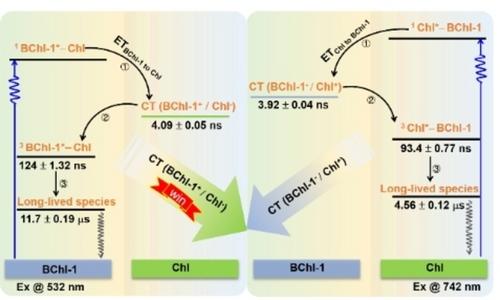
The natural Z-scheme of oxygenic photosynthesis efficiently drives electron transfer from photosystem II (PSII) to photosystem I (PSI) via an electron transport chain, despite the lower energy levels of PSII. Inspired by this sophisticated mechanism, we present a layered cascade bio-solar cell (CBSC) that emulates the Z-scheme. In this design, chlorophyll derivatives (Chl) act as PSI analogs, while bacteriochlorophyll derivatives (BChl) serve as PSII analogs in the active layer. The resulting photocurrent, prominently detected in the near-infrared region, is validated through external quantum efficiency measurements. Sub-nanosecond transient absorption spectroscopy reveals a prolonged charge transfer (CT) state from BChl to Chl (Chl–/BChl+ species) compared to the reverse direction (Chl+/BChl– species). This asymmetry highlights a dominant electron flow from BChl (PSII analog) to Chl (PSI analog) under simultaneous excitation, effectively replicating the natural Z-scheme electron transfer. These findings represent a significant advance in the design of bio-inspired solar cells, paving the way for artificial photosynthesis systems and offering profound insights into improving photovoltaic theory and efficiency.
期刊介绍:
ChemSusChem
Impact Factor (2016): 7.226
Scope:
Interdisciplinary journal
Focuses on research at the interface of chemistry and sustainability
Features the best research on sustainability and energy
Areas Covered:
Chemistry
Materials Science
Chemical Engineering
Biotechnology






 京公网安备 11010802042870号
京ICP备2023020795号-1
京公网安备 11010802042870号
京ICP备2023020795号-1

 分享
分享
 求助内容:
求助内容: 应助结果提醒方式:
 扫码关注我们
