Stefan Motov , Vicki M. Butenschoen , Philipp E. Krauss , Anand Veeravagu , Kelly H. Yoo , Felix C. Stengel , Nader Hejrati , Martin N. Stienen
{"title":"Current state and future perspectives of spinal navigation and robotics—an AO spine survey","authors":"Stefan Motov , Vicki M. Butenschoen , Philipp E. Krauss , Anand Veeravagu , Kelly H. Yoo , Felix C. Stengel , Nader Hejrati , Martin N. Stienen","doi":"10.1016/j.bas.2024.104165","DOIUrl":null,"url":null,"abstract":"<div><h3>Introduction</h3><div>The use of robotics in spine surgery has gained popularity. This study aims to assess the current state of robotics and raise awareness of its educational implications.</div></div><div><h3>Research question</h3><div>What are the current adoption trends and barriers to the implementation of robotic assistance in spine surgery?</div></div><div><h3>Material and methods</h3><div>An online questionnaire comprising 27 questions was distributed to AO spine members between October 25th and November 13th, 2023, using the SurveyMonkey platform (<span><span>https://www.surveymonkey.com</span><svg><path></path></svg></span>; SurveyMonkey Inc., San Mateo, CA, USA). Statistical analyses (descriptive statistics, Pearson Chi-Square tests) and generation of all graphs were performed using SPSS Version 29.0.1.0 (IBM SPSS Statistic).</div></div><div><h3>Results</h3><div>We received 424 responses from AO Spine members (response rate = 9.9 %). The participants were mostly board-certified orthopedic surgeons (46 %, n = 195) and neurosurgeons (32%, n = 136). While 49% (n = 208) of the participants reported occasional or frequent use of navigation assistance, only 18 % (n = 70) indicated the use of robotic assistance for spinal instrumentation. A significant difference based on the country's median income status (p < 0.001) and the respondent's number of annual instrumentation procedures (p < 0.001) has been observed. While 11 % (n = 47) of all surgeons use a spinal robot frequently, 36 % (n = 153) of the participants stated they don't need a robot from a current perspective. Most participants (77%, n = 301) concluded that high acquisition costs are the primary barrier for the implementation of robotics.</div></div><div><h3>Discussion and conclusion</h3><div>Although the hype for robotics in spine surgery increased recently, robotic systems remain non-standard equipment due to cost constraints and limited usability.</div></div>","PeriodicalId":72443,"journal":{"name":"Brain & spine","volume":"5 ","pages":"Article 104165"},"PeriodicalIF":2.5000,"publicationDate":"2025-01-01","publicationTypes":"Journal Article","fieldsOfStudy":null,"isOpenAccess":false,"openAccessPdf":"https://www.ncbi.nlm.nih.gov/pmc/articles/PMC11732222/pdf/","citationCount":"0","resultStr":null,"platform":"Semanticscholar","paperid":null,"PeriodicalName":"Brain & spine","FirstCategoryId":"1085","ListUrlMain":"https://www.sciencedirect.com/science/article/pii/S2772529424014218","RegionNum":0,"RegionCategory":null,"ArticlePicture":[],"TitleCN":null,"AbstractTextCN":null,"PMCID":null,"EPubDate":"","PubModel":"","JCR":"Q3","JCRName":"CLINICAL NEUROLOGY","Score":null,"Total":0}
引用次数: 0
Abstract
Introduction
The use of robotics in spine surgery has gained popularity. This study aims to assess the current state of robotics and raise awareness of its educational implications.
Research question
What are the current adoption trends and barriers to the implementation of robotic assistance in spine surgery?
Material and methods
An online questionnaire comprising 27 questions was distributed to AO spine members between October 25th and November 13th, 2023, using the SurveyMonkey platform (https://www.surveymonkey.com; SurveyMonkey Inc., San Mateo, CA, USA). Statistical analyses (descriptive statistics, Pearson Chi-Square tests) and generation of all graphs were performed using SPSS Version 29.0.1.0 (IBM SPSS Statistic).
Results
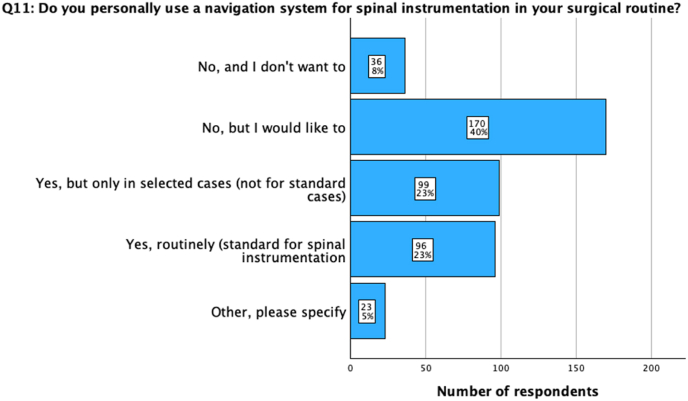
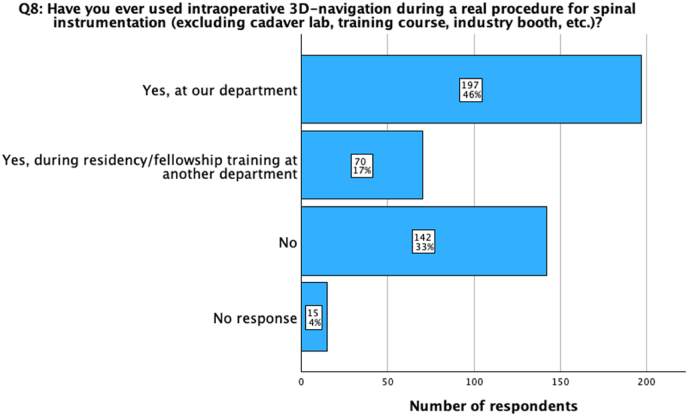
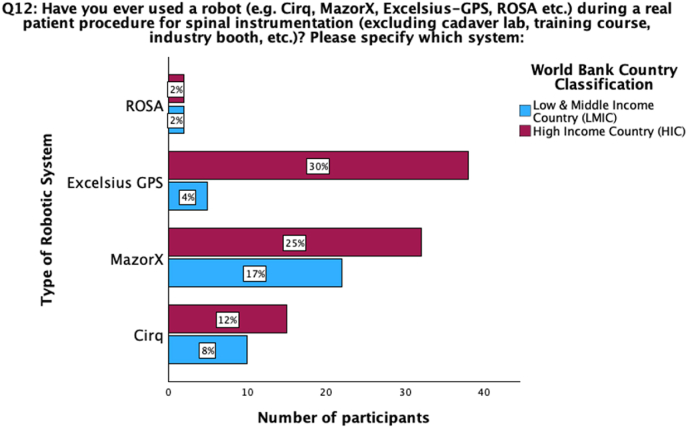
We received 424 responses from AO Spine members (response rate = 9.9 %). The participants were mostly board-certified orthopedic surgeons (46 %, n = 195) and neurosurgeons (32%, n = 136). While 49% (n = 208) of the participants reported occasional or frequent use of navigation assistance, only 18 % (n = 70) indicated the use of robotic assistance for spinal instrumentation. A significant difference based on the country's median income status (p < 0.001) and the respondent's number of annual instrumentation procedures (p < 0.001) has been observed. While 11 % (n = 47) of all surgeons use a spinal robot frequently, 36 % (n = 153) of the participants stated they don't need a robot from a current perspective. Most participants (77%, n = 301) concluded that high acquisition costs are the primary barrier for the implementation of robotics.
Discussion and conclusion
Although the hype for robotics in spine surgery increased recently, robotic systems remain non-standard equipment due to cost constraints and limited usability.




 京公网安备 11010802042870号
京ICP备2023020795号-1
京公网安备 11010802042870号
京ICP备2023020795号-1

 分享
分享
 求助内容:
求助内容: 应助结果提醒方式:
 扫码关注我们
