Visual Acuity, Full-field Stimulus Thresholds, and Electroretinography for 4 Years in The Rate of Progression of USH2A-related Retinal Degeneration (RUSH2A) Study
David G. Birch PhD , Peiyao Cheng PhD , Maureen G. Maguire PhD , Jacque L. Duncan MD , Allison R. Ayala MS , Janet K. Cheetham PharmD , Nicole R. Doucet MPH , Todd A. Durham PhD , Abigail T. Fahim MD, PhD , Frederick L. Ferris III MD , Rachel M. Huckfeldt MD, PhD , Michele Melia ScM , Michel Michaelides MD (Res) , Mark E. Pennesi MD, PhD , José-Alain Sahel MD , Katarina Stingl MD , Ajoy Vincent MBBS, MS , Christina Y. Weng MD, MBA , Foundation Fighting Blindness Clinical Consortium Investigator Group
{"title":"Visual Acuity, Full-field Stimulus Thresholds, and Electroretinography for 4 Years in The Rate of Progression of USH2A-related Retinal Degeneration (RUSH2A) Study","authors":"David G. Birch PhD , Peiyao Cheng PhD , Maureen G. Maguire PhD , Jacque L. Duncan MD , Allison R. Ayala MS , Janet K. Cheetham PharmD , Nicole R. Doucet MPH , Todd A. Durham PhD , Abigail T. Fahim MD, PhD , Frederick L. Ferris III MD , Rachel M. Huckfeldt MD, PhD , Michele Melia ScM , Michel Michaelides MD (Res) , Mark E. Pennesi MD, PhD , José-Alain Sahel MD , Katarina Stingl MD , Ajoy Vincent MBBS, MS , Christina Y. Weng MD, MBA , Foundation Fighting Blindness Clinical Consortium Investigator Group","doi":"10.1016/j.xops.2024.100648","DOIUrl":null,"url":null,"abstract":"<div><h3>Purpose</h3><div>To describe progression of best-corrected visual acuity (BCVA), full-field stimulus thresholds (FST), and electroretinography (ERG) over 4 years in the <em>USH2A</em>-related Retinal Degeneration study and to assess their suitability as clinical trial endpoints.</div></div><div><h3>Design</h3><div>Prospective natural history study.</div></div><div><h3>Participants</h3><div>Participants (n = 105) with biallelic disease-causing sequence variants in USH2A and BCVA letter scores of ≥54 were included.</div></div><div><h3>Methods</h3><div>BCVA, FST, fundus-guided microperimetry, static perimetry, and spectral domain OCT were performed annually and ERG at baseline and 4 years only. Mixed effects models were used to estimate annual rates of change with 95% confidence intervals. Associations of change from baseline to 4 years between BCVA, FST, ERG, and other metrics were assessed with Spearman correlation coefficients (r<sub>s</sub>).</div></div><div><h3>Main Outcome Measures</h3><div>Best-corrected visual acuity, FST, and ERG.</div></div><div><h3>Results</h3><div>The annual rate of decline in BCVA was 0.83 (95% confidence interval: 0.65−1.02) letters/year. For FST, the change was 0.09 (0.07−0.11) log cd.s/m<sup>2</sup>/year for white threshold, 0.10 (0.08−0.12) log cd.s/m<sup>2</sup>/year for blue threshold, and 0.05 (0.04−0.06) log cd.s/m<sup>2</sup>/year for red threshold. Changes were 22.6 (17.4−28.2)%/year for white threshold, 26.0 (20.3−32.1)%/year for blue threshold, and 12.3 (8.7−16.0)%/year for red threshold. The high percentage of eyes with undetectable ERGs at baseline limited assessment of change.</div></div><div><h3>Conclusions</h3><div>Best-corrected visual acuity was not a sensitive measure of progression over 4 years. Full-field stimulus threshold was a more sensitive measure; however, additional information on the clinical relevance of changes in FST is needed before this test can be adopted as an endpoint for clinical trials.</div></div><div><h3>Financial Disclosure(s)</h3><div>Proprietary or commercial disclosure may be found in the Footnotes and Disclosures at the end of this article.</div></div>","PeriodicalId":74363,"journal":{"name":"Ophthalmology science","volume":"5 2","pages":"Article 100648"},"PeriodicalIF":4.6000,"publicationDate":"2025-03-01","publicationTypes":"Journal Article","fieldsOfStudy":null,"isOpenAccess":false,"openAccessPdf":"https://www.ncbi.nlm.nih.gov/pmc/articles/PMC11730847/pdf/","citationCount":"0","resultStr":null,"platform":"Semanticscholar","paperid":null,"PeriodicalName":"Ophthalmology science","FirstCategoryId":"1085","ListUrlMain":"https://www.sciencedirect.com/science/article/pii/S2666914524001842","RegionNum":0,"RegionCategory":null,"ArticlePicture":[],"TitleCN":null,"AbstractTextCN":null,"PMCID":null,"EPubDate":"2024/11/8 0:00:00","PubModel":"Epub","JCR":"Q1","JCRName":"OPHTHALMOLOGY","Score":null,"Total":0}
引用次数: 0
Abstract
Purpose
To describe progression of best-corrected visual acuity (BCVA), full-field stimulus thresholds (FST), and electroretinography (ERG) over 4 years in the USH2A-related Retinal Degeneration study and to assess their suitability as clinical trial endpoints.
Design
Prospective natural history study.
Participants
Participants (n = 105) with biallelic disease-causing sequence variants in USH2A and BCVA letter scores of ≥54 were included.
Methods
BCVA, FST, fundus-guided microperimetry, static perimetry, and spectral domain OCT were performed annually and ERG at baseline and 4 years only. Mixed effects models were used to estimate annual rates of change with 95% confidence intervals. Associations of change from baseline to 4 years between BCVA, FST, ERG, and other metrics were assessed with Spearman correlation coefficients (rs).
Main Outcome Measures
Best-corrected visual acuity, FST, and ERG.
Results
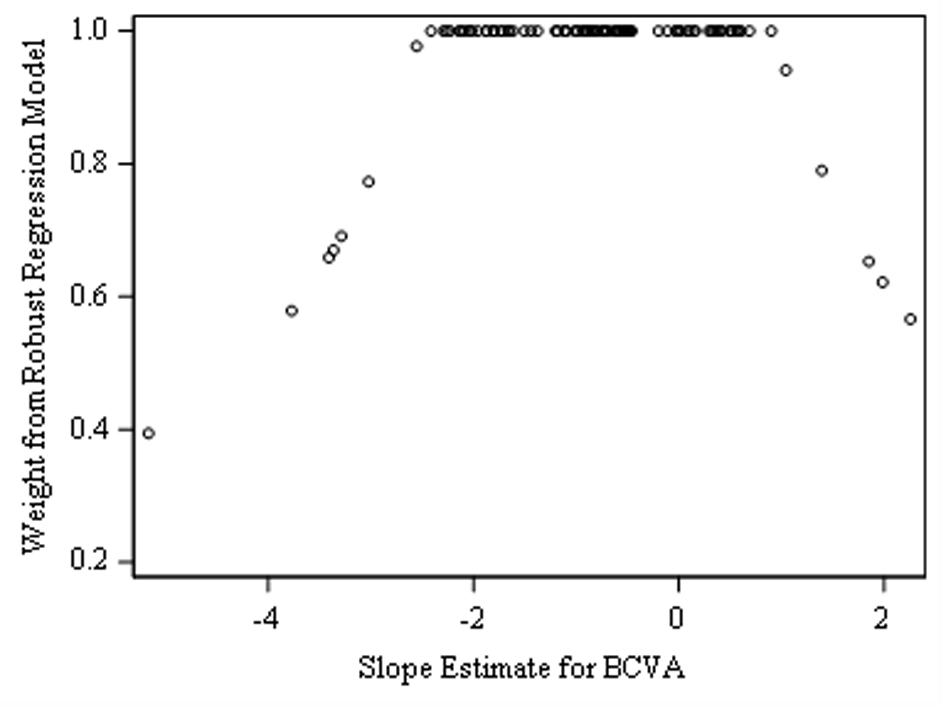
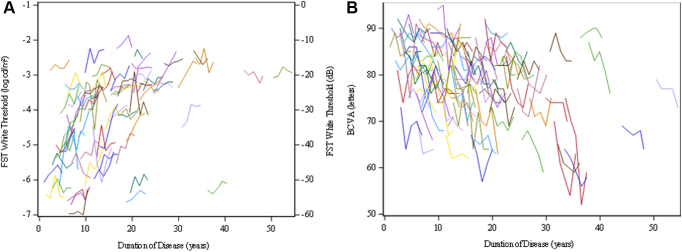
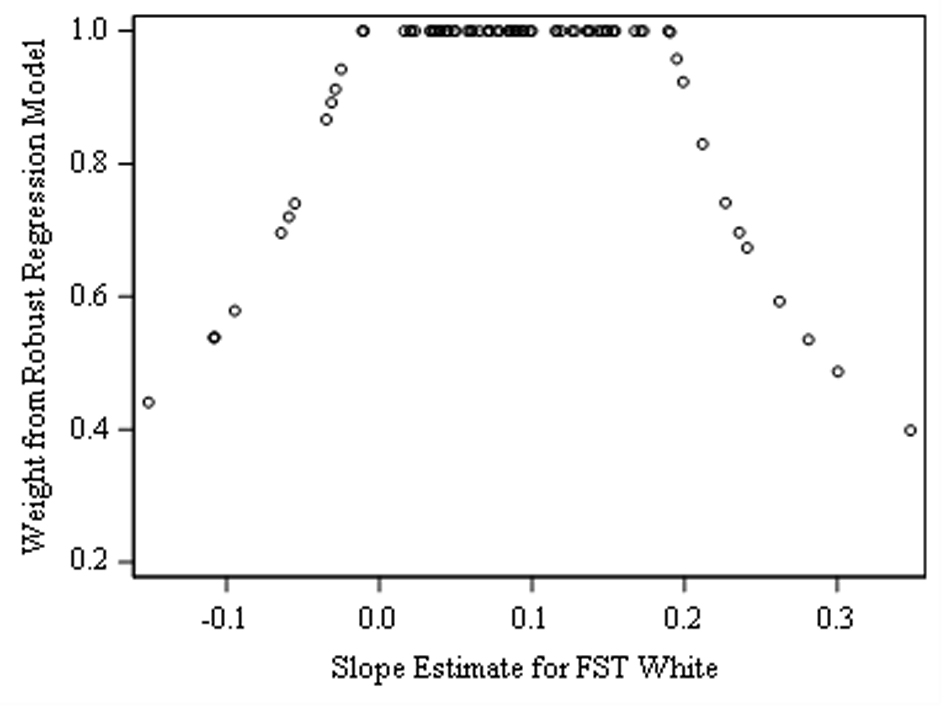
The annual rate of decline in BCVA was 0.83 (95% confidence interval: 0.65−1.02) letters/year. For FST, the change was 0.09 (0.07−0.11) log cd.s/m2/year for white threshold, 0.10 (0.08−0.12) log cd.s/m2/year for blue threshold, and 0.05 (0.04−0.06) log cd.s/m2/year for red threshold. Changes were 22.6 (17.4−28.2)%/year for white threshold, 26.0 (20.3−32.1)%/year for blue threshold, and 12.3 (8.7−16.0)%/year for red threshold. The high percentage of eyes with undetectable ERGs at baseline limited assessment of change.
Conclusions
Best-corrected visual acuity was not a sensitive measure of progression over 4 years. Full-field stimulus threshold was a more sensitive measure; however, additional information on the clinical relevance of changes in FST is needed before this test can be adopted as an endpoint for clinical trials.
Financial Disclosure(s)
Proprietary or commercial disclosure may be found in the Footnotes and Disclosures at the end of this article.





 京公网安备 11010802042870号
京ICP备2023020795号-1
京公网安备 11010802042870号
京ICP备2023020795号-1

 分享
分享
 求助内容:
求助内容: 应助结果提醒方式:
 扫码关注我们
