Xin-Mian Chen, Hong-Yi Li, Cheng-Chao Wei, Jie Cheng, Jiang Diao, Bing Xie, Fusheng Pan
{"title":"Selective Chemical Etching of Vanadium Slag Enables Highly Efficient and Clean Extraction of Vanadium","authors":"Xin-Mian Chen, Hong-Yi Li, Cheng-Chao Wei, Jie Cheng, Jiang Diao, Bing Xie, Fusheng Pan","doi":"10.1021/acssuschemeng.4c08516","DOIUrl":null,"url":null,"abstract":"Vanadium slag with high calcium and phosphorus contents (HCPVS) is considered an inadequate raw material for vanadium extraction. Existing vanadium extraction techniques are incapable of efficiently extracting vanadium from HCPVS due to the severe interference of phosphorus and silicon impurities. This study proposed selective chemical etching to remove phosphorus and silicon prior to vanadium extraction under mild conditions. Results showed that the (Mn,Fe)V<sub>2</sub>O<sub>4</sub> spinels in HCPVS were enveloped by a silicate matrix comprising Ca<sub>2</sub>SiO<sub>4</sub>–Ca<sub>3</sub>(PO<sub>4</sub>)<sub>2</sub> and CaFeSiO<sub>4</sub>. Chemical etching with 1.5 mol/L hydrochloric acid for 30 min effectively removed the silicate matrix, yielding the etched slag for further processing. The etched slag underwent magnesiation roasting at a Mg/V molar ratio of 1.0 for 60 min at 1173 K. Subsequent leaching with sulfuric acid at pH 3.5 and 313 K for 10 min yielded a vanadium extraction efficiency of 93.2%. V<sub>2</sub>O<sub>5</sub> with a purity of 98.6% was obtained after ammonium precipitation and calcination. The resulting leaching residue and wastewater are recyclable, demonstrating the proposed vanadium extraction process as environmentally friendly and sustainable. This study sheds light on a novel way for sustainable resource extraction from low-grade ores.","PeriodicalId":25,"journal":{"name":"ACS Sustainable Chemistry & Engineering","volume":"1 1","pages":""},"PeriodicalIF":7.3000,"publicationDate":"2025-01-15","publicationTypes":"Journal Article","fieldsOfStudy":null,"isOpenAccess":false,"openAccessPdf":"","citationCount":"0","resultStr":null,"platform":"Semanticscholar","paperid":null,"PeriodicalName":"ACS Sustainable Chemistry & Engineering","FirstCategoryId":"92","ListUrlMain":"https://doi.org/10.1021/acssuschemeng.4c08516","RegionNum":1,"RegionCategory":"化学","ArticlePicture":[],"TitleCN":null,"AbstractTextCN":null,"PMCID":null,"EPubDate":"","PubModel":"","JCR":"Q1","JCRName":"CHEMISTRY, MULTIDISCIPLINARY","Score":null,"Total":0}
引用次数: 0
Abstract
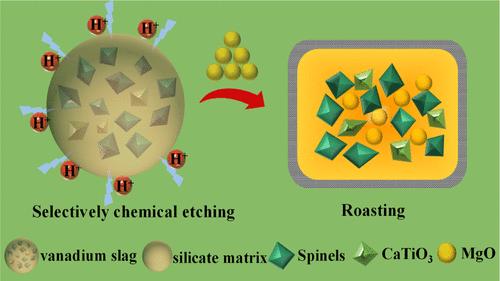
Vanadium slag with high calcium and phosphorus contents (HCPVS) is considered an inadequate raw material for vanadium extraction. Existing vanadium extraction techniques are incapable of efficiently extracting vanadium from HCPVS due to the severe interference of phosphorus and silicon impurities. This study proposed selective chemical etching to remove phosphorus and silicon prior to vanadium extraction under mild conditions. Results showed that the (Mn,Fe)V2O4 spinels in HCPVS were enveloped by a silicate matrix comprising Ca2SiO4–Ca3(PO4)2 and CaFeSiO4. Chemical etching with 1.5 mol/L hydrochloric acid for 30 min effectively removed the silicate matrix, yielding the etched slag for further processing. The etched slag underwent magnesiation roasting at a Mg/V molar ratio of 1.0 for 60 min at 1173 K. Subsequent leaching with sulfuric acid at pH 3.5 and 313 K for 10 min yielded a vanadium extraction efficiency of 93.2%. V2O5 with a purity of 98.6% was obtained after ammonium precipitation and calcination. The resulting leaching residue and wastewater are recyclable, demonstrating the proposed vanadium extraction process as environmentally friendly and sustainable. This study sheds light on a novel way for sustainable resource extraction from low-grade ores.
期刊介绍:
ACS Sustainable Chemistry & Engineering is a prestigious weekly peer-reviewed scientific journal published by the American Chemical Society. Dedicated to advancing the principles of green chemistry and green engineering, it covers a wide array of research topics including green chemistry, green engineering, biomass, alternative energy, and life cycle assessment.
The journal welcomes submissions in various formats, including Letters, Articles, Features, and Perspectives (Reviews), that address the challenges of sustainability in the chemical enterprise and contribute to the advancement of sustainable practices. Join us in shaping the future of sustainable chemistry and engineering.



 京公网安备 11010802042870号
京ICP备2023020795号-1
京公网安备 11010802042870号
京ICP备2023020795号-1

 分享
分享
 求助内容:
求助内容: 应助结果提醒方式:
 扫码关注我们
