Zihao Wang, Jiaman Hu, Minglin Yang, Jize Liu and Xinxing Zhang
{"title":"Recent advances in multimodal mechanoluminescent sensors enabled by nanostructure design†","authors":"Zihao Wang, Jiaman Hu, Minglin Yang, Jize Liu and Xinxing Zhang","doi":"10.1039/D4NR04875J","DOIUrl":null,"url":null,"abstract":"<p >Multiple modes of perception have evolved in creatures to help them survive in a highly complex world under different harsh environments. Inspired by this, multimodal sensing materials have been created as one of the most crucial elements to bridge artificial intelligence with reality. The well-organized integration of multiple independent stimuli in a single material rather than simple integration, is expected to increase the accuracy and multifunctional applications of sensing devices. However, achieving multifunction coupling through elaborate nanostructure and supramolecular design, still remains a challenge that attracts great attention. Under the framework of nanostructural design for a multimodal response, the coupling of mechanoluminescence ability and advanced stimulus-response, has been reported to realize comprehensive perception and multifunctional applications for more complex scenarios. Herein, this mini review briefly provides an overview on the latest advances of multimodal mechanoluminescent sensors, concentrating on the nanostructure design strategy for multifunctional coupling, including triboelectric compositing, supramolecular interfacial connection, and band structure modulation; as well as emphatically discussing the advantages of mechanoluminescence coupling with self-powered sensing, piezoresistive response, temperature/chemical detection, and the corresponding advanced tools for heterogeneous output decoupling. Finally, the conclusions and outlook of multimodal mechanoluminescent sensors are presented.</p>","PeriodicalId":92,"journal":{"name":"Nanoscale","volume":" 11","pages":" 6414-6426"},"PeriodicalIF":5.1000,"publicationDate":"2025-01-16","publicationTypes":"Journal Article","fieldsOfStudy":null,"isOpenAccess":false,"openAccessPdf":"","citationCount":"0","resultStr":null,"platform":"Semanticscholar","paperid":null,"PeriodicalName":"Nanoscale","FirstCategoryId":"88","ListUrlMain":"https://pubs.rsc.org/en/content/articlelanding/2025/nr/d4nr04875j","RegionNum":3,"RegionCategory":"材料科学","ArticlePicture":[],"TitleCN":null,"AbstractTextCN":null,"PMCID":null,"EPubDate":"","PubModel":"","JCR":"Q1","JCRName":"CHEMISTRY, MULTIDISCIPLINARY","Score":null,"Total":0}
引用次数: 0
Abstract
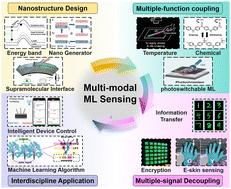
Multiple modes of perception have evolved in creatures to help them survive in a highly complex world under different harsh environments. Inspired by this, multimodal sensing materials have been created as one of the most crucial elements to bridge artificial intelligence with reality. The well-organized integration of multiple independent stimuli in a single material rather than simple integration, is expected to increase the accuracy and multifunctional applications of sensing devices. However, achieving multifunction coupling through elaborate nanostructure and supramolecular design, still remains a challenge that attracts great attention. Under the framework of nanostructural design for a multimodal response, the coupling of mechanoluminescence ability and advanced stimulus-response, has been reported to realize comprehensive perception and multifunctional applications for more complex scenarios. Herein, this mini review briefly provides an overview on the latest advances of multimodal mechanoluminescent sensors, concentrating on the nanostructure design strategy for multifunctional coupling, including triboelectric compositing, supramolecular interfacial connection, and band structure modulation; as well as emphatically discussing the advantages of mechanoluminescence coupling with self-powered sensing, piezoresistive response, temperature/chemical detection, and the corresponding advanced tools for heterogeneous output decoupling. Finally, the conclusions and outlook of multimodal mechanoluminescent sensors are presented.
期刊介绍:
Nanoscale is a high-impact international journal, publishing high-quality research across nanoscience and nanotechnology. Nanoscale publishes a full mix of research articles on experimental and theoretical work, including reviews, communications, and full papers.Highly interdisciplinary, this journal appeals to scientists, researchers and professionals interested in nanoscience and nanotechnology, quantum materials and quantum technology, including the areas of physics, chemistry, biology, medicine, materials, energy/environment, information technology, detection science, healthcare and drug discovery, and electronics.



 京公网安备 11010802042870号
京ICP备2023020795号-1
京公网安备 11010802042870号
京ICP备2023020795号-1

 分享
分享
 求助内容:
求助内容: 应助结果提醒方式:
 扫码关注我们
