Robert P. Hirten , Matteo Danieletto , Milagros Sanchez-Mayor , Jessica K. Whang , Kyung Won Lee , Kyle Landell , Micol Zweig , Drew Helmus , Thomas J. Fuchs , Zahi A. Fayad , Girish N. Nadkarni , Laurie Keefer , Mayte Suarez-Farinas , Bruce E. Sands
{"title":"Physiological Data Collected From Wearable Devices Identify and Predict Inflammatory Bowel Disease Flares","authors":"Robert P. Hirten , Matteo Danieletto , Milagros Sanchez-Mayor , Jessica K. Whang , Kyung Won Lee , Kyle Landell , Micol Zweig , Drew Helmus , Thomas J. Fuchs , Zahi A. Fayad , Girish N. Nadkarni , Laurie Keefer , Mayte Suarez-Farinas , Bruce E. Sands","doi":"10.1053/j.gastro.2024.12.024","DOIUrl":null,"url":null,"abstract":"<div><h3>Background & Aims</h3><div>Wearable devices capture physiological signals noninvasively and passively. Many of these parameters have been linked to inflammatory bowel disease (IBD) activity. We evaluated the associative ability of several physiological metrics with IBD flares and how they change before the development of flare.</div></div><div><h3>Methods</h3><div>Participants throughout the United States answered daily disease activity surveys and wore an Apple Watch (Apple), Fitbit (Google), or Oura Ring (Oura Health). These devices collected longitudinal heart rate (HR), resting heart rate (RHR), heart rate variability (HRV), steps, and oxygenation. C-reactive protein, erythrocyte sedimentation rate, and fecal calprotectin were collected as standard of care. Linear mixed-effect models were implemented to analyze HR, RHR, steps, and oxygenation, and cosinor mixed-effect models were applied to HRV circadian features. Mixed-effect logistic regression was used to determine the predictive ability of physiological metrics.</div></div><div><h3>Results</h3><div>Three hundred and nine participants were enrolled across 36 states. Circadian patterns of HRV differed significantly between periods of inflammatory flare and remission and symptomatic flare and remission. Marginal means for HR and RHR were higher during periods of inflammatory flare and symptomatic flare. There were fewer daily steps during inflammatory flares. HRV, HR, and RHR differentiated whether participants with symptoms had inflammation. HRV, HR, RHR, steps, and oxygenation were significantly altered up to 7 weeks before inflammatory and symptomatic flares.</div></div><div><h3>Conclusions</h3><div>Longitudinally collected physiological metrics from wearable devices can identify and change before IBD flares, suggesting their feasibility to monitor and predict IBD activity.</div></div>","PeriodicalId":12590,"journal":{"name":"Gastroenterology","volume":"168 5","pages":"Pages 939-951.e5"},"PeriodicalIF":25.1000,"publicationDate":"2025-05-01","publicationTypes":"Journal Article","fieldsOfStudy":null,"isOpenAccess":false,"openAccessPdf":"","citationCount":"0","resultStr":null,"platform":"Semanticscholar","paperid":null,"PeriodicalName":"Gastroenterology","FirstCategoryId":"3","ListUrlMain":"https://www.sciencedirect.com/science/article/pii/S0016508525000137","RegionNum":1,"RegionCategory":"医学","ArticlePicture":[],"TitleCN":null,"AbstractTextCN":null,"PMCID":null,"EPubDate":"2025/1/16 0:00:00","PubModel":"Epub","JCR":"Q1","JCRName":"GASTROENTEROLOGY & HEPATOLOGY","Score":null,"Total":0}
引用次数: 0
Abstract
Background & Aims
Wearable devices capture physiological signals noninvasively and passively. Many of these parameters have been linked to inflammatory bowel disease (IBD) activity. We evaluated the associative ability of several physiological metrics with IBD flares and how they change before the development of flare.
Methods
Participants throughout the United States answered daily disease activity surveys and wore an Apple Watch (Apple), Fitbit (Google), or Oura Ring (Oura Health). These devices collected longitudinal heart rate (HR), resting heart rate (RHR), heart rate variability (HRV), steps, and oxygenation. C-reactive protein, erythrocyte sedimentation rate, and fecal calprotectin were collected as standard of care. Linear mixed-effect models were implemented to analyze HR, RHR, steps, and oxygenation, and cosinor mixed-effect models were applied to HRV circadian features. Mixed-effect logistic regression was used to determine the predictive ability of physiological metrics.
Results
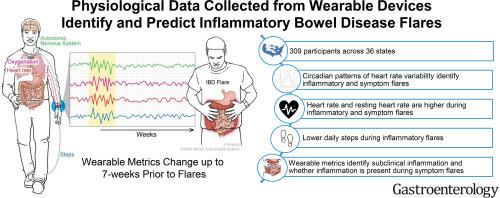
Three hundred and nine participants were enrolled across 36 states. Circadian patterns of HRV differed significantly between periods of inflammatory flare and remission and symptomatic flare and remission. Marginal means for HR and RHR were higher during periods of inflammatory flare and symptomatic flare. There were fewer daily steps during inflammatory flares. HRV, HR, and RHR differentiated whether participants with symptoms had inflammation. HRV, HR, RHR, steps, and oxygenation were significantly altered up to 7 weeks before inflammatory and symptomatic flares.
Conclusions
Longitudinally collected physiological metrics from wearable devices can identify and change before IBD flares, suggesting their feasibility to monitor and predict IBD activity.
期刊介绍:
Gastroenterology is the most prominent journal in the field of gastrointestinal disease. It is the flagship journal of the American Gastroenterological Association and delivers authoritative coverage of clinical, translational, and basic studies of all aspects of the digestive system, including the liver and pancreas, as well as nutrition.
Some regular features of Gastroenterology include original research studies by leading authorities, comprehensive reviews and perspectives on important topics in adult and pediatric gastroenterology and hepatology. The journal also includes features such as editorials, correspondence, and commentaries, as well as special sections like "Mentoring, Education and Training Corner," "Diversity, Equity and Inclusion in GI," "Gastro Digest," "Gastro Curbside Consult," and "Gastro Grand Rounds."
Gastroenterology also provides digital media materials such as videos and "GI Rapid Reel" animations. It is abstracted and indexed in various databases including Scopus, Biological Abstracts, Current Contents, Embase, Nutrition Abstracts, Chemical Abstracts, Current Awareness in Biological Sciences, PubMed/Medline, and the Science Citation Index.




 京公网安备 11010802042870号
京ICP备2023020795号-1
京公网安备 11010802042870号
京ICP备2023020795号-1

 分享
分享
 求助内容:
求助内容: 应助结果提醒方式:
 扫码关注我们
