{"title":"Motor Fault Diagnosis Based on Generative Adversarial Network Using Hyperchaotic Sequences and Mixed-Dimensional Network","authors":"Houzhen Li;Lina Yao","doi":"10.1109/TII.2024.3523570","DOIUrl":null,"url":null,"abstract":"Fault is extremely destructive in industrial process, and imbalanced data greatly affect the accuracy of fault diagnosis. Many methods have been proposed to deal with imbalanced data, but the concern for improving the performance of fault diagnostic networks is not enough. Therefore, novel modified conditional generative adversarial network (MCGAN) based on memristive hyperchaotic sequences and mixed-dimensional convolutional neural network (MCNN) is proposed. The 2-D data are obtained by fast Fourier transform and piecewise reconstruction of vibration signals. A novel tanh-input-type memristive hyperchaotic map is utilized to obtain chaos-based random noises. MCGAN can generate synthetic samples for augmenting the fault sample and reducing the imbalanced rate, and chaos-based random noises are used as the noise variable of MCGAN to generate high-quality synthetic samples. By cascading convolution layers with different dimensions, the lightweight MCNN is designed to improve accuracy of motor fault diagnosis. Experiments are implemented using the Case Western Reserve University and practical laboratory platform. The results show that the accuracy of the proposed method is higher than that of some diagnostic networks under imbalanced data.","PeriodicalId":13301,"journal":{"name":"IEEE Transactions on Industrial Informatics","volume":"21 4","pages":"3216-3225"},"PeriodicalIF":9.9000,"publicationDate":"2025-01-16","publicationTypes":"Journal Article","fieldsOfStudy":null,"isOpenAccess":false,"openAccessPdf":"","citationCount":"0","resultStr":null,"platform":"Semanticscholar","paperid":null,"PeriodicalName":"IEEE Transactions on Industrial Informatics","FirstCategoryId":"94","ListUrlMain":"https://ieeexplore.ieee.org/document/10843957/","RegionNum":1,"RegionCategory":"计算机科学","ArticlePicture":[],"TitleCN":null,"AbstractTextCN":null,"PMCID":null,"EPubDate":"","PubModel":"","JCR":"Q1","JCRName":"AUTOMATION & CONTROL SYSTEMS","Score":null,"Total":0}
引用次数: 0
Abstract
Fault is extremely destructive in industrial process, and imbalanced data greatly affect the accuracy of fault diagnosis. Many methods have been proposed to deal with imbalanced data, but the concern for improving the performance of fault diagnostic networks is not enough. Therefore, novel modified conditional generative adversarial network (MCGAN) based on memristive hyperchaotic sequences and mixed-dimensional convolutional neural network (MCNN) is proposed. The 2-D data are obtained by fast Fourier transform and piecewise reconstruction of vibration signals. A novel tanh-input-type memristive hyperchaotic map is utilized to obtain chaos-based random noises. MCGAN can generate synthetic samples for augmenting the fault sample and reducing the imbalanced rate, and chaos-based random noises are used as the noise variable of MCGAN to generate high-quality synthetic samples. By cascading convolution layers with different dimensions, the lightweight MCNN is designed to improve accuracy of motor fault diagnosis. Experiments are implemented using the Case Western Reserve University and practical laboratory platform. The results show that the accuracy of the proposed method is higher than that of some diagnostic networks under imbalanced data.
期刊介绍:
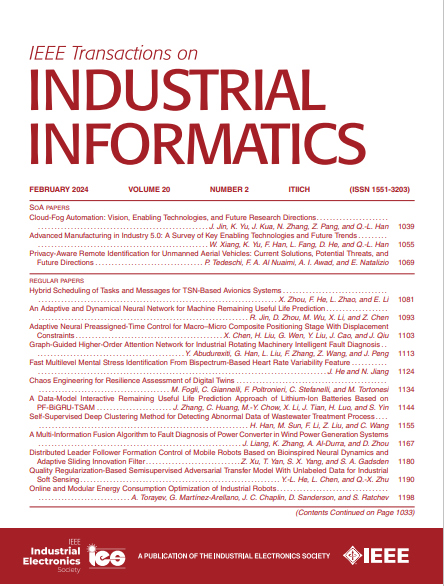
The IEEE Transactions on Industrial Informatics is a multidisciplinary journal dedicated to publishing technical papers that connect theory with practical applications of informatics in industrial settings. It focuses on the utilization of information in intelligent, distributed, and agile industrial automation and control systems. The scope includes topics such as knowledge-based and AI-enhanced automation, intelligent computer control systems, flexible and collaborative manufacturing, industrial informatics in software-defined vehicles and robotics, computer vision, industrial cyber-physical and industrial IoT systems, real-time and networked embedded systems, security in industrial processes, industrial communications, systems interoperability, and human-machine interaction.




 京公网安备 11010802042870号
京ICP备2023020795号-1
京公网安备 11010802042870号
京ICP备2023020795号-1

 分享
分享
 求助内容:
求助内容: 应助结果提醒方式:
 扫码关注我们
