Arenn F. Carlos, Stephen D. Weigand, Nha Trang Thu Pham, Ronald C. Petersen, Clifford R. Jack Jr, Dennis W. Dickson, Jennifer L. Whitwell, Keith A. Josephs
{"title":"White matter hyperintensities and TDP-43 pathology in Alzheimer's disease","authors":"Arenn F. Carlos, Stephen D. Weigand, Nha Trang Thu Pham, Ronald C. Petersen, Clifford R. Jack Jr, Dennis W. Dickson, Jennifer L. Whitwell, Keith A. Josephs","doi":"10.1002/alz.14516","DOIUrl":null,"url":null,"abstract":"<div>\n \n \n <section>\n \n <h3> INTRODUCTION</h3>\n \n <p>Greater white matter hyperintensities (WMHs) on magnetic resonance imaging (MRI) are seen with transactive response DNA-binding protein 43 (TDP-43) pathology in frontotemporal lobar degeneration (FTLD-TDP). WMH associations with TDP-43 pathology in Alzheimer's disease (AD-TDP) remain unclear.</p>\n </section>\n \n <section>\n \n <h3> METHODS</h3>\n \n <p>A total of 157 participants from Mayo Clinic Rochester with autopsy-confirmed AD, known TDP-43 status, and antemortem fluid-attenuated inversion recovery (FLAIR) MRI were included. Vascular risk factors were assessed. A semi-automated WMH segmentation-quantification process produced total and regional WMH volumes. Penalized linear regression models adjusting for age at MRI analyzed TDP-43 associations (status and typing) with WMHs.</p>\n </section>\n \n <section>\n \n <h3> RESULTS</h3>\n \n <p>TDP-43-positive status was not associated with WMH burden overall because opposite effects were seen based on AD-TDP typing. Despite similar antemortem vascular risk factors and postmortem vascular pathologies, AD-TDP type-<i>α</i> showed greater total and regional WMH burden (particularly in subcortical frontotemporal and basal ganglia regions) than TDP-43 negatives and AD-TDP type-<i>β</i>.</p>\n </section>\n \n <section>\n \n <h3> DISCUSSION</h3>\n \n <p>AD-TDP types may have different WMH pathomechanisms, with type-<i>α</i> having associations more like FTLD-TDP than AD.</p>\n </section>\n \n <section>\n \n <h3> Highlights</h3>\n \n <div>\n <ul>\n \n <li>In transactive response DNA-binding protein 43 (TDP-43) pathology in Alzheimer's disease (AD-TDP), TDP-43 status alone is not associated with total or regional WMH burden</li>\n \n <li>AD-TDP type-<i>α</i> shows greater total, frontotemporal subcortical, and basal ganglia white matter hyperintensities (WMHs)</li>\n \n <li>AD-TDP type-<i>β</i> shows less total and subcortical occipital WMHs</li>\n \n <li>AD-TDP type-<i>α</i> effect on WMH burden closely mimics the effects of frontotemporal lobar degeneration with TDP-43 (FTLD-TDP) rather than AD</li>\n \n <li>Different relationships of AD-TDP types with WMHs suggest different pathomechanisms</li>\n </ul>\n </div>\n </section>\n </div>","PeriodicalId":7471,"journal":{"name":"Alzheimer's & Dementia","volume":"21 2","pages":""},"PeriodicalIF":11.1000,"publicationDate":"2025-01-17","publicationTypes":"Journal Article","fieldsOfStudy":null,"isOpenAccess":false,"openAccessPdf":"https://onlinelibrary.wiley.com/doi/epdf/10.1002/alz.14516","citationCount":"0","resultStr":null,"platform":"Semanticscholar","paperid":null,"PeriodicalName":"Alzheimer's & Dementia","FirstCategoryId":"3","ListUrlMain":"https://alz-journals.onlinelibrary.wiley.com/doi/10.1002/alz.14516","RegionNum":1,"RegionCategory":"医学","ArticlePicture":[],"TitleCN":null,"AbstractTextCN":null,"PMCID":null,"EPubDate":"","PubModel":"","JCR":"Q1","JCRName":"CLINICAL NEUROLOGY","Score":null,"Total":0}
引用次数: 0
Abstract
INTRODUCTION
Greater white matter hyperintensities (WMHs) on magnetic resonance imaging (MRI) are seen with transactive response DNA-binding protein 43 (TDP-43) pathology in frontotemporal lobar degeneration (FTLD-TDP). WMH associations with TDP-43 pathology in Alzheimer's disease (AD-TDP) remain unclear.
METHODS
A total of 157 participants from Mayo Clinic Rochester with autopsy-confirmed AD, known TDP-43 status, and antemortem fluid-attenuated inversion recovery (FLAIR) MRI were included. Vascular risk factors were assessed. A semi-automated WMH segmentation-quantification process produced total and regional WMH volumes. Penalized linear regression models adjusting for age at MRI analyzed TDP-43 associations (status and typing) with WMHs.
RESULTS
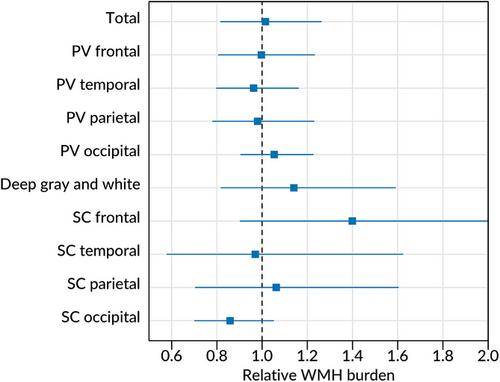
TDP-43-positive status was not associated with WMH burden overall because opposite effects were seen based on AD-TDP typing. Despite similar antemortem vascular risk factors and postmortem vascular pathologies, AD-TDP type-α showed greater total and regional WMH burden (particularly in subcortical frontotemporal and basal ganglia regions) than TDP-43 negatives and AD-TDP type-β.
DISCUSSION
AD-TDP types may have different WMH pathomechanisms, with type-α having associations more like FTLD-TDP than AD.
Highlights
In transactive response DNA-binding protein 43 (TDP-43) pathology in Alzheimer's disease (AD-TDP), TDP-43 status alone is not associated with total or regional WMH burden
AD-TDP type-α shows greater total, frontotemporal subcortical, and basal ganglia white matter hyperintensities (WMHs)
AD-TDP type-β shows less total and subcortical occipital WMHs
AD-TDP type-α effect on WMH burden closely mimics the effects of frontotemporal lobar degeneration with TDP-43 (FTLD-TDP) rather than AD
Different relationships of AD-TDP types with WMHs suggest different pathomechanisms
期刊介绍:
Alzheimer's & Dementia is a peer-reviewed journal that aims to bridge knowledge gaps in dementia research by covering the entire spectrum, from basic science to clinical trials to social and behavioral investigations. It provides a platform for rapid communication of new findings and ideas, optimal translation of research into practical applications, increasing knowledge across diverse disciplines for early detection, diagnosis, and intervention, and identifying promising new research directions. In July 2008, Alzheimer's & Dementia was accepted for indexing by MEDLINE, recognizing its scientific merit and contribution to Alzheimer's research.





 京公网安备 11010802042870号
京ICP备2023020795号-1
京公网安备 11010802042870号
京ICP备2023020795号-1

 分享
分享
 求助内容:
求助内容: 应助结果提醒方式:
 扫码关注我们
