Samira Amini, Kerstin Oppelt, Olivier Blacque, Mikhail Agrachev, Gunnar Jeschke and Felix Zelder
{"title":"Biomimetic thiyl radical formation from diphenyl disulfide with the low valent Ni(i) state of a cofactor F430 model†","authors":"Samira Amini, Kerstin Oppelt, Olivier Blacque, Mikhail Agrachev, Gunnar Jeschke and Felix Zelder","doi":"10.1039/D4SC08416K","DOIUrl":null,"url":null,"abstract":"<p >Cofactor F430 is a nickel-containing hydrocorphinato complex that plays important roles in the enzymatic formation and oxidation of methane. In methanotrophic bacteria, F430-dependent methyl-coenzyme M reductase (MCR) catalyses the endergonic conversion of the heterodisulfide adduct of coenzymes M and B with methane to methyl-coenzyme M and coenzyme B. In a radical mechanism, the Ni(<small>I</small>)-induced formation of a transient thiyl radical of coenzyme B from the heterodisulfide has been proposed. Herein, we introduce a new semi-artificial Ni-complex derived from vitamin B<small><sub>12</sub></small> as functional model of F430. We demonstrate with electrochemical studies that the low valent Ni(<small>I</small>) complex cleaves the biomimetic model compound diphenyl disulfide into approx. 0.5 equivalents of thiophenol and a transient thiophenyl radical at a potential of −1.65 V <em>vs.</em> Fc/Fc<small><sup>+</sup></small>. Thiyl radicals are trapped in solution with phenylacetylene as thiophenyl-substituted olefins, but also lead to degradation of the Ni-complex.</p>","PeriodicalId":9909,"journal":{"name":"Chemical Science","volume":" 10","pages":" 4290-4294"},"PeriodicalIF":7.4000,"publicationDate":"2025-01-20","publicationTypes":"Journal Article","fieldsOfStudy":null,"isOpenAccess":false,"openAccessPdf":"https://pubs.rsc.org/en/content/articlepdf/2025/sc/d4sc08416k?page=search","citationCount":"0","resultStr":null,"platform":"Semanticscholar","paperid":null,"PeriodicalName":"Chemical Science","FirstCategoryId":"92","ListUrlMain":"https://pubs.rsc.org/en/content/articlelanding/2025/sc/d4sc08416k","RegionNum":1,"RegionCategory":"化学","ArticlePicture":[],"TitleCN":null,"AbstractTextCN":null,"PMCID":null,"EPubDate":"","PubModel":"","JCR":"Q1","JCRName":"CHEMISTRY, MULTIDISCIPLINARY","Score":null,"Total":0}
引用次数: 0
Abstract
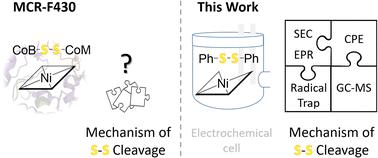
Cofactor F430 is a nickel-containing hydrocorphinato complex that plays important roles in the enzymatic formation and oxidation of methane. In methanotrophic bacteria, F430-dependent methyl-coenzyme M reductase (MCR) catalyses the endergonic conversion of the heterodisulfide adduct of coenzymes M and B with methane to methyl-coenzyme M and coenzyme B. In a radical mechanism, the Ni(I)-induced formation of a transient thiyl radical of coenzyme B from the heterodisulfide has been proposed. Herein, we introduce a new semi-artificial Ni-complex derived from vitamin B12 as functional model of F430. We demonstrate with electrochemical studies that the low valent Ni(I) complex cleaves the biomimetic model compound diphenyl disulfide into approx. 0.5 equivalents of thiophenol and a transient thiophenyl radical at a potential of −1.65 V vs. Fc/Fc+. Thiyl radicals are trapped in solution with phenylacetylene as thiophenyl-substituted olefins, but also lead to degradation of the Ni-complex.
辅因子F430是一种含镍的氢化corphinto复合物,在甲烷的酶促形成和氧化中起重要作用。在甲烷营养细菌中,依赖于f430的甲基辅酶M还原酶(MCR)催化辅酶M和辅酶B的杂二硫加合物与甲烷的内生转化为甲基辅酶M和辅酶B。在自由基机制中,已经提出了Ni(I)诱导由杂二硫形成辅酶B的瞬时巯基自由基。本文介绍了一种从维生素B12中提取的半人工镍配合物作为F430的功能模型。我们通过电化学研究证明,低价Ni(I)配合物将仿生模型化合物二苯基二硫化物切割成大约。0.5等量的噻吩和一个瞬态噻吩自由基,电位为-1.65 V vs. Fc/Fc+。噻基自由基与苯乙炔作为噻吩取代烯烃被困在溶液中,但也导致ni配合物的降解。
期刊介绍:
Chemical Science is a journal that encompasses various disciplines within the chemical sciences. Its scope includes publishing ground-breaking research with significant implications for its respective field, as well as appealing to a wider audience in related areas. To be considered for publication, articles must showcase innovative and original advances in their field of study and be presented in a manner that is understandable to scientists from diverse backgrounds. However, the journal generally does not publish highly specialized research.




 京公网安备 11010802042870号
京ICP备2023020795号-1
京公网安备 11010802042870号
京ICP备2023020795号-1

 分享
分享
 求助内容:
求助内容: 应助结果提醒方式:
 扫码关注我们
