Differential activation of defense responses in cucumbers by adapted versus non-adapted lineages of the cotton-melon aphid

IF 3.8 1区 农林科学 Q1 AGRONOMY Pest Management Science Pub Date : 2025-01-21 DOI:10.1002/ps.8649
Qinglan Yang, Hanwei Kang, Ganxi Ning, Jingjing Feng, Xichen Xiao, Zeyu Wan, James P. Hereward, Yongmo Wang
{"title":"Differential activation of defense responses in cucumbers by adapted versus non-adapted lineages of the cotton-melon aphid","authors":"Qinglan Yang,&nbsp;Hanwei Kang,&nbsp;Ganxi Ning,&nbsp;Jingjing Feng,&nbsp;Xichen Xiao,&nbsp;Zeyu Wan,&nbsp;James P. Hereward,&nbsp;Yongmo Wang","doi":"10.1002/ps.8649","DOIUrl":null,"url":null,"abstract":"<div>\n \n \n <section>\n \n <h3> Background</h3>\n \n <p>The cotton-melon aphid, <i>Aphis gossypii</i> Glover, is a polyphagous pest damaging plants across over 100 families. It has multiple host-specialized lineages, including one colonizing Malvaceae (MA) and one colonizing Cucurbitaceae (CU). The mechanisms underlying these host relationships remain unknown. Here, we compared defensive compounds, gene expressions and aphid susceptibility of cucumbers (<i>Cucumis sativus</i> L.) that were infested with both lineages for up to 14 days.</p>\n </section>\n \n <section>\n \n <h3> Results</h3>\n \n <p>Total jasmonic acid (JA) remained constant in CU-infested cucumbers while increased to a maximum of 19.11 folds at 1 dpi (days post infestation) in MA-infested cucumbers. Total salicylic acid (SA) increased to a maximum of 4.42 folds at 7 dpi in MA-infested cucumbers while increased to a maximum of 2.83 folds at 14 dpi in CU-infested cucumbers. Reactive oxygen species were constantly higher in MA-infested cucumbers than CU-infested cucumbers at each time point. Genes involved in defense signaling, for example, <i>MAPKs</i>, <i>PR-1s</i>, and <i>WRKY</i>, and genes involved in JA and SA biosynthesis, were largely up-regulated in MA-infested cucumbers compared with CU-infested ones. Both lineages exhibited more stylet probing, less phloem ingestion, higher mortality, and less reproduction on MA-infested cucumbers compared with CU-infested ones.</p>\n </section>\n \n <section>\n \n <h3> Conclusion</h3>\n \n <p>MA lineage aphids elicited stronger defenses in cucumbers than the CU lineage aphids. A lack of salivary effectors specific to cucumbers most likely prevents MA lineage aphids from using cucumbers. Identifying lineage-specific elicitors or effectors is therefore expected to unveil the molecular mechanisms of host specificity of this aphid. © 2025 Society of Chemical Industry.</p>\n </section>\n </div>","PeriodicalId":218,"journal":{"name":"Pest Management Science","volume":"81 6","pages":"2830-2839"},"PeriodicalIF":3.8000,"publicationDate":"2025-01-21","publicationTypes":"Journal Article","fieldsOfStudy":null,"isOpenAccess":false,"openAccessPdf":"","citationCount":"0","resultStr":null,"platform":"Semanticscholar","paperid":null,"PeriodicalName":"Pest Management Science","FirstCategoryId":"97","ListUrlMain":"https://scijournals.onlinelibrary.wiley.com/doi/10.1002/ps.8649","RegionNum":1,"RegionCategory":"农林科学","ArticlePicture":[],"TitleCN":null,"AbstractTextCN":null,"PMCID":null,"EPubDate":"","PubModel":"","JCR":"Q1","JCRName":"AGRONOMY","Score":null,"Total":0}
引用次数: 0

Abstract

Background

The cotton-melon aphid, Aphis gossypii Glover, is a polyphagous pest damaging plants across over 100 families. It has multiple host-specialized lineages, including one colonizing Malvaceae (MA) and one colonizing Cucurbitaceae (CU). The mechanisms underlying these host relationships remain unknown. Here, we compared defensive compounds, gene expressions and aphid susceptibility of cucumbers (Cucumis sativus L.) that were infested with both lineages for up to 14 days.

Results

Total jasmonic acid (JA) remained constant in CU-infested cucumbers while increased to a maximum of 19.11 folds at 1 dpi (days post infestation) in MA-infested cucumbers. Total salicylic acid (SA) increased to a maximum of 4.42 folds at 7 dpi in MA-infested cucumbers while increased to a maximum of 2.83 folds at 14 dpi in CU-infested cucumbers. Reactive oxygen species were constantly higher in MA-infested cucumbers than CU-infested cucumbers at each time point. Genes involved in defense signaling, for example, MAPKs, PR-1s, and WRKY, and genes involved in JA and SA biosynthesis, were largely up-regulated in MA-infested cucumbers compared with CU-infested ones. Both lineages exhibited more stylet probing, less phloem ingestion, higher mortality, and less reproduction on MA-infested cucumbers compared with CU-infested ones.

Conclusion

MA lineage aphids elicited stronger defenses in cucumbers than the CU lineage aphids. A lack of salivary effectors specific to cucumbers most likely prevents MA lineage aphids from using cucumbers. Identifying lineage-specific elicitors or effectors is therefore expected to unveil the molecular mechanisms of host specificity of this aphid. © 2025 Society of Chemical Industry.
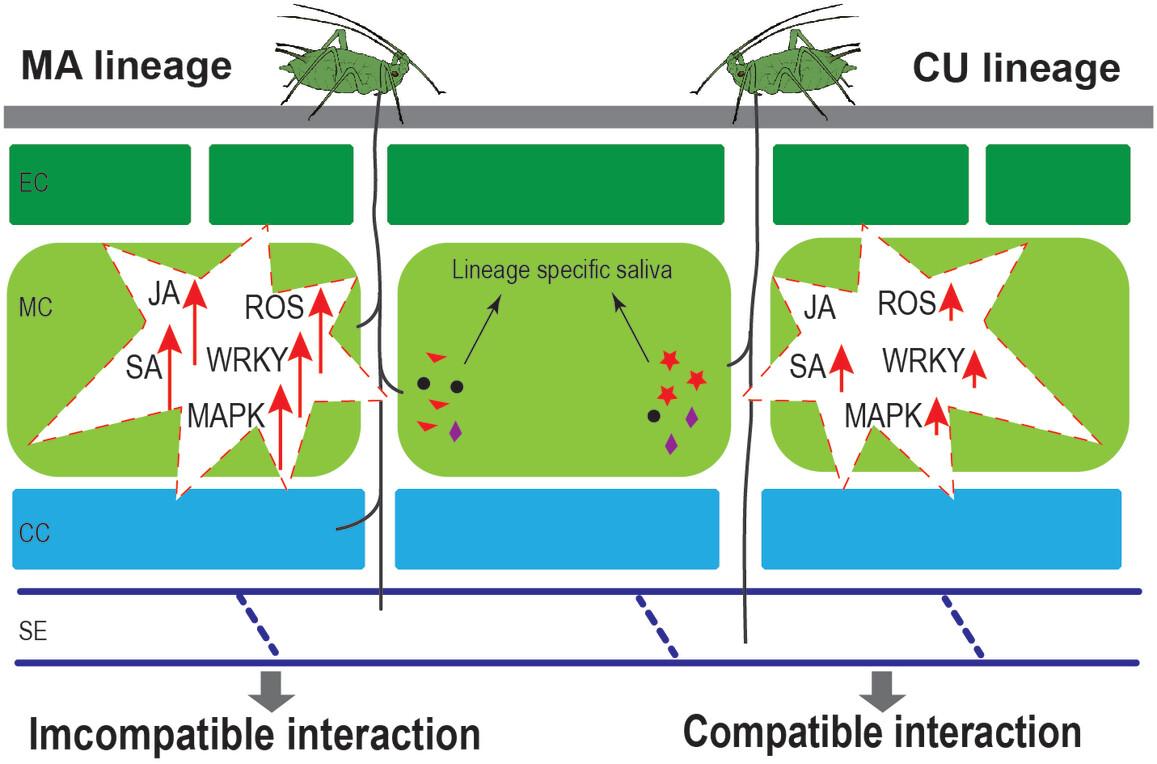
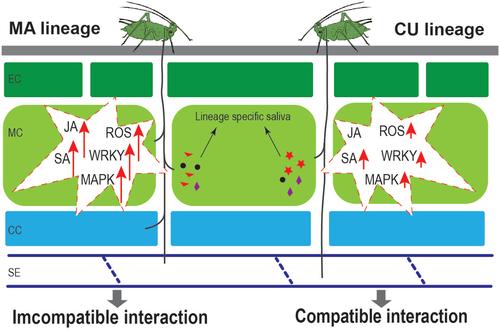
Abstract Image

Abstract Image

Abstract Image

Abstract Image

Abstract Image

查看原文
分享 分享
微信好友 朋友圈 QQ好友 复制链接
本刊更多论文
棉瓜蚜适应与非适应系对黄瓜防御反应的差异激活
棉瓜蚜(Aphis gossypii Glover)是一种多食性害虫,危害100多个科的植物。它有多个寄主特化谱系,包括一个定殖Malvaceae (MA)和一个定殖葫芦科(CU)。这些宿主关系背后的机制尚不清楚。在此,我们比较了黄瓜(Cucumis sativus L.)的防御化合物、基因表达和对蚜虫的敏感性,这些黄瓜(Cucumis sativus L.)被这两个谱系侵染长达14天。
本文章由计算机程序翻译,如有差异,请以英文原文为准。
求助全文
约1分钟内获得全文 去求助
来源期刊
Pest Management Science
Pest Management Science 农林科学-昆虫学
CiteScore
7.90
自引率
9.80%
发文量
553
审稿时长
4.8 months
期刊介绍: Pest Management Science is the international journal of research and development in crop protection and pest control. Since its launch in 1970, the journal has become the premier forum for papers on the discovery, application, and impact on the environment of products and strategies designed for pest management. Published for SCI by John Wiley & Sons Ltd.
期刊最新文献
Potential of endophytic Beauveria bassiana against Coraebus (Coleoptera: Buprestidae) oak borers. Artificial shelters as dual-purpose tools for monitoring natural enemies and providing microhabitats in orchards. Residue dynamics and metabolic pathways of sulfoxaflor in Cirsium japonicum var. maackii and Olea europaea L. Molecular co-assembly engineering towards natural tea saponin-based nanopesticides for synergistic enhanced foliar affinity. Cytochrome P450 and glutathione S-transferase may confer bensulfuron-methyl resistance in Cyperus iria.
×
引用
GB/T 7714-2015
复制
MLA
复制
APA
复制
导出至
BibTeX EndNote RefMan NoteFirst NoteExpress
×
×
提示
您的信息不完整,为了账户安全,请先补充。
现在去补充
×
提示
您因"违规操作"
具体请查看互助需知
我知道了
×
提示
现在去查看 取消
×
提示
确定
0
微信
客服QQ
Book学术公众号 扫码关注我们
反馈
×
意见反馈
请填写您的意见或建议
请填写您的手机或邮箱
已复制链接
已复制链接
快去分享给好友吧!
我知道了
×
扫码分享
扫码分享
Book学术官方微信
Book学术文献互助
Book学术文献互助群
群 号:604180095
Book学术
文献互助 智能选刊 最新文献 互助须知 联系我们:info@booksci.cn
Book学术提供免费学术资源搜索服务,方便国内外学者检索中英文文献。致力于提供最便捷和优质的服务体验。
Copyright © 2023 Book学术 All rights reserved.
ghs 京公网安备 11010802042870号 京ICP备2023020795号-1