Diverse lepidopteran insects cause serious damage to plants, and their larvae possess a crucial epidermal barrier against environmental stimuli. Their ultraviolet (UV) resistance is enhanced by accumulating uric acid granules in the epidermis, suggesting that genes involved in this process may be potential targets for lepidopteran pest management.
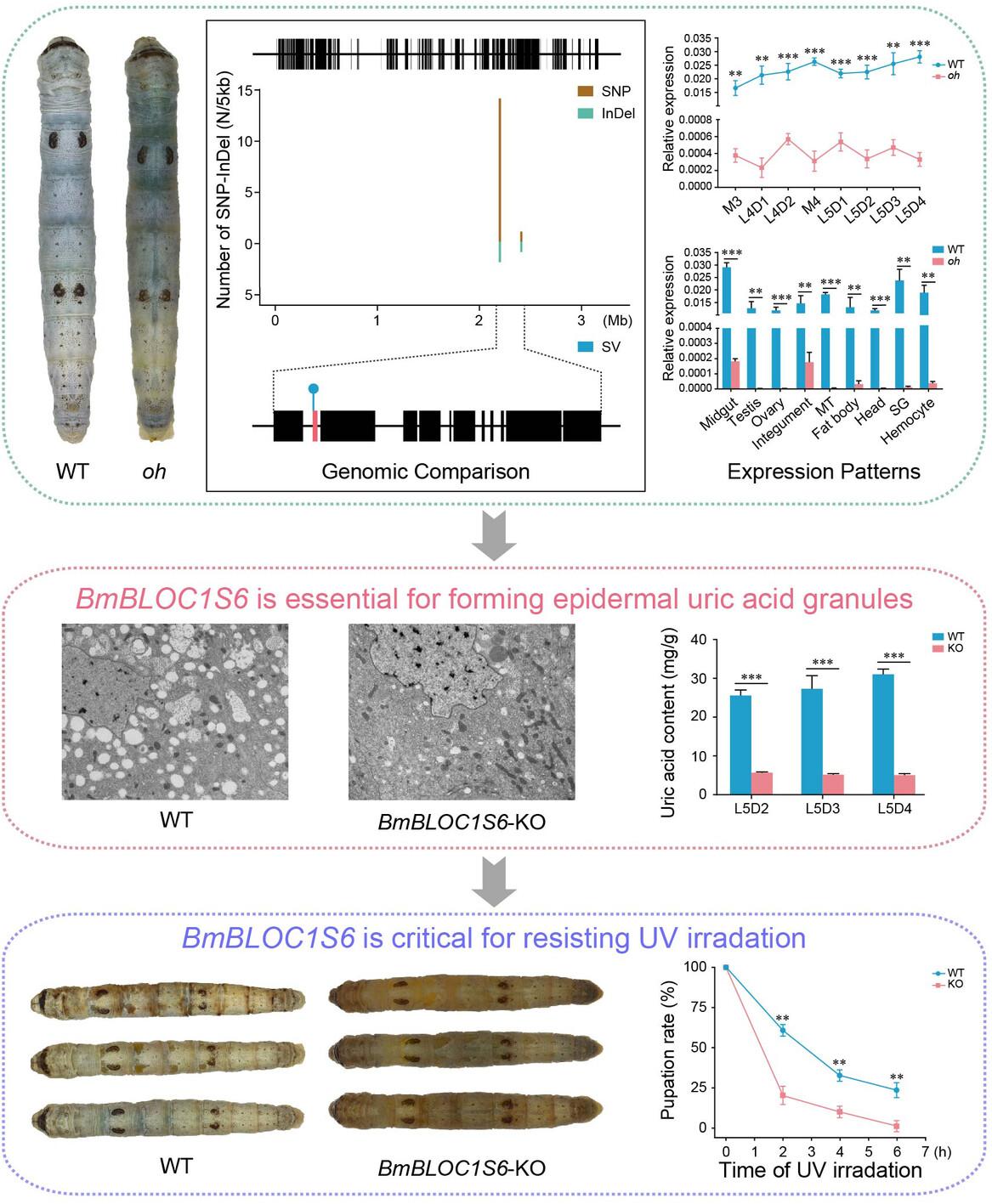
The silkworm pan-genome dataset is a valuable source for studying genomic mutations and phenotype–genotype associations. Hoarfrost translucent (oh) is a recessive silkworm mutant with a translucent larval integument. Using comparative genomic analysis, we found that the oh mutant has an 828-bp deletion in the BmBLOC1S6 genome. BmBLOC1S6 encodes a BLOC-1 complex subunit and is conserved during lepidopteran evolution. Knockout of BmBLOC1S6 replicated the oh phenotype. Furthermore, BmBLOC1S6 knockout and oh larvae are more sensitive to UV irradiation compared to the wild-type. These results revealed that BmBLOC1S6 is essential in forming uric acid granules for silkworm epidermal UV resistance.
Our results showed that BmBLOC1S6 is responsible for the oh phenotype in silkworms and is conserved during lepidopteran evolution. This study may help us better clarify uric acid granules formation in the epidermis, explore their function in UV resistance and identify a potential molecular target for lepidopteran pest control. © 2025 Society of Chemical Industry.






 京公网安备 11010802042870号
京ICP备2023020795号-1
京公网安备 11010802042870号
京ICP备2023020795号-1

 分享
分享
 求助内容:
求助内容: 应助结果提醒方式:
 扫码关注我们
