Dan Lu, Yun-Hui Yu, Yong Yu, Yan-Ran Weng, Jia-Zi She and Yong Ai
{"title":"Enantiomeric Fe(ii)-incorporated organic–inorganic hybrid crystals for energy harvesting†","authors":"Dan Lu, Yun-Hui Yu, Yong Yu, Yan-Ran Weng, Jia-Zi She and Yong Ai","doi":"10.1039/D4QI02865A","DOIUrl":null,"url":null,"abstract":"<p >Hybrid organic–inorganic piezoelectric materials, characterized by their tunable structure and inherent mechanical flexibility, are garnering significant attention for their potential applications in electronic sensors and devices. Herein, we introduce a pair of Fe(<small>II</small>)-incorporated hybrid enantiomeric piezoelectric materials, designed as (<em>R</em>/<em>S</em>-3-hydroxyquinuclidium)<small><sub>2</sub></small>FeCl<small><sub>4</sub></small> [(<em>R</em>/<em>S</em>-HQ)<small><sub>2</sub></small>FeCl<small><sub>4</sub></small>]. The enantiomers show a piezoelectric coefficient (<em>d</em><small><sub>33</sub></small>) of 21 pC N<small><sup>−1</sup></small> and a high piezoelectric voltage coefficient (<em>g</em><small><sub>33</sub></small>) of 408 × 10<small><sup>−3</sup></small> V m N<small><sup>−1</sup></small>, surpassing that of the conventional piezoelectric polymer PVDF. Additionally, (<em>R</em>/<em>S</em>-HQ)<small><sub>2</sub></small>FeCl<small><sub>4</sub></small> demonstrates significant dielectric permittivity switching and excellent cycling stability. Moreover, in a piezoelectric generation device, this material produces a peak-to-peak output voltage of approximately 2.0 V and shows a small deviation of only ±0.1 V after 60 days, confirming its long-term excellent output stability. This work highlights its considerable potential for integration into self-powered low-voltage electronic devices and energy harvesting systems.</p>","PeriodicalId":79,"journal":{"name":"Inorganic Chemistry Frontiers","volume":" 6","pages":" 2387-2394"},"PeriodicalIF":6.4000,"publicationDate":"2025-01-22","publicationTypes":"Journal Article","fieldsOfStudy":null,"isOpenAccess":false,"openAccessPdf":"","citationCount":"0","resultStr":null,"platform":"Semanticscholar","paperid":null,"PeriodicalName":"Inorganic Chemistry Frontiers","FirstCategoryId":"92","ListUrlMain":"https://pubs.rsc.org/en/content/articlelanding/2025/qi/d4qi02865a","RegionNum":1,"RegionCategory":"化学","ArticlePicture":[],"TitleCN":null,"AbstractTextCN":null,"PMCID":null,"EPubDate":"","PubModel":"","JCR":"Q1","JCRName":"CHEMISTRY, INORGANIC & NUCLEAR","Score":null,"Total":0}
引用次数: 0
Abstract
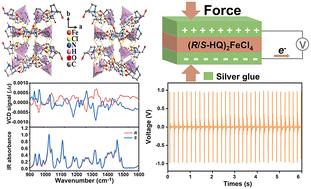
Hybrid organic–inorganic piezoelectric materials, characterized by their tunable structure and inherent mechanical flexibility, are garnering significant attention for their potential applications in electronic sensors and devices. Herein, we introduce a pair of Fe(II)-incorporated hybrid enantiomeric piezoelectric materials, designed as (R/S-3-hydroxyquinuclidium)2FeCl4 [(R/S-HQ)2FeCl4]. The enantiomers show a piezoelectric coefficient (d33) of 21 pC N−1 and a high piezoelectric voltage coefficient (g33) of 408 × 10−3 V m N−1, surpassing that of the conventional piezoelectric polymer PVDF. Additionally, (R/S-HQ)2FeCl4 demonstrates significant dielectric permittivity switching and excellent cycling stability. Moreover, in a piezoelectric generation device, this material produces a peak-to-peak output voltage of approximately 2.0 V and shows a small deviation of only ±0.1 V after 60 days, confirming its long-term excellent output stability. This work highlights its considerable potential for integration into self-powered low-voltage electronic devices and energy harvesting systems.
有机-无机杂化压电材料以其结构可调和固有的机械柔性为特点,在能量收集装置中的潜在应用备受关注。本文介绍了一对Fe(II)掺杂杂化对映体压电材料,设计为(R/ s -3-羟基喹啉)2FeCl4 [(R/S-HQ)2FeCl4]。对映体的压电系数(d33)为21 pC/N,压电电压系数(g33)为408 × 10-3 V m N-1,优于传统的压电聚合物PVDF。此外,(R/S-HQ)2FeCl4具有显著的介电常数开关和优良的循环稳定性。此外,在压电产生装置中,该装置产生的峰对峰输出电压约为2.0 V, 60天后显示的小偏差仅为±0.1 V,证实了长期优异的输出稳定性。这项工作突出了它们在集成到自供电的低压电子设备和能量收集系统方面的巨大潜力。



 京公网安备 11010802042870号
京ICP备2023020795号-1
京公网安备 11010802042870号
京ICP备2023020795号-1

 分享
分享
 求助内容:
求助内容: 应助结果提醒方式:
 扫码关注我们
