Yilin Zhu, Rongyuan Zhang, Xu-Min Cai, Liping Zhang, Bo Wu, Haozhe Tan, Kun Zhou, Haoran Wang, Yong Liu, Yumei Luo, Ryan T. K. Kwok, Jacky W. Y. Lam, Zheng Zhao, Cuiping Yao, Ben Zhong Tang
{"title":"Acceptor Elongation Boosted Intersystem Crossing Affords Efficient NIR Type-I and AIE-Active Photosensitizers for Targeting Ferroptosis-Based Cancer Therapy","authors":"Yilin Zhu, Rongyuan Zhang, Xu-Min Cai, Liping Zhang, Bo Wu, Haozhe Tan, Kun Zhou, Haoran Wang, Yong Liu, Yumei Luo, Ryan T. K. Kwok, Jacky W. Y. Lam, Zheng Zhao, Cuiping Yao, Ben Zhong Tang","doi":"10.1002/adhm.202404505","DOIUrl":null,"url":null,"abstract":"<p>Photosensitizers (PSs) featuring type I reactive oxygen species (ROS) generation and aggregation-induced emission (AIE) activity offer a promising solution to achieve non-invasive and precise theranostics. However, the reported AIE luminogens (AIEgens) with both AIE characteristic and strong type-I ROS generation are still scarce and the structure-property relationship is still unclear. Herein, an innovative acceptor elongation boosted intersystem crossing (AEBIC) design strategy has been proposed to endow the AIEgen strong type-I ROS producibility. The results indicate that the obtained AIEgen exhibit type-I ROS and aggregation-enhanced ROS efficacy, which has been verified by both experimental and theoretical results. Mechanistic study reveal that the acceptor elongation has promoted a dual-channel intersystem crossing pathway to enhance the intersystem crossing (ISC) process due to the differences in triplet configurations, which can be further amplified by aggregation. The afforded type-I AIE-PS show lipid droplet-anchored characteristic and can induce the ferroptosis through destroying the cellular redox homeostasis and increasing lethal levels of lipid peroxidation. Finally, targeting ferroptosis-based cancer therapy can be realized with excellent anti-tumor effect.</p>","PeriodicalId":113,"journal":{"name":"Advanced Healthcare Materials","volume":"14 7","pages":""},"PeriodicalIF":9.6000,"publicationDate":"2025-01-19","publicationTypes":"Journal Article","fieldsOfStudy":null,"isOpenAccess":false,"openAccessPdf":"","citationCount":"0","resultStr":null,"platform":"Semanticscholar","paperid":null,"PeriodicalName":"Advanced Healthcare Materials","FirstCategoryId":"5","ListUrlMain":"https://advanced.onlinelibrary.wiley.com/doi/10.1002/adhm.202404505","RegionNum":2,"RegionCategory":"医学","ArticlePicture":[],"TitleCN":null,"AbstractTextCN":null,"PMCID":null,"EPubDate":"","PubModel":"","JCR":"Q1","JCRName":"ENGINEERING, BIOMEDICAL","Score":null,"Total":0}
引用次数: 0
Abstract
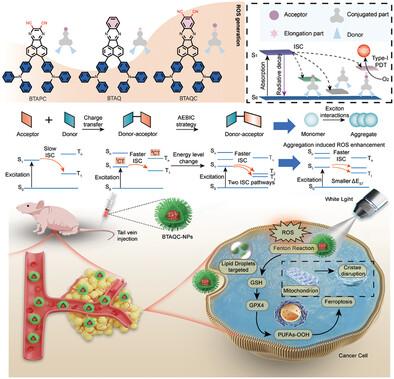
Photosensitizers (PSs) featuring type I reactive oxygen species (ROS) generation and aggregation-induced emission (AIE) activity offer a promising solution to achieve non-invasive and precise theranostics. However, the reported AIE luminogens (AIEgens) with both AIE characteristic and strong type-I ROS generation are still scarce and the structure-property relationship is still unclear. Herein, an innovative acceptor elongation boosted intersystem crossing (AEBIC) design strategy has been proposed to endow the AIEgen strong type-I ROS producibility. The results indicate that the obtained AIEgen exhibit type-I ROS and aggregation-enhanced ROS efficacy, which has been verified by both experimental and theoretical results. Mechanistic study reveal that the acceptor elongation has promoted a dual-channel intersystem crossing pathway to enhance the intersystem crossing (ISC) process due to the differences in triplet configurations, which can be further amplified by aggregation. The afforded type-I AIE-PS show lipid droplet-anchored characteristic and can induce the ferroptosis through destroying the cellular redox homeostasis and increasing lethal levels of lipid peroxidation. Finally, targeting ferroptosis-based cancer therapy can be realized with excellent anti-tumor effect.
期刊介绍:
Advanced Healthcare Materials, a distinguished member of the esteemed Advanced portfolio, has been dedicated to disseminating cutting-edge research on materials, devices, and technologies for enhancing human well-being for over ten years. As a comprehensive journal, it encompasses a wide range of disciplines such as biomaterials, biointerfaces, nanomedicine and nanotechnology, tissue engineering, and regenerative medicine.





 京公网安备 11010802042870号
京ICP备2023020795号-1
京公网安备 11010802042870号
京ICP备2023020795号-1

 分享
分享
 求助内容:
求助内容: 应助结果提醒方式:
 扫码关注我们
