Quantitative Assessment of Microbial Transmission onto Environmental Surfaces Using Thermoresponsive Gelatin Hydrogels as a Finger Mimetic under In Situ-Mimicking Conditions
Mihyun Lee, Luzia Wiesli, Frank Schreiber, Angela Ivask, Qun Ren
{"title":"Quantitative Assessment of Microbial Transmission onto Environmental Surfaces Using Thermoresponsive Gelatin Hydrogels as a Finger Mimetic under In Situ-Mimicking Conditions","authors":"Mihyun Lee, Luzia Wiesli, Frank Schreiber, Angela Ivask, Qun Ren","doi":"10.1002/adhm.202403790","DOIUrl":null,"url":null,"abstract":"<p>Surface-mediated transmission of pathogens plays a key role in healthcare-associated infections. However, proper techniques for its quantitative analysis are lacking, making it challenging to develop novel antimicrobial and anti-fouling surfaces to reduce pathogen spread via environmental surfaces. This study demonstrates a gelatin hydrogel-based touch transfer test, the HydroTouch test, to evaluate pathogen transmission on high-touch surfaces under semi-dry conditions. The HydroTouch test employs gelatin as a finger mimetic, facilitating testing with pathogenic bacteria under controlled conditions. The thermoresponsive sol–gel transition of gelatin allows easy recovery and quantification of bacteria before and after testing. The HydroTouch test demonstrates that methicillin-resistant <i>Staphylococcus aureus</i> has a high transmission efficiency of ≈16% onto stainless steel, compared to <3% for <i>Escherichia coli</i> or <i>Pseudomonas aeruginosa</i>. Polyurethane surfaces exhibit strong resistance to bacterial contamination with a transmission efficiency of ≈0.6%, while polytetrafluoroethylene shows a transmission efficiency approximately four times higher than polyurethane. Additionally, quaternary ammonium-based antimicrobial coatings reduce the transmission efficiency of live bacteria on stainless steel to ≈4% of the original level. The HydroTouch test provides a reliable method for assessing pathogen transmission on various surfaces under semi-dry settings, supporting the development of effective antimicrobial, anti-transmission coatings to reduce healthcare-associated infections.</p>","PeriodicalId":113,"journal":{"name":"Advanced Healthcare Materials","volume":"14 6","pages":""},"PeriodicalIF":9.6000,"publicationDate":"2025-01-15","publicationTypes":"Journal Article","fieldsOfStudy":null,"isOpenAccess":false,"openAccessPdf":"https://onlinelibrary.wiley.com/doi/epdf/10.1002/adhm.202403790","citationCount":"0","resultStr":null,"platform":"Semanticscholar","paperid":null,"PeriodicalName":"Advanced Healthcare Materials","FirstCategoryId":"5","ListUrlMain":"https://advanced.onlinelibrary.wiley.com/doi/10.1002/adhm.202403790","RegionNum":2,"RegionCategory":"医学","ArticlePicture":[],"TitleCN":null,"AbstractTextCN":null,"PMCID":null,"EPubDate":"","PubModel":"","JCR":"Q1","JCRName":"ENGINEERING, BIOMEDICAL","Score":null,"Total":0}
引用次数: 0
Abstract
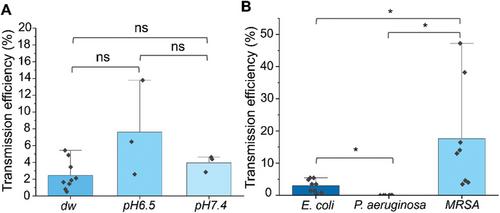
Surface-mediated transmission of pathogens plays a key role in healthcare-associated infections. However, proper techniques for its quantitative analysis are lacking, making it challenging to develop novel antimicrobial and anti-fouling surfaces to reduce pathogen spread via environmental surfaces. This study demonstrates a gelatin hydrogel-based touch transfer test, the HydroTouch test, to evaluate pathogen transmission on high-touch surfaces under semi-dry conditions. The HydroTouch test employs gelatin as a finger mimetic, facilitating testing with pathogenic bacteria under controlled conditions. The thermoresponsive sol–gel transition of gelatin allows easy recovery and quantification of bacteria before and after testing. The HydroTouch test demonstrates that methicillin-resistant Staphylococcus aureus has a high transmission efficiency of ≈16% onto stainless steel, compared to <3% for Escherichia coli or Pseudomonas aeruginosa. Polyurethane surfaces exhibit strong resistance to bacterial contamination with a transmission efficiency of ≈0.6%, while polytetrafluoroethylene shows a transmission efficiency approximately four times higher than polyurethane. Additionally, quaternary ammonium-based antimicrobial coatings reduce the transmission efficiency of live bacteria on stainless steel to ≈4% of the original level. The HydroTouch test provides a reliable method for assessing pathogen transmission on various surfaces under semi-dry settings, supporting the development of effective antimicrobial, anti-transmission coatings to reduce healthcare-associated infections.
期刊介绍:
Advanced Healthcare Materials, a distinguished member of the esteemed Advanced portfolio, has been dedicated to disseminating cutting-edge research on materials, devices, and technologies for enhancing human well-being for over ten years. As a comprehensive journal, it encompasses a wide range of disciplines such as biomaterials, biointerfaces, nanomedicine and nanotechnology, tissue engineering, and regenerative medicine.





 京公网安备 11010802042870号
京ICP备2023020795号-1
京公网安备 11010802042870号
京ICP备2023020795号-1

 分享
分享
 求助内容:
求助内容: 应助结果提醒方式:
 扫码关注我们
