{"title":"Dynamic G-Quadruplexes in the Rous Sarcoma Virus Genome: Scaffolds for Protein Interaction and Potential Anti-Viral Targets","authors":"Debopriya Bose, Suman Panda, Nilanjan Banerjee, Subhrangsu Chatterjee","doi":"10.1002/cbic.202400941","DOIUrl":null,"url":null,"abstract":"<p>Summarising the study, RSV is an important pathogen that causes oncogenic transformation in its host via the action of a protein kinase that it expresses. The RSV genome is reverse-transcribed into its complementary DNA, which then integrates into the host genome. This DNA thereafter serves as a template for transcription to manufacture viral proteins. The viral life cycle can, therefore, be inhibited if the functional elements of this DNA are altered. In this aspect, G4s may play an important role due to their involvement in hijacking the host machinery. Interestingly, the RSV-DNA contains multiple probable G4 forming elements, among which the sequences with the highest G4 forming propensity are located within the GAG and POL genes. Additionally, a sequence within the SRC oncogene also has G4 forming potential. In this study, we verified the G4 formation in these sequences via various biophysical assays. Further, the structural topology of these G4s has also been studied using computational and biophysical methods. We have established that GG4 forms a parallel G4 structure while PG4 and SG4 form highly dynamic G4s, switching between various structural forms. Such molecular switching behaviour may also aid in the functional properties of these G4s <i>in vivo</i>. However, further studies are required to elucidate the functional properties of these elements. We have also analysed the binding of these G4s to specific small-molecule ligands and the structural changes induced by the binding of Braco-19 on the G4s. Finally, we have observed that the G4 forming sequences in the RSV-DNA are recognised and bound by human nucleolin, which is highly similar in structure to the chicken nucleolin. This suggests that the G4s in the RSV-DNA may be implicated in various biological functions. These studies conclude that G4s are formed in the RSV-DNA at multiple locations, and these G4s show molecular switching properties under physiological conditions. Further, these G4s are also bound by small-molecule ligands and proteins, which induce structural changes. Thus, these G4s may be targetable sites for the control of RSV infection.</p>","PeriodicalId":140,"journal":{"name":"ChemBioChem","volume":"26 9","pages":""},"PeriodicalIF":2.8000,"publicationDate":"2025-01-22","publicationTypes":"Journal Article","fieldsOfStudy":null,"isOpenAccess":false,"openAccessPdf":"","citationCount":"0","resultStr":null,"platform":"Semanticscholar","paperid":null,"PeriodicalName":"ChemBioChem","FirstCategoryId":"99","ListUrlMain":"https://chemistry-europe.onlinelibrary.wiley.com/doi/10.1002/cbic.202400941","RegionNum":4,"RegionCategory":"生物学","ArticlePicture":[],"TitleCN":null,"AbstractTextCN":null,"PMCID":null,"EPubDate":"","PubModel":"","JCR":"Q3","JCRName":"BIOCHEMISTRY & MOLECULAR BIOLOGY","Score":null,"Total":0}
引用次数: 0
Abstract
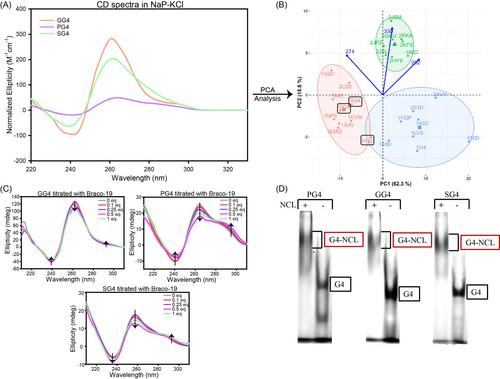
Summarising the study, RSV is an important pathogen that causes oncogenic transformation in its host via the action of a protein kinase that it expresses. The RSV genome is reverse-transcribed into its complementary DNA, which then integrates into the host genome. This DNA thereafter serves as a template for transcription to manufacture viral proteins. The viral life cycle can, therefore, be inhibited if the functional elements of this DNA are altered. In this aspect, G4s may play an important role due to their involvement in hijacking the host machinery. Interestingly, the RSV-DNA contains multiple probable G4 forming elements, among which the sequences with the highest G4 forming propensity are located within the GAG and POL genes. Additionally, a sequence within the SRC oncogene also has G4 forming potential. In this study, we verified the G4 formation in these sequences via various biophysical assays. Further, the structural topology of these G4s has also been studied using computational and biophysical methods. We have established that GG4 forms a parallel G4 structure while PG4 and SG4 form highly dynamic G4s, switching between various structural forms. Such molecular switching behaviour may also aid in the functional properties of these G4s in vivo. However, further studies are required to elucidate the functional properties of these elements. We have also analysed the binding of these G4s to specific small-molecule ligands and the structural changes induced by the binding of Braco-19 on the G4s. Finally, we have observed that the G4 forming sequences in the RSV-DNA are recognised and bound by human nucleolin, which is highly similar in structure to the chicken nucleolin. This suggests that the G4s in the RSV-DNA may be implicated in various biological functions. These studies conclude that G4s are formed in the RSV-DNA at multiple locations, and these G4s show molecular switching properties under physiological conditions. Further, these G4s are also bound by small-molecule ligands and proteins, which induce structural changes. Thus, these G4s may be targetable sites for the control of RSV infection.
期刊介绍:
ChemBioChem (Impact Factor 2018: 2.641) publishes important breakthroughs across all areas at the interface of chemistry and biology, including the fields of chemical biology, bioorganic chemistry, bioinorganic chemistry, synthetic biology, biocatalysis, bionanotechnology, and biomaterials. It is published on behalf of Chemistry Europe, an association of 16 European chemical societies, and supported by the Asian Chemical Editorial Society (ACES).





 京公网安备 11010802042870号
京ICP备2023020795号-1
京公网安备 11010802042870号
京ICP备2023020795号-1

 分享
分享
 求助内容:
求助内容: 应助结果提醒方式:
 扫码关注我们
