Safety and effectiveness in an uncontrolled setting of glucagon-like-peptide-1 receptor agonists in patients with familial partial lipodystrophy: Real-life experience from a national reference network
{"title":"Safety and effectiveness in an uncontrolled setting of glucagon-like-peptide-1 receptor agonists in patients with familial partial lipodystrophy: Real-life experience from a national reference network","authors":"Sophie Lamothe MD, Ines Belalem MS, Marie-Christine Vantyghem MD, Estelle Nobecourt MD, Héléna Mosbah MD, Sophie Béliard MD, Brigitte Delemer MD, Hippolyte Dupuis MD, Paul Vandenbroere MD, Nicolas Scheyer MD, Chloé Amouyal MD, Samy Hadjadj MD, Sonja Janmaat PhD, Corinne Vigouroux MD, Camille Vatier MD","doi":"10.1111/dom.16175","DOIUrl":null,"url":null,"abstract":"<div>\n \n \n <section>\n \n <h3> Aim</h3>\n \n <p>To describe the effects of Glucagon-like peptide-1 receptor agonists (GLP-1RA) in patients with familial partial lipodystrophy (FPLD) assessed in a real-life setting in a national reference network.</p>\n </section>\n \n <section>\n \n <h3> Patients and Methods</h3>\n \n <p>We retrospectively collected clinical and metabolic parameters in patients with FPLD in the French lipodystrophy reference network, who initiated GLP-1RA. Data were recorded before, at one-year (12 ± 6 months) and at the latest follow-up on GLP-1RA therapy (≥18 months).</p>\n </section>\n \n <section>\n \n <h3> Results</h3>\n \n <p>Seventy-six patients (89.4% of women), diagnosed with <i>LMNA</i>-related FPLD2 (<i>n</i> = 57), <i>PPARG</i>-related FPLD3 (<i>n</i> = 4), <i>PLIN1</i>-related FPLD4 (<i>n</i> = 5) or FPLD1 (<i>n</i> = 10) initiated GLP-1RA therapy between 2008 and 2024. Patients were aged a median (IQR) 48 years (34.5–57), body mass index (BMI) was 26.0 kg/m<sup>2</sup> (23.9–29.5), HbA1c 8.3% (7.5–9.3), triglycerides 2.31 mmol/L (1.62–3.88). GLP-1RA were used in addition to previously used antidiabetics, 50% of patients being insulin-treated. After one year with GLP-1RA therapy, BMI, HbA1c and triglycerides significantly decreased to 25.6 kg/m<sup>2</sup> (22.7–29.1), 7.3% (6.6–8.3) and 1.97 mmol/L (1.5–3.2) respectively (<i>p</i> < 0.001, <i>p</i> < 0.001 and <i>p</i> < 0.01, respectively), without significant changes in other antidiabetic and lipid-lowering drugs. Gamma-glutamyl-transferase and alanine-aminotransferase levels also significantly decreased. Effects on HbA1c, BMI and triglycerides persisted in the long term. One case of acute pancreatitis occurred during follow-up, associated with severe hypertriglyceridemia in a non-observant patient. Gastrointestinal symptoms affected 34% of patients, leading to GLP-1RA withdrawal in six patients.</p>\n </section>\n \n <section>\n \n <h3> Conclusion</h3>\n \n <p>GLP-1RA significantly improved BMI, HbA1c and triglycerides in a large majority of patients with FPLD. Larger and prospective controlled studies are warranted for identification of predictive factors and safety.</p>\n </section>\n </div>","PeriodicalId":158,"journal":{"name":"Diabetes, Obesity & Metabolism","volume":"27 4","pages":"1815-1825"},"PeriodicalIF":5.7000,"publicationDate":"2025-01-20","publicationTypes":"Journal Article","fieldsOfStudy":null,"isOpenAccess":false,"openAccessPdf":"https://onlinelibrary.wiley.com/doi/epdf/10.1111/dom.16175","citationCount":"0","resultStr":null,"platform":"Semanticscholar","paperid":null,"PeriodicalName":"Diabetes, Obesity & Metabolism","FirstCategoryId":"3","ListUrlMain":"https://dom-pubs.onlinelibrary.wiley.com/doi/10.1111/dom.16175","RegionNum":2,"RegionCategory":"医学","ArticlePicture":[],"TitleCN":null,"AbstractTextCN":null,"PMCID":null,"EPubDate":"","PubModel":"","JCR":"Q1","JCRName":"ENDOCRINOLOGY & METABOLISM","Score":null,"Total":0}
引用次数: 0
Abstract
Aim
To describe the effects of Glucagon-like peptide-1 receptor agonists (GLP-1RA) in patients with familial partial lipodystrophy (FPLD) assessed in a real-life setting in a national reference network.
Patients and Methods
We retrospectively collected clinical and metabolic parameters in patients with FPLD in the French lipodystrophy reference network, who initiated GLP-1RA. Data were recorded before, at one-year (12 ± 6 months) and at the latest follow-up on GLP-1RA therapy (≥18 months).
Results
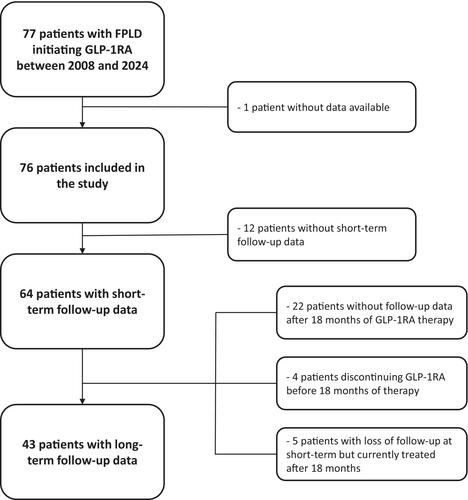
Seventy-six patients (89.4% of women), diagnosed with LMNA-related FPLD2 (n = 57), PPARG-related FPLD3 (n = 4), PLIN1-related FPLD4 (n = 5) or FPLD1 (n = 10) initiated GLP-1RA therapy between 2008 and 2024. Patients were aged a median (IQR) 48 years (34.5–57), body mass index (BMI) was 26.0 kg/m2 (23.9–29.5), HbA1c 8.3% (7.5–9.3), triglycerides 2.31 mmol/L (1.62–3.88). GLP-1RA were used in addition to previously used antidiabetics, 50% of patients being insulin-treated. After one year with GLP-1RA therapy, BMI, HbA1c and triglycerides significantly decreased to 25.6 kg/m2 (22.7–29.1), 7.3% (6.6–8.3) and 1.97 mmol/L (1.5–3.2) respectively (p < 0.001, p < 0.001 and p < 0.01, respectively), without significant changes in other antidiabetic and lipid-lowering drugs. Gamma-glutamyl-transferase and alanine-aminotransferase levels also significantly decreased. Effects on HbA1c, BMI and triglycerides persisted in the long term. One case of acute pancreatitis occurred during follow-up, associated with severe hypertriglyceridemia in a non-observant patient. Gastrointestinal symptoms affected 34% of patients, leading to GLP-1RA withdrawal in six patients.
Conclusion
GLP-1RA significantly improved BMI, HbA1c and triglycerides in a large majority of patients with FPLD. Larger and prospective controlled studies are warranted for identification of predictive factors and safety.
期刊介绍:
Diabetes, Obesity and Metabolism is primarily a journal of clinical and experimental pharmacology and therapeutics covering the interrelated areas of diabetes, obesity and metabolism. The journal prioritises high-quality original research that reports on the effects of new or existing therapies, including dietary, exercise and lifestyle (non-pharmacological) interventions, in any aspect of metabolic and endocrine disease, either in humans or animal and cellular systems. ‘Metabolism’ may relate to lipids, bone and drug metabolism, or broader aspects of endocrine dysfunction. Preclinical pharmacology, pharmacokinetic studies, meta-analyses and those addressing drug safety and tolerability are also highly suitable for publication in this journal. Original research may be published as a main paper or as a research letter.