Alison A Garrett, Taylor H Orellana, Thing Rinda Soong, Taylor A Rives, Sarah E Taylor, Lan Coffman, Ronald Buckanovich, Haider Mahdi, Sushil Beriwal, Paniti Sukumvanich, Rohit Bhargava, Alexander B Olawaiye
{"title":"Adjuvant therapy in early uterine serous carcinoma.","authors":"Alison A Garrett, Taylor H Orellana, Thing Rinda Soong, Taylor A Rives, Sarah E Taylor, Lan Coffman, Ronald Buckanovich, Haider Mahdi, Sushil Beriwal, Paniti Sukumvanich, Rohit Bhargava, Alexander B Olawaiye","doi":"10.1093/aje/kwaf008","DOIUrl":null,"url":null,"abstract":"<p><p>Uterine serous carcinoma (USC) is a rare diagnosis but is associated with high mortality. There are limited data to guide adjuvant treatment decisions in early-stage disease. The purpose of this study is to evaluate the impact of adjuvant therapy on recurrence-free survival (RFS) and overall survival (OS) in early-stage USC. Patients with stage I and II USC treated at a single institution from January 2006 to December 2019 were identified. Demographic, clinicopathologic, treatment, and outcome data were collected. Data were compared using descriptive statistics. Survival analyses were performed using Kaplan-Meier and Cox proportional hazards methods. Ninety-four patients were identified. Median follow-up time was 33.5 months. The median age was 68 years (range, 49-87), the majority of patients were White (n = 78, 83.0%), and the median BMI was 30.7 (range, 14.2-57.3). Minimally invasive surgical staging was performed in 59.6% of cases (n = 56). Most patients had stage IA disease (n = 70, 74.5%). Most patients (n = 79, 84.0%) received adjuvant therapy, and a majority of patients received a combination of systemic chemotherapy and radiation therapy (n = 55, 58.5%), with the most common combination being chemotherapy plus vaginal brachytherapy (n = 42, 44.7%). Most patients (n = 77, 81.9%) remain without evidence of disease, while 17 patients (18.1%) have recurred. Patients receiving 6 cycles of adjuvant chemotherapy experienced improved OS (P = .004) and improved RFS (P = .02) compared to those receiving no adjuvant chemotherapy. Patients with early-stage USC who received 6 cycles of adjuvant chemotherapy had significantly improved OS and RFS when compared to those patients who did not receive adjuvant chemotherapy. This article is part of a Special Collection on Gynecological Cancer.</p>","PeriodicalId":7472,"journal":{"name":"American journal of epidemiology","volume":" ","pages":"198-204"},"PeriodicalIF":4.8000,"publicationDate":"2026-01-08","publicationTypes":"Journal Article","fieldsOfStudy":null,"isOpenAccess":false,"openAccessPdf":"","citationCount":"0","resultStr":null,"platform":"Semanticscholar","paperid":null,"PeriodicalName":"American journal of epidemiology","FirstCategoryId":"3","ListUrlMain":"https://doi.org/10.1093/aje/kwaf008","RegionNum":2,"RegionCategory":"医学","ArticlePicture":[],"TitleCN":null,"AbstractTextCN":null,"PMCID":null,"EPubDate":"","PubModel":"","JCR":"Q1","JCRName":"PUBLIC, ENVIRONMENTAL & OCCUPATIONAL HEALTH","Score":null,"Total":0}
引用次数: 0
Abstract
Uterine serous carcinoma (USC) is a rare diagnosis but is associated with high mortality. There are limited data to guide adjuvant treatment decisions in early-stage disease. The purpose of this study is to evaluate the impact of adjuvant therapy on recurrence-free survival (RFS) and overall survival (OS) in early-stage USC. Patients with stage I and II USC treated at a single institution from January 2006 to December 2019 were identified. Demographic, clinicopathologic, treatment, and outcome data were collected. Data were compared using descriptive statistics. Survival analyses were performed using Kaplan-Meier and Cox proportional hazards methods. Ninety-four patients were identified. Median follow-up time was 33.5 months. The median age was 68 years (range, 49-87), the majority of patients were White (n = 78, 83.0%), and the median BMI was 30.7 (range, 14.2-57.3). Minimally invasive surgical staging was performed in 59.6% of cases (n = 56). Most patients had stage IA disease (n = 70, 74.5%). Most patients (n = 79, 84.0%) received adjuvant therapy, and a majority of patients received a combination of systemic chemotherapy and radiation therapy (n = 55, 58.5%), with the most common combination being chemotherapy plus vaginal brachytherapy (n = 42, 44.7%). Most patients (n = 77, 81.9%) remain without evidence of disease, while 17 patients (18.1%) have recurred. Patients receiving 6 cycles of adjuvant chemotherapy experienced improved OS (P = .004) and improved RFS (P = .02) compared to those receiving no adjuvant chemotherapy. Patients with early-stage USC who received 6 cycles of adjuvant chemotherapy had significantly improved OS and RFS when compared to those patients who did not receive adjuvant chemotherapy. This article is part of a Special Collection on Gynecological Cancer.
期刊介绍:
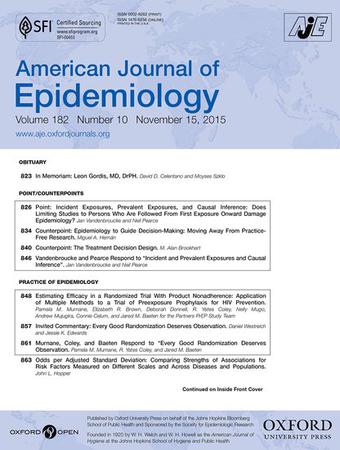
The American Journal of Epidemiology is the oldest and one of the premier epidemiologic journals devoted to the publication of empirical research findings, opinion pieces, and methodological developments in the field of epidemiologic research.
It is a peer-reviewed journal aimed at both fellow epidemiologists and those who use epidemiologic data, including public health workers and clinicians.



 京公网安备 11010802042870号
京ICP备2023020795号-1
京公网安备 11010802042870号
京ICP备2023020795号-1

 分享
分享
 求助内容:
求助内容: 应助结果提醒方式:
 扫码关注我们
