Dorian S. Sneddon, Paul V. Kevorkian and Thomas R. Hoye
{"title":"Rapid (≤25 °C) cycloisomerization of anhydride-tethered triynes to benzynes – origin of a remarkable anhydride linker-induced rate enhancement†","authors":"Dorian S. Sneddon, Paul V. Kevorkian and Thomas R. Hoye","doi":"10.1039/D4SC07232D","DOIUrl":null,"url":null,"abstract":"<p >The hexadehydro-Diels–Alder (HDDA) reaction is a cycloisomerization between a conjugated diyne and a tethered diynophile that generates <em>ortho</em>-benzyne derivatives. Considerable fundamental understanding of aryne reactivity has resulted from this body of research. The multi-yne cycloisomerization substrate is typically pre-formed and the (rate-limiting) closure of this diyne/diynophile pair to produce the isomeric benzyne generally requires thermal input, often requiring reaction temperatures of >100 °C and times of 16–48 h to achieve near-full conversion. We report here that diynoic acids can be dimerized and that the resulting substrate, having a 3-atom anhydride linker (<em>i.e.</em>, O<img>COC<img>O), then undergoes HDDA cyclization within minutes at or below room temperature. This allows for the novel <em>in situ</em> assembly and cyclization of HDDA benzyne precursors in an operationally simple protocol. Experimental kinetic data along with DFT computations are used to identify the source of this surprisingly huge rate acceleration afforded by the anhydride linker: >10<small><sup>7</sup></small> faster than the analogous multi-yne having, instead, a CH<small><sub>2</sub></small>OCH<small><sub>2</sub></small> ether linker.</p>","PeriodicalId":9909,"journal":{"name":"Chemical Science","volume":" 6","pages":" 2898-2906"},"PeriodicalIF":7.4000,"publicationDate":"2025-01-07","publicationTypes":"Journal Article","fieldsOfStudy":null,"isOpenAccess":false,"openAccessPdf":"https://www.ncbi.nlm.nih.gov/pmc/articles/PMC11734507/pdf/","citationCount":"0","resultStr":null,"platform":"Semanticscholar","paperid":null,"PeriodicalName":"Chemical Science","FirstCategoryId":"92","ListUrlMain":"https://pubs.rsc.org/en/content/articlelanding/2025/sc/d4sc07232d","RegionNum":1,"RegionCategory":"化学","ArticlePicture":[],"TitleCN":null,"AbstractTextCN":null,"PMCID":null,"EPubDate":"","PubModel":"","JCR":"Q1","JCRName":"CHEMISTRY, MULTIDISCIPLINARY","Score":null,"Total":0}
引用次数: 0
Abstract
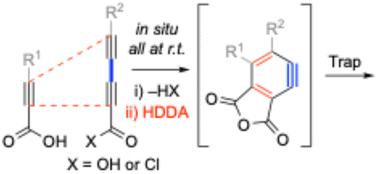
The hexadehydro-Diels–Alder (HDDA) reaction is a cycloisomerization between a conjugated diyne and a tethered diynophile that generates ortho-benzyne derivatives. Considerable fundamental understanding of aryne reactivity has resulted from this body of research. The multi-yne cycloisomerization substrate is typically pre-formed and the (rate-limiting) closure of this diyne/diynophile pair to produce the isomeric benzyne generally requires thermal input, often requiring reaction temperatures of >100 °C and times of 16–48 h to achieve near-full conversion. We report here that diynoic acids can be dimerized and that the resulting substrate, having a 3-atom anhydride linker (i.e., OCOCO), then undergoes HDDA cyclization within minutes at or below room temperature. This allows for the novel in situ assembly and cyclization of HDDA benzyne precursors in an operationally simple protocol. Experimental kinetic data along with DFT computations are used to identify the source of this surprisingly huge rate acceleration afforded by the anhydride linker: >107 faster than the analogous multi-yne having, instead, a CH2OCH2 ether linker.
期刊介绍:
Chemical Science is a journal that encompasses various disciplines within the chemical sciences. Its scope includes publishing ground-breaking research with significant implications for its respective field, as well as appealing to a wider audience in related areas. To be considered for publication, articles must showcase innovative and original advances in their field of study and be presented in a manner that is understandable to scientists from diverse backgrounds. However, the journal generally does not publish highly specialized research.




 京公网安备 11010802042870号
京ICP备2023020795号-1
京公网安备 11010802042870号
京ICP备2023020795号-1

 分享
分享
 求助内容:
求助内容: 应助结果提醒方式:
 扫码关注我们
