{"title":"A computed tomography–based evaluation and comparison of ganglionated plexus targeting techniques for cardioneuroablation","authors":"Léa Benabou MD , Ciro Ascione MD , Bruno Soré BSc , Miloud Cherbi MD , Rodolphe Labrousse MSc , Romain Tixier MD , Benjamin Bouyer MD , Marine Arnaud MD , Samuel Buliard MD , Thomas Pambrun MD , Nicolas Derval MD , Frédéric Sacher MD, PhD , Hubert Cochet MD, PhD , Xavier Bouteiller PhD , Mélèze Hocini MD , Pierre Jaïs MD , Michel Haïssaguerre MD , Josselin Duchateau MD, PhD","doi":"10.1016/j.hrthm.2025.01.013","DOIUrl":null,"url":null,"abstract":"<div><h3>Background</h3><div><span><span>Cardioneuroablation (CNA) targets the ganglionated plexus (GP) to treat neurally mediated syncope, yet a standardized GP identification method is lacking. Postprocessing of </span>cardiac computed tomography (CT) data identifies </span>epicardial fat<span>, thus allowing fat pad identification. Whereas the feasibility of CT-guided CNA is documented, data about GP anatomy and comprehensive evaluations of GP targeting methods remain scarce.</span></div></div><div><h3>Objective</h3><div>This study sought to describe GP anatomy using CT fat pad segmentation and to evaluate the accuracy of different approaches in locating these GPs.</div></div><div><h3>Methods</h3><div><span>The study included 26 CNA or atrial fibrillation ablation patients. GPs were identified through CT-based fat segmentation. CT-derived atrial meshes were merged with corresponding meshes from electroanatomic mapping. Spatial correlation was studied between atrial fractionated </span>electrograms (FEGMs) and epicardial fat pads. Several target areas from the different ablation approaches (FEGM, anatomic, CT-based fat pad identification, and target line) were spatially compared.</div></div><div><h3>Results</h3><div><span>Correlation between epicardial fat pads and signal fragmentation was weak in the left atrium (ρ = 0.01 ± 0.13 [</span><em>P</em> = .73]; ϕ = –0.00 ± 0.10 [<em>P</em><span> = .94]) and even negative in the right atrium (ρ = 0.11 ± 0.09 [</span><em>P</em> < .001]; ϕ = –0.10 ± 0.08 [<em>P</em> < .001]). The FEGM approach was associated with a more extensive ablation area (3.74% vs 17.0% [<em>P</em> < .001] for the anatomic and the FEGM approach for the left atrium and 3.45% vs 9.53% [<em>P</em> < .001] for the anatomic and the FEGM approach for the right atrium).</div></div><div><h3>Conclusion</h3><div>CT-based fat pad segmentation reveals significant interpatient variability in GP anatomy. GPs show low colocalization with signal fragmentation, causing inaccurate localization based on fragmentation alone. An anatomy-focused approach offers a more targeted ablation strategy.</div></div>","PeriodicalId":12886,"journal":{"name":"Heart rhythm","volume":"22 12","pages":"Pages 3171-3179"},"PeriodicalIF":5.7000,"publicationDate":"2025-12-01","publicationTypes":"Journal Article","fieldsOfStudy":null,"isOpenAccess":false,"openAccessPdf":"","citationCount":"0","resultStr":null,"platform":"Semanticscholar","paperid":null,"PeriodicalName":"Heart rhythm","FirstCategoryId":"3","ListUrlMain":"https://www.sciencedirect.com/science/article/pii/S154752712500027X","RegionNum":2,"RegionCategory":"医学","ArticlePicture":[],"TitleCN":null,"AbstractTextCN":null,"PMCID":null,"EPubDate":"2025/1/16 0:00:00","PubModel":"Epub","JCR":"Q1","JCRName":"CARDIAC & CARDIOVASCULAR SYSTEMS","Score":null,"Total":0}
引用次数: 0
Abstract
Background
Cardioneuroablation (CNA) targets the ganglionated plexus (GP) to treat neurally mediated syncope, yet a standardized GP identification method is lacking. Postprocessing of cardiac computed tomography (CT) data identifies epicardial fat, thus allowing fat pad identification. Whereas the feasibility of CT-guided CNA is documented, data about GP anatomy and comprehensive evaluations of GP targeting methods remain scarce.
Objective
This study sought to describe GP anatomy using CT fat pad segmentation and to evaluate the accuracy of different approaches in locating these GPs.
Methods
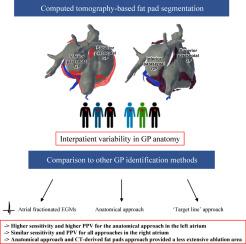
The study included 26 CNA or atrial fibrillation ablation patients. GPs were identified through CT-based fat segmentation. CT-derived atrial meshes were merged with corresponding meshes from electroanatomic mapping. Spatial correlation was studied between atrial fractionated electrograms (FEGMs) and epicardial fat pads. Several target areas from the different ablation approaches (FEGM, anatomic, CT-based fat pad identification, and target line) were spatially compared.
Results
Correlation between epicardial fat pads and signal fragmentation was weak in the left atrium (ρ = 0.01 ± 0.13 [P = .73]; ϕ = –0.00 ± 0.10 [P = .94]) and even negative in the right atrium (ρ = 0.11 ± 0.09 [P < .001]; ϕ = –0.10 ± 0.08 [P < .001]). The FEGM approach was associated with a more extensive ablation area (3.74% vs 17.0% [P < .001] for the anatomic and the FEGM approach for the left atrium and 3.45% vs 9.53% [P < .001] for the anatomic and the FEGM approach for the right atrium).
Conclusion
CT-based fat pad segmentation reveals significant interpatient variability in GP anatomy. GPs show low colocalization with signal fragmentation, causing inaccurate localization based on fragmentation alone. An anatomy-focused approach offers a more targeted ablation strategy.
期刊介绍:
HeartRhythm, the official Journal of the Heart Rhythm Society and the Cardiac Electrophysiology Society, is a unique journal for fundamental discovery and clinical applicability.
HeartRhythm integrates the entire cardiac electrophysiology (EP) community from basic and clinical academic researchers, private practitioners, engineers, allied professionals, industry, and trainees, all of whom are vital and interdependent members of our EP community.
The Heart Rhythm Society is the international leader in science, education, and advocacy for cardiac arrhythmia professionals and patients, and the primary information resource on heart rhythm disorders. Its mission is to improve the care of patients by promoting research, education, and optimal health care policies and standards.




 京公网安备 11010802042870号
京ICP备2023020795号-1
京公网安备 11010802042870号
京ICP备2023020795号-1

 分享
分享
 求助内容:
求助内容: 应助结果提醒方式:
 扫码关注我们
