Hyunglae Kim, Seon A Jeong, Yoonjung Cho, Kyeong Min Kim, Sun Deuk Hwang, Sun Ryoung Choi, Hajeong Lee, Ji Hyun Kim, Su Hyun Kim, Tae Hee Kim, Ho-Seok Koo, Chang-Yun Yoon, Kiwon Kim, Seon Ho Ahn, Hye Eun Yoon, Tae Hyun Ban, Yu Ah Hong, Yong Kyun Kim
{"title":"The impact of body mass index on mortality according to age in hemodialysis patients: an analysis of the Korean Renal Data System.","authors":"Hyunglae Kim, Seon A Jeong, Yoonjung Cho, Kyeong Min Kim, Sun Deuk Hwang, Sun Ryoung Choi, Hajeong Lee, Ji Hyun Kim, Su Hyun Kim, Tae Hee Kim, Ho-Seok Koo, Chang-Yun Yoon, Kiwon Kim, Seon Ho Ahn, Hye Eun Yoon, Tae Hyun Ban, Yu Ah Hong, Yong Kyun Kim","doi":"10.23876/j.krcp.24.160","DOIUrl":null,"url":null,"abstract":"<p><p>The impact of age on the relationship between body mass index (BMI) and all-cause mortality in hemodialysis (HD) patients is not clearly understood. Using data from the Korean Renal Data System (2001-2022), we analyzed 66,129 HD patients, stratified into young (<65 years, n = 24,589), younger-old (65-74 years, n = 17,732), and older-old (≥75 years, n = 23,808) groups. Patients were categorized into BMI quartiles, and survival outcomes were evaluated using Kaplan-Meier curves and event time ratios for the relative change in the survival time. During the follow-up period, 14,360 of the patients (21.7%) died, with a median follow-up of 3.4 years. Kaplan-Meier curves revealed poorer outcomes in lower BMI quartiles across all age groups. The lowest BMI quartile was significantly associated with a shorter survival time compared to the highest BMI quartile, with a 15% reduction in the young group (p = 0.001) and a 12% reduction in the older-old group (p = 0.002). Predicted survival time increases with rising BMI in the young group, but the rate of increase slows in the younger-old group and plateaus in the older-old group after a BMI of 25 kg/m2. Lower BMI correlates with higher mortality, particularly in younger HD patients.</p>","PeriodicalId":17716,"journal":{"name":"Kidney Research and Clinical Practice","volume":" ","pages":"217-227"},"PeriodicalIF":3.8000,"publicationDate":"2025-03-01","publicationTypes":"Journal Article","fieldsOfStudy":null,"isOpenAccess":false,"openAccessPdf":"https://www.ncbi.nlm.nih.gov/pmc/articles/PMC11985308/pdf/","citationCount":"0","resultStr":null,"platform":"Semanticscholar","paperid":null,"PeriodicalName":"Kidney Research and Clinical Practice","FirstCategoryId":"3","ListUrlMain":"https://doi.org/10.23876/j.krcp.24.160","RegionNum":3,"RegionCategory":"医学","ArticlePicture":[],"TitleCN":null,"AbstractTextCN":null,"PMCID":null,"EPubDate":"2025/1/16 0:00:00","PubModel":"Epub","JCR":"Q1","JCRName":"UROLOGY & NEPHROLOGY","Score":null,"Total":0}
引用次数: 0
Abstract
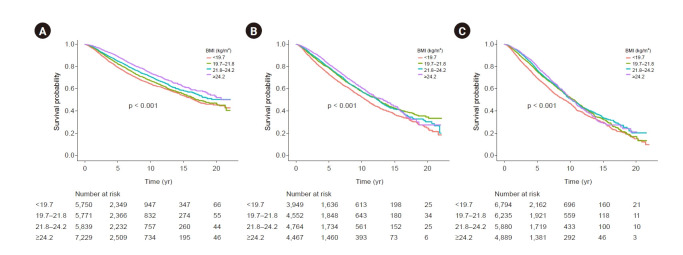
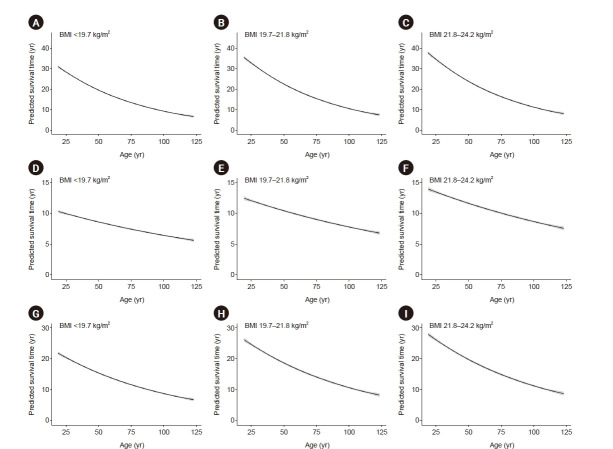
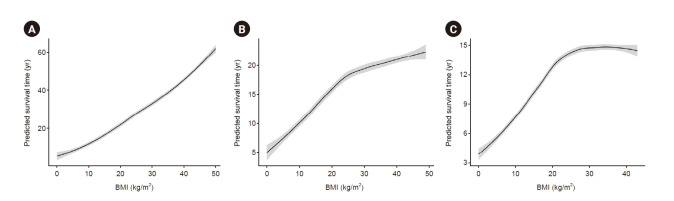
The impact of age on the relationship between body mass index (BMI) and all-cause mortality in hemodialysis (HD) patients is not clearly understood. Using data from the Korean Renal Data System (2001-2022), we analyzed 66,129 HD patients, stratified into young (<65 years, n = 24,589), younger-old (65-74 years, n = 17,732), and older-old (≥75 years, n = 23,808) groups. Patients were categorized into BMI quartiles, and survival outcomes were evaluated using Kaplan-Meier curves and event time ratios for the relative change in the survival time. During the follow-up period, 14,360 of the patients (21.7%) died, with a median follow-up of 3.4 years. Kaplan-Meier curves revealed poorer outcomes in lower BMI quartiles across all age groups. The lowest BMI quartile was significantly associated with a shorter survival time compared to the highest BMI quartile, with a 15% reduction in the young group (p = 0.001) and a 12% reduction in the older-old group (p = 0.002). Predicted survival time increases with rising BMI in the young group, but the rate of increase slows in the younger-old group and plateaus in the older-old group after a BMI of 25 kg/m2. Lower BMI correlates with higher mortality, particularly in younger HD patients.
期刊介绍:
Kidney Research and Clinical Practice (formerly The Korean Journal of Nephrology; ISSN 1975-9460, launched in 1982), the official journal of the Korean Society of Nephrology, is an international, peer-reviewed journal published in English. Its ISO abbreviation is Kidney Res Clin Pract. To provide an efficient venue for dissemination of knowledge and discussion of topics related to basic renal science and clinical practice, the journal offers open access (free submission and free access) and considers articles on all aspects of clinical nephrology and hypertension as well as related molecular genetics, anatomy, pathology, physiology, pharmacology, and immunology. In particular, the journal focuses on translational renal research that helps bridging laboratory discovery with the diagnosis and treatment of human kidney disease. Topics covered include basic science with possible clinical applicability and papers on the pathophysiological basis of disease processes of the kidney. Original researches from areas of intervention nephrology or dialysis access are also welcomed. Major article types considered for publication include original research and reviews on current topics of interest. Accepted manuscripts are granted free online open-access immediately after publication, which permits its users to read, download, copy, distribute, print, search, or link to the full texts of its articles to facilitate access to a broad readership. Circulation number of print copies is 1,600.




 京公网安备 11010802042870号
京ICP备2023020795号-1
京公网安备 11010802042870号
京ICP备2023020795号-1

 分享
分享
 求助内容:
求助内容: 应助结果提醒方式:
 扫码关注我们
