Youhani Samarakoon, Tamas Yelland, Esther Garcia-Gonzalez, Amauri da Silva Justo Junior, Mahnoor Mahmood, Anand Manoharan, Shaun Patterson, Valentina Serafin, Payam A Gammage, Sandra Marmiroli, Christina Halsey, Shehab Ismail, Edward W Roberts
{"title":"UNC119 regulates T-cell receptor signalling in primary T cells and T acute lymphocytic leukaemia.","authors":"Youhani Samarakoon, Tamas Yelland, Esther Garcia-Gonzalez, Amauri da Silva Justo Junior, Mahnoor Mahmood, Anand Manoharan, Shaun Patterson, Valentina Serafin, Payam A Gammage, Sandra Marmiroli, Christina Halsey, Shehab Ismail, Edward W Roberts","doi":"10.26508/lsa.202403066","DOIUrl":null,"url":null,"abstract":"<p><p>T-cell receptor recognition of cognate peptide-MHC leads to the formation of signalling domains and the immunological synapse. Because of the close membrane apposition, there is rapid exclusion of CD45, and therefore LCK activation. Much less is known about whether spatial regulation of the intracellular face dictates LCK activity and TCR signal transduction. Moreover, as LCK is a driver in T acute lymphocytic leukaemia, it is important to understand its regulation. Here, we demonstrate a direct role of the ciliary protein UNC119 in trafficking LCK to the immunological synapse. Inhibiting UNC119 reduces localisation of LCK without impairing LCK phosphorylation and reduces T-cell receptor signal transduction. Although important for initial LCK reorganisation, activated CD8<sup>+</sup> T cells retained their ability to kill target tumour cells when UNC119 was inhibited. UNC119 was also needed to sustain proliferation in patient-derived T-ALL cells. UNC119 may therefore represent a novel therapeutic target in T acute lymphocytic leukaemia, which alters the subcellular localisation of LCK in T acute lymphocytic leukaemia cells but preserves the function of existing cytotoxic lymphocytes.</p>","PeriodicalId":18081,"journal":{"name":"Life Science Alliance","volume":"8 3","pages":""},"PeriodicalIF":2.9000,"publicationDate":"2025-01-15","publicationTypes":"Journal Article","fieldsOfStudy":null,"isOpenAccess":false,"openAccessPdf":"https://www.ncbi.nlm.nih.gov/pmc/articles/PMC11735834/pdf/","citationCount":"0","resultStr":null,"platform":"Semanticscholar","paperid":null,"PeriodicalName":"Life Science Alliance","FirstCategoryId":"99","ListUrlMain":"https://doi.org/10.26508/lsa.202403066","RegionNum":2,"RegionCategory":"生物学","ArticlePicture":[],"TitleCN":null,"AbstractTextCN":null,"PMCID":null,"EPubDate":"2025/3/1 0:00:00","PubModel":"Print","JCR":"Q1","JCRName":"BIOLOGY","Score":null,"Total":0}
引用次数: 0
Abstract
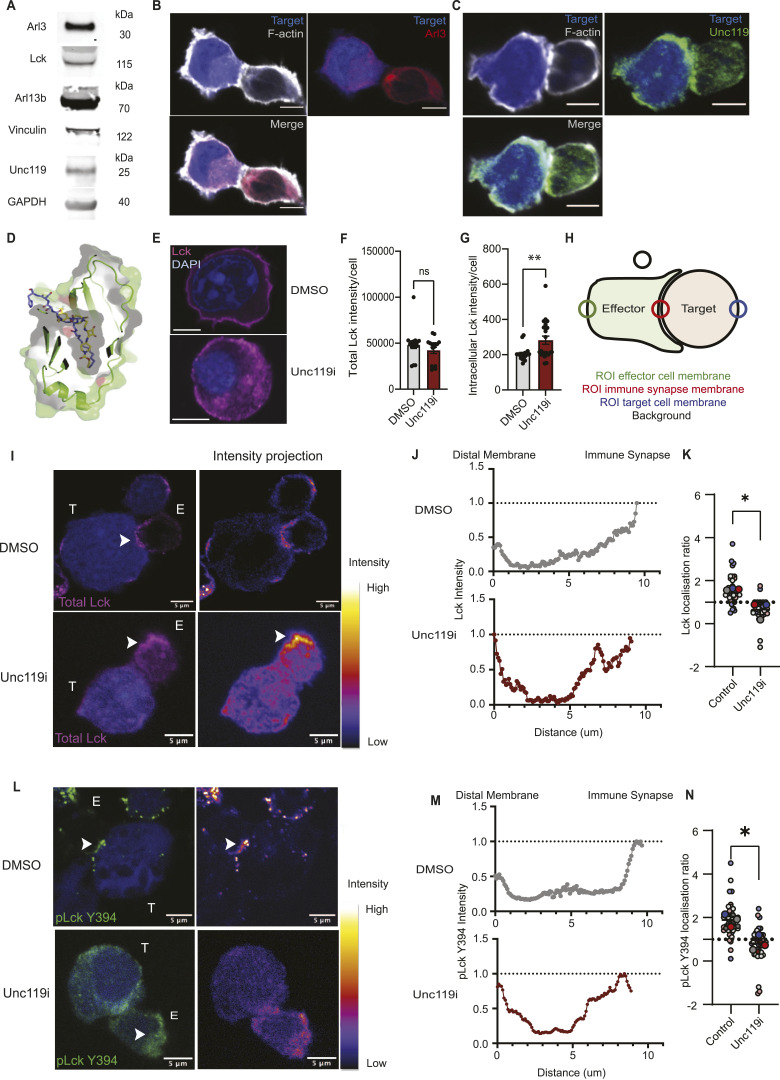
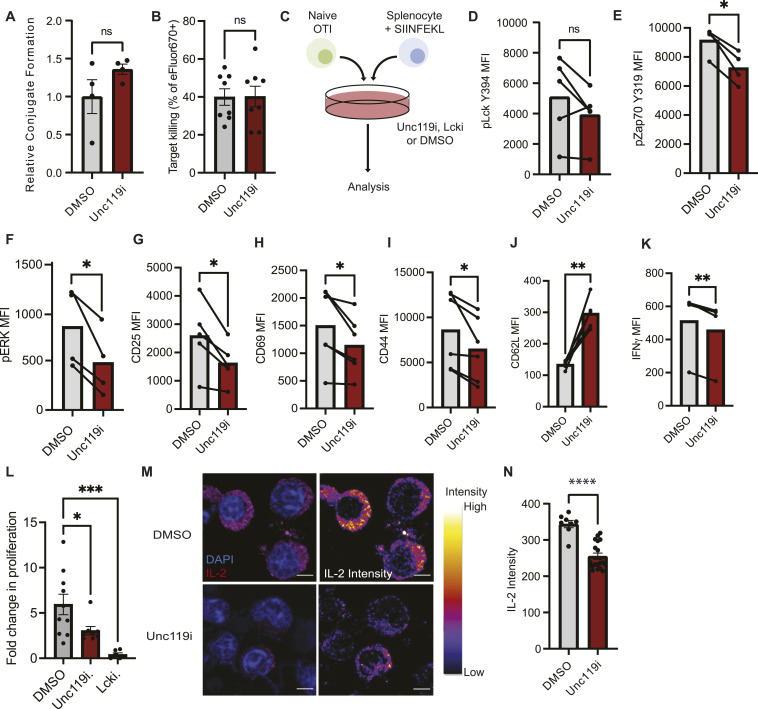
T-cell receptor recognition of cognate peptide-MHC leads to the formation of signalling domains and the immunological synapse. Because of the close membrane apposition, there is rapid exclusion of CD45, and therefore LCK activation. Much less is known about whether spatial regulation of the intracellular face dictates LCK activity and TCR signal transduction. Moreover, as LCK is a driver in T acute lymphocytic leukaemia, it is important to understand its regulation. Here, we demonstrate a direct role of the ciliary protein UNC119 in trafficking LCK to the immunological synapse. Inhibiting UNC119 reduces localisation of LCK without impairing LCK phosphorylation and reduces T-cell receptor signal transduction. Although important for initial LCK reorganisation, activated CD8+ T cells retained their ability to kill target tumour cells when UNC119 was inhibited. UNC119 was also needed to sustain proliferation in patient-derived T-ALL cells. UNC119 may therefore represent a novel therapeutic target in T acute lymphocytic leukaemia, which alters the subcellular localisation of LCK in T acute lymphocytic leukaemia cells but preserves the function of existing cytotoxic lymphocytes.
期刊介绍:
Life Science Alliance is a global, open-access, editorially independent, and peer-reviewed journal launched by an alliance of EMBO Press, Rockefeller University Press, and Cold Spring Harbor Laboratory Press. Life Science Alliance is committed to rapid, fair, and transparent publication of valuable research from across all areas in the life sciences.



 京公网安备 11010802042870号
京ICP备2023020795号-1
京公网安备 11010802042870号
京ICP备2023020795号-1

 分享
分享
 求助内容:
求助内容: 应助结果提醒方式:
 扫码关注我们
