Laura Jefferson, Elin Webster, Su Golder, Katie Barnett, Nicola Greenwood, Veronica Dale, Karen Bloor
{"title":"Barriers to and facilitators of women GPs' careers: a systematic review.","authors":"Laura Jefferson, Elin Webster, Su Golder, Katie Barnett, Nicola Greenwood, Veronica Dale, Karen Bloor","doi":"10.3399/BJGPO.2024.0282","DOIUrl":null,"url":null,"abstract":"<p><strong>Background: </strong>Despite women comprising 52% of full-time equivalent GPs in England, a significant gender pay gap persists (15% after adjustments). Further understanding of the barriers and facilitators impacting women GPs' careers is needed.</p><p><strong>Aim: </strong>To identify and synthesise research evidence exploring barriers to and facilitators of women GPs' careers.</p><p><strong>Design & setting: </strong>Systematic review of qualitative and quantitative studies. Studies were included of GPs conducted in the UK NHS general practice setting.</p><p><strong>Method: </strong>Review methods followed Cochrane and Preferred Reporting Items for Systematic reviews and Meta-Analyses (PRISMA) guidelines to systematically search MEDLINE, Embase, Health Management Information Consortium (HMIC), and Google Scholar to identify studies that explored gendered barriers and facilitators to GP careers. An inductive thematic analysis was used to synthesise the evidence.</p><p><strong>Results: </strong>Twenty-one articles were included in this review, with varied study designs. No relevant intervention studies were identified. There was a lack of recent research evidence; over half of the studies were conducted more than 20 years ago. Most met quality criteria, although there were some problems with reporting and adjustment for potential confounders. Studies found barriers at personal, socio-cultural, and system levels that inhibit women GPs' careers. While some positive changes have been documented across studies that span some 30 years, many challenges remain.</p><p><strong>Conclusion: </strong>Despite general practice being a medical specialty where women outnumber men, barriers at personal, socio-cultural, and system levels continue to inhibit women GPs' careers.</p>","PeriodicalId":36541,"journal":{"name":"BJGP Open","volume":" ","pages":""},"PeriodicalIF":2.0000,"publicationDate":"2025-10-27","publicationTypes":"Journal Article","fieldsOfStudy":null,"isOpenAccess":false,"openAccessPdf":"https://www.ncbi.nlm.nih.gov/pmc/articles/PMC12728865/pdf/","citationCount":"0","resultStr":null,"platform":"Semanticscholar","paperid":null,"PeriodicalName":"BJGP Open","FirstCategoryId":"1085","ListUrlMain":"https://doi.org/10.3399/BJGPO.2024.0282","RegionNum":0,"RegionCategory":null,"ArticlePicture":[],"TitleCN":null,"AbstractTextCN":null,"PMCID":null,"EPubDate":"2025/10/1 0:00:00","PubModel":"Print","JCR":"Q2","JCRName":"PRIMARY HEALTH CARE","Score":null,"Total":0}
引用次数: 0
Abstract
Background: Despite women comprising 52% of full-time equivalent GPs in England, a significant gender pay gap persists (15% after adjustments). Further understanding of the barriers and facilitators impacting women GPs' careers is needed.
Aim: To identify and synthesise research evidence exploring barriers to and facilitators of women GPs' careers.
Design & setting: Systematic review of qualitative and quantitative studies. Studies were included of GPs conducted in the UK NHS general practice setting.
Method: Review methods followed Cochrane and Preferred Reporting Items for Systematic reviews and Meta-Analyses (PRISMA) guidelines to systematically search MEDLINE, Embase, Health Management Information Consortium (HMIC), and Google Scholar to identify studies that explored gendered barriers and facilitators to GP careers. An inductive thematic analysis was used to synthesise the evidence.
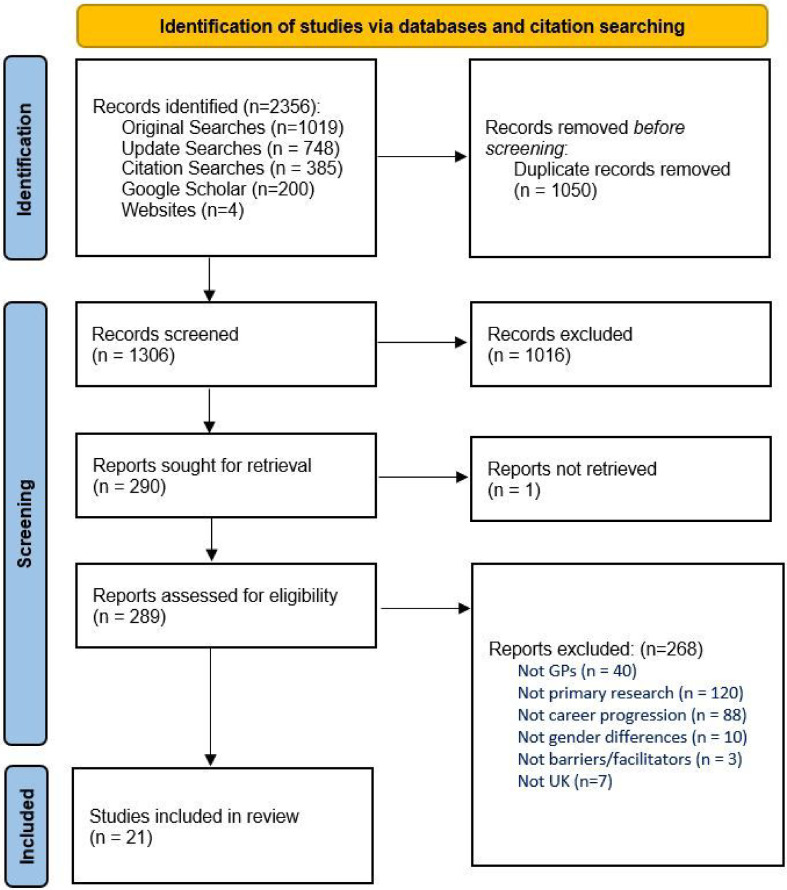
Results: Twenty-one articles were included in this review, with varied study designs. No relevant intervention studies were identified. There was a lack of recent research evidence; over half of the studies were conducted more than 20 years ago. Most met quality criteria, although there were some problems with reporting and adjustment for potential confounders. Studies found barriers at personal, socio-cultural, and system levels that inhibit women GPs' careers. While some positive changes have been documented across studies that span some 30 years, many challenges remain.
Conclusion: Despite general practice being a medical specialty where women outnumber men, barriers at personal, socio-cultural, and system levels continue to inhibit women GPs' careers.




 京公网安备 11010802042870号
京ICP备2023020795号-1
京公网安备 11010802042870号
京ICP备2023020795号-1

 分享
分享
 求助内容:
求助内容: 应助结果提醒方式:
 扫码关注我们
