Umera Saleem, Muhammad Asif Naveed, Muhammad Samiullah, Urwah Tanveer, Shahroz Alam, Ahmed Faraz Zafar, Sohail Safdar
{"title":"Is the curriculum of transfusion medicine in MBBS aligned with practical needs: A point of view of fresh graduates.","authors":"Umera Saleem, Muhammad Asif Naveed, Muhammad Samiullah, Urwah Tanveer, Shahroz Alam, Ahmed Faraz Zafar, Sohail Safdar","doi":"10.4103/ajts.ajts_120_21","DOIUrl":null,"url":null,"abstract":"<p><strong>Objective: </strong>The objective of the study is to assess the satisfaction level of doctors regarding their competence in the blood transfusion process and their reflection on training at the undergraduate level.</p><p><strong>Background: </strong>Transfusion errors due to suboptimal knowledge and lack of training can lead to grave outcomes. Therefore, to optimize patient care, a thorough understanding of transfusion medicine basics is highly imperative for all medical graduates.</p><p><strong>Methodology: </strong>This survey was conducted online through Google forms with a questionnaire consisting of 15 questions. 8 medical colleges (4 government and 4 private) were selected by random cluster sampling technique. Data were analyzed with SPSS version 23.</p><p><strong>Results: </strong>Of 502 participants, 53.8% were females and 69.9% were graduates of public medical colleges. About 84.6% did not receive any formal training on transfusion during graduation. Almost 82% felt that the current curriculum is not designed to meet their practical needs of blood transfusion and 52% agreed that knowledge of transfusion medicine is required for undergraduates. The survey also revealed that 70.5% of participants believed that whole blood is required for most patients and 49.8% did not feel confident to manage transfusion-related complications by themselves.</p><p><strong>Conclusion: </strong>Our survey showed that our undergraduate curriculum is not aligned with the practical transfusion needs of a young doctor. As transfusions are being carried out by these young doctors, this needs to be addressed by revising the current curriculum and incorporating teaching and hands-on training to our medical graduates.</p>","PeriodicalId":42296,"journal":{"name":"Asian Journal of Transfusion Science","volume":"18 2","pages":"230-236"},"PeriodicalIF":0.6000,"publicationDate":"2024-07-01","publicationTypes":"Journal Article","fieldsOfStudy":null,"isOpenAccess":false,"openAccessPdf":"https://www.ncbi.nlm.nih.gov/pmc/articles/PMC11734779/pdf/","citationCount":"0","resultStr":null,"platform":"Semanticscholar","paperid":null,"PeriodicalName":"Asian Journal of Transfusion Science","FirstCategoryId":"1085","ListUrlMain":"https://doi.org/10.4103/ajts.ajts_120_21","RegionNum":0,"RegionCategory":null,"ArticlePicture":[],"TitleCN":null,"AbstractTextCN":null,"PMCID":null,"EPubDate":"2022/5/26 0:00:00","PubModel":"Epub","JCR":"Q4","JCRName":"HEMATOLOGY","Score":null,"Total":0}
引用次数: 0
Abstract
Objective: The objective of the study is to assess the satisfaction level of doctors regarding their competence in the blood transfusion process and their reflection on training at the undergraduate level.
Background: Transfusion errors due to suboptimal knowledge and lack of training can lead to grave outcomes. Therefore, to optimize patient care, a thorough understanding of transfusion medicine basics is highly imperative for all medical graduates.
Methodology: This survey was conducted online through Google forms with a questionnaire consisting of 15 questions. 8 medical colleges (4 government and 4 private) were selected by random cluster sampling technique. Data were analyzed with SPSS version 23.
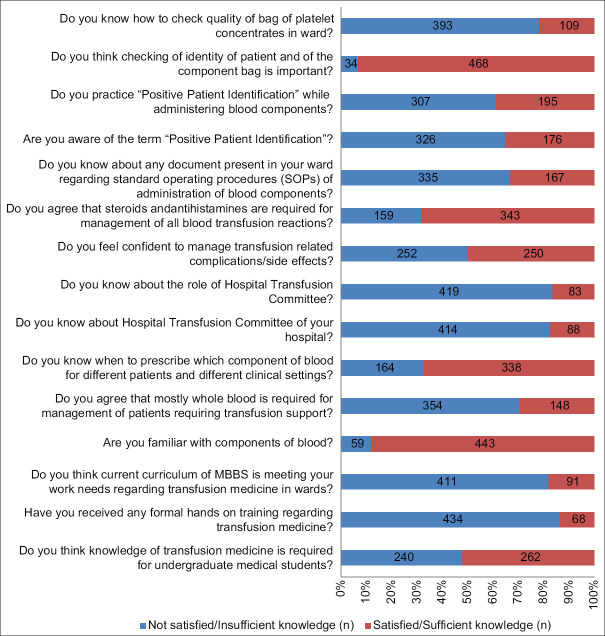
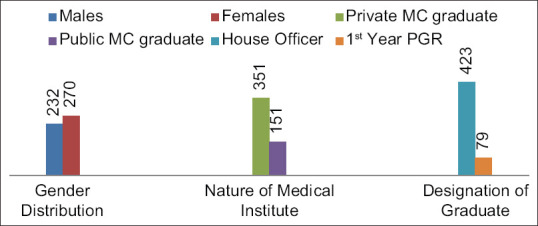
Results: Of 502 participants, 53.8% were females and 69.9% were graduates of public medical colleges. About 84.6% did not receive any formal training on transfusion during graduation. Almost 82% felt that the current curriculum is not designed to meet their practical needs of blood transfusion and 52% agreed that knowledge of transfusion medicine is required for undergraduates. The survey also revealed that 70.5% of participants believed that whole blood is required for most patients and 49.8% did not feel confident to manage transfusion-related complications by themselves.
Conclusion: Our survey showed that our undergraduate curriculum is not aligned with the practical transfusion needs of a young doctor. As transfusions are being carried out by these young doctors, this needs to be addressed by revising the current curriculum and incorporating teaching and hands-on training to our medical graduates.
目的:本研究的目的是评估医生对其输血过程能力的满意度及其对本科阶段培训的反思。背景:由于知识不足和缺乏培训而导致的输血错误可能导致严重的后果。因此,为了优化患者护理,全面了解输血医学基础知识对所有医学毕业生来说都是非常必要的。调查方法:本调查采用谷歌在线表格进行,共15个问题。采用随机整群抽样方法,选取8所医学院校(4所公立,4所民办)。数据采用SPSS version 23进行分析。结果:502名参与者中,女性占53.8%,公立医学院毕业生占69.9%。约84.6%的人在毕业时没有接受过任何正规的输血培训。近82%的人认为目前的课程设计不能满足他们对输血的实际需求,52%的人认为输血医学知识是本科生必须具备的。调查还显示,70.5%的参与者认为大多数患者需要全血,49.8%的参与者对自己处理输血相关并发症没有信心。结论:我们的调查显示,我们的本科课程与年轻医生的实际输血需求不一致。由于输血是由这些年轻的医生进行的,这需要通过修改目前的课程来解决,并将教学和实践培训纳入我们的医学毕业生。




 京公网安备 11010802042870号
京ICP备2023020795号-1
京公网安备 11010802042870号
京ICP备2023020795号-1

 分享
分享
 求助内容:
求助内容: 应助结果提醒方式:
 扫码关注我们
