Nicoletta Inverardi, Maria F. Serafim, Anthony Marzouca, Keita Fujino, Matheus Ferreira, Mehmet D. Asik, Amita Sekar, Orhun K. Muratoglu and Ebru Oral
{"title":"Synergistic antibacterial drug elution from UHMWPE for load-bearing implants†","authors":"Nicoletta Inverardi, Maria F. Serafim, Anthony Marzouca, Keita Fujino, Matheus Ferreira, Mehmet D. Asik, Amita Sekar, Orhun K. Muratoglu and Ebru Oral","doi":"10.1039/D4TB02672A","DOIUrl":null,"url":null,"abstract":"<p >Total joint replacement is a successful procedure for restoring the patient's musculoskeletal mobility and quality of life, but it carries the risk of severe peri-prosthetic joint infections (PJI) and is accompanied by post-operative pain. Cocktails of multiple drugs are often used for prevention/treatment of PJI and for addressing pain. Local drug delivery systems are promising for improving the outcome of the treatment and decreasing the side effects of systemic drugs. To this end, the ultra-high molecular weight polyethylene (UHMWPE) bearing surface of the joint implant is here proposed as a platform for simultaneous release of multiple therapeutics. The combined use of non-antibiotic drugs and antibiotics, and their incorporation into UHMWPE allows to obtain novel antibacterial implant materials. The combined elution of analgesics and antibiotics from UHMWPE is found to be synergistically effective in eradicating <em>Staphylococcus aureus</em>, as the non-antibiotic compound significantly enhances the antibacterial activity of the antibiotic. The drug properties and the employed method for their incorporation into UHMWPE are found to dictate the morphology, thus the mechanical properties of the resulting material. By adopting various fabrication methods, novel formulations showing an enhanced antibacterial activity and outstanding mechanical properties are here proposed to amplify the functionality of polymeric implant materials.</p>","PeriodicalId":83,"journal":{"name":"Journal of Materials Chemistry B","volume":" 7","pages":" 2382-2399"},"PeriodicalIF":6.1000,"publicationDate":"2025-01-13","publicationTypes":"Journal Article","fieldsOfStudy":null,"isOpenAccess":false,"openAccessPdf":"","citationCount":"0","resultStr":null,"platform":"Semanticscholar","paperid":null,"PeriodicalName":"Journal of Materials Chemistry B","FirstCategoryId":"1","ListUrlMain":"https://pubs.rsc.org/en/content/articlelanding/2025/tb/d4tb02672a","RegionNum":3,"RegionCategory":"医学","ArticlePicture":[],"TitleCN":null,"AbstractTextCN":null,"PMCID":null,"EPubDate":"","PubModel":"","JCR":"Q1","JCRName":"MATERIALS SCIENCE, BIOMATERIALS","Score":null,"Total":0}
引用次数: 0
Abstract
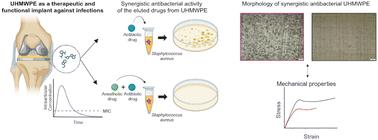
Total joint replacement is a successful procedure for restoring the patient's musculoskeletal mobility and quality of life, but it carries the risk of severe peri-prosthetic joint infections (PJI) and is accompanied by post-operative pain. Cocktails of multiple drugs are often used for prevention/treatment of PJI and for addressing pain. Local drug delivery systems are promising for improving the outcome of the treatment and decreasing the side effects of systemic drugs. To this end, the ultra-high molecular weight polyethylene (UHMWPE) bearing surface of the joint implant is here proposed as a platform for simultaneous release of multiple therapeutics. The combined use of non-antibiotic drugs and antibiotics, and their incorporation into UHMWPE allows to obtain novel antibacterial implant materials. The combined elution of analgesics and antibiotics from UHMWPE is found to be synergistically effective in eradicating Staphylococcus aureus, as the non-antibiotic compound significantly enhances the antibacterial activity of the antibiotic. The drug properties and the employed method for their incorporation into UHMWPE are found to dictate the morphology, thus the mechanical properties of the resulting material. By adopting various fabrication methods, novel formulations showing an enhanced antibacterial activity and outstanding mechanical properties are here proposed to amplify the functionality of polymeric implant materials.
期刊介绍:
Journal of Materials Chemistry A, B & C cover high quality studies across all fields of materials chemistry. The journals focus on those theoretical or experimental studies that report new understanding, applications, properties and synthesis of materials. Journal of Materials Chemistry A, B & C are separated by the intended application of the material studied. Broadly, applications in energy and sustainability are of interest to Journal of Materials Chemistry A, applications in biology and medicine are of interest to Journal of Materials Chemistry B, and applications in optical, magnetic and electronic devices are of interest to Journal of Materials Chemistry C.Journal of Materials Chemistry B is a Transformative Journal and Plan S compliant. Example topic areas within the scope of Journal of Materials Chemistry B are listed below. This list is neither exhaustive nor exclusive:
Antifouling coatings
Biocompatible materials
Bioelectronics
Bioimaging
Biomimetics
Biomineralisation
Bionics
Biosensors
Diagnostics
Drug delivery
Gene delivery
Immunobiology
Nanomedicine
Regenerative medicine & Tissue engineering
Scaffolds
Soft robotics
Stem cells
Therapeutic devices



 京公网安备 11010802042870号
京ICP备2023020795号-1
京公网安备 11010802042870号
京ICP备2023020795号-1

 分享
分享
 求助内容:
求助内容: 应助结果提醒方式:
 扫码关注我们
