Xinyue Zheng, Lianlei Wen, Yan Xiao and Meidong Lang
{"title":"Thermo-sensitive polycaprolactone coacervates for preventing protein aggregation under thermal stress†","authors":"Xinyue Zheng, Lianlei Wen, Yan Xiao and Meidong Lang","doi":"10.1039/D4TB02450H","DOIUrl":null,"url":null,"abstract":"<p >Inspired from heat shock proteins (HSPs), a thermo-sensitive coacervate-forming polycaprolactone (CPCL) was designed as a natural chaperone mimic to protect proteins from thermal stress. Unlike the coil–globule polymers of poly(<em>N</em>-isopropyl acrylamide) (PNIPAM), the as-designed CPCL underwent a partial dehydration during heating, characterizing it as a coacervate-forming polymer. With its ability to transform between the coil and coacervate states in response to temperature, theCPCL spontaneously captured and released targeted proteins, thereby behaving like a natural chaperone of HSPs. Remarkably, compared with the PNIPAM homopolymer, the CPCL provided more efficient protection for proteins by inhibiting heat-induced aggregation above the melting temperature (<em>T</em><small><sub>m</sub></small>). Taken together, we envision that the CPCL with excellent biodegradability and biocompatibility could be a safe excipient for protein protection against thermal damage without separation.</p>","PeriodicalId":83,"journal":{"name":"Journal of Materials Chemistry B","volume":" 7","pages":" 2520-2532"},"PeriodicalIF":6.1000,"publicationDate":"2025-01-07","publicationTypes":"Journal Article","fieldsOfStudy":null,"isOpenAccess":false,"openAccessPdf":"","citationCount":"0","resultStr":null,"platform":"Semanticscholar","paperid":null,"PeriodicalName":"Journal of Materials Chemistry B","FirstCategoryId":"1","ListUrlMain":"https://pubs.rsc.org/en/content/articlelanding/2025/tb/d4tb02450h","RegionNum":3,"RegionCategory":"医学","ArticlePicture":[],"TitleCN":null,"AbstractTextCN":null,"PMCID":null,"EPubDate":"","PubModel":"","JCR":"Q1","JCRName":"MATERIALS SCIENCE, BIOMATERIALS","Score":null,"Total":0}
引用次数: 0
Abstract
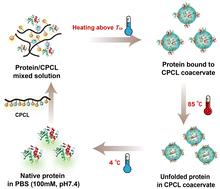
Inspired from heat shock proteins (HSPs), a thermo-sensitive coacervate-forming polycaprolactone (CPCL) was designed as a natural chaperone mimic to protect proteins from thermal stress. Unlike the coil–globule polymers of poly(N-isopropyl acrylamide) (PNIPAM), the as-designed CPCL underwent a partial dehydration during heating, characterizing it as a coacervate-forming polymer. With its ability to transform between the coil and coacervate states in response to temperature, theCPCL spontaneously captured and released targeted proteins, thereby behaving like a natural chaperone of HSPs. Remarkably, compared with the PNIPAM homopolymer, the CPCL provided more efficient protection for proteins by inhibiting heat-induced aggregation above the melting temperature (Tm). Taken together, we envision that the CPCL with excellent biodegradability and biocompatibility could be a safe excipient for protein protection against thermal damage without separation.
期刊介绍:
Journal of Materials Chemistry A, B & C cover high quality studies across all fields of materials chemistry. The journals focus on those theoretical or experimental studies that report new understanding, applications, properties and synthesis of materials. Journal of Materials Chemistry A, B & C are separated by the intended application of the material studied. Broadly, applications in energy and sustainability are of interest to Journal of Materials Chemistry A, applications in biology and medicine are of interest to Journal of Materials Chemistry B, and applications in optical, magnetic and electronic devices are of interest to Journal of Materials Chemistry C.Journal of Materials Chemistry B is a Transformative Journal and Plan S compliant. Example topic areas within the scope of Journal of Materials Chemistry B are listed below. This list is neither exhaustive nor exclusive:
Antifouling coatings
Biocompatible materials
Bioelectronics
Bioimaging
Biomimetics
Biomineralisation
Bionics
Biosensors
Diagnostics
Drug delivery
Gene delivery
Immunobiology
Nanomedicine
Regenerative medicine & Tissue engineering
Scaffolds
Soft robotics
Stem cells
Therapeutic devices



 京公网安备 11010802042870号
京ICP备2023020795号-1
京公网安备 11010802042870号
京ICP备2023020795号-1

 分享
分享
 求助内容:
求助内容: 应助结果提醒方式:
 扫码关注我们
