Effect of dry needling, ischemic compression and cross-taping of the masseter in patients with orofacial myofascial pain: a randomized comparative study.
B Macedo de Sousa, N López-Valverde, A López-Valverde, D Neves, M Santos, J A Blanco Rueda
{"title":"Effect of dry needling, ischemic compression and cross-taping of the masseter in patients with orofacial myofascial pain: a randomized comparative study.","authors":"B Macedo de Sousa, N López-Valverde, A López-Valverde, D Neves, M Santos, J A Blanco Rueda","doi":"10.3389/froh.2024.1524496","DOIUrl":null,"url":null,"abstract":"<p><strong>Background and objective: </strong>Temporomandibular disorders, of multifactorial etiology, refer to a series of pathologies that affect the temporomandibular joint and the associated musculature of the orofacial region and are the result of alterations in the physiological relationships of the stomatognathic system, responsible for functions such as chewing, phonation and swallowing. They produce, among other symptoms, mainly pain, which affects the quality of life of the patients who suffer from them. To alleviate the discomfort of neuromuscular pathology in the orofacial region, various therapeutic strategies are employed, ranging from non-invasive to more invasive methods. The aim of the study was to compare the efficacy of three therapeutic methods (dry needling, ischemic compression and cross-taping) in reducing or relieving masseter pain in individuals with orofacial myofascial pain.</p><p><strong>Materials and methods: </strong>A multicenter randomized comparative clinical trial was conducted in 60 subjects over 18 years of age, divided into three groups: dry needling, ischemic compression and cross-taping. Pain intensity was assessed, randomly, by a single blinded evaluator, according to the Numerical Pain Rating Scale in the pre-treatment period, immediately after, 1-2 weeks and one month later.</p><p><strong>Results: </strong>Immediately after applying the therapies, there was a greater decrease in pain intensity in dry needling, followed by ischemic compression and a smaller decrease in the cross-taping technique (<i>p</i> < 0.0001; <i>p</i> = 0.0001; <i>p</i> = 0.0014, respectively). After 1-2 weeks, there was a noticeable increase in the dry needling technique, however, there was a decrease in pain in the cross-taping technique. After 1 month of application, both dry needling and ischemic compression showed a slight reduction in pain intensity, in contrast to the cross-taping group, which showed an increase in pain intensity.</p><p><strong>Conclusions: </strong>Dry needling and ischemic compression were more effective than cross-taping for immediate reduction of orofacial myofascial pain. Further short- and long-term research is needed to confirm these findings.</p><p><strong>Clinical trial registration: </strong>clinicaltrials.gov, identifier (NCT0660604).</p>","PeriodicalId":94016,"journal":{"name":"Frontiers in oral health","volume":"5 ","pages":"1524496"},"PeriodicalIF":3.1000,"publicationDate":"2025-01-07","publicationTypes":"Journal Article","fieldsOfStudy":null,"isOpenAccess":false,"openAccessPdf":"https://www.ncbi.nlm.nih.gov/pmc/articles/PMC11747114/pdf/","citationCount":"0","resultStr":null,"platform":"Semanticscholar","paperid":null,"PeriodicalName":"Frontiers in oral health","FirstCategoryId":"1085","ListUrlMain":"https://doi.org/10.3389/froh.2024.1524496","RegionNum":0,"RegionCategory":null,"ArticlePicture":[],"TitleCN":null,"AbstractTextCN":null,"PMCID":null,"EPubDate":"2024/1/1 0:00:00","PubModel":"eCollection","JCR":"Q1","JCRName":"DENTISTRY, ORAL SURGERY & MEDICINE","Score":null,"Total":0}
引用次数: 0
Abstract
Background and objective: Temporomandibular disorders, of multifactorial etiology, refer to a series of pathologies that affect the temporomandibular joint and the associated musculature of the orofacial region and are the result of alterations in the physiological relationships of the stomatognathic system, responsible for functions such as chewing, phonation and swallowing. They produce, among other symptoms, mainly pain, which affects the quality of life of the patients who suffer from them. To alleviate the discomfort of neuromuscular pathology in the orofacial region, various therapeutic strategies are employed, ranging from non-invasive to more invasive methods. The aim of the study was to compare the efficacy of three therapeutic methods (dry needling, ischemic compression and cross-taping) in reducing or relieving masseter pain in individuals with orofacial myofascial pain.
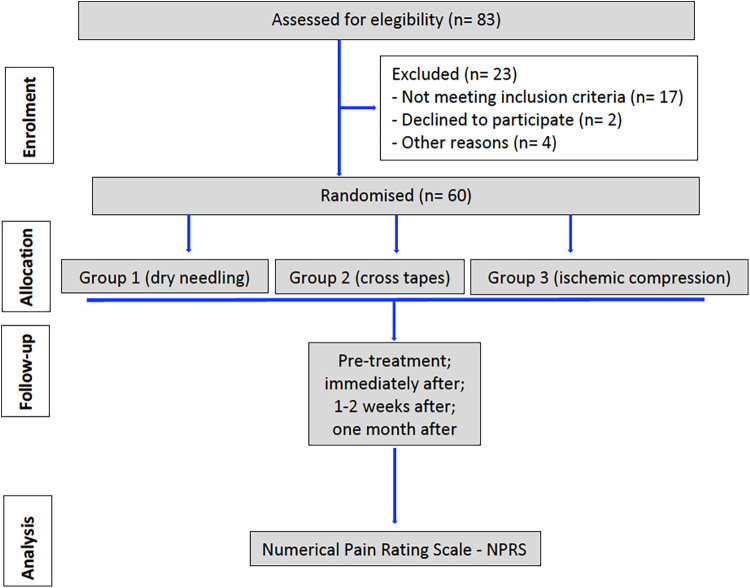
Materials and methods: A multicenter randomized comparative clinical trial was conducted in 60 subjects over 18 years of age, divided into three groups: dry needling, ischemic compression and cross-taping. Pain intensity was assessed, randomly, by a single blinded evaluator, according to the Numerical Pain Rating Scale in the pre-treatment period, immediately after, 1-2 weeks and one month later.
Results: Immediately after applying the therapies, there was a greater decrease in pain intensity in dry needling, followed by ischemic compression and a smaller decrease in the cross-taping technique (p < 0.0001; p = 0.0001; p = 0.0014, respectively). After 1-2 weeks, there was a noticeable increase in the dry needling technique, however, there was a decrease in pain in the cross-taping technique. After 1 month of application, both dry needling and ischemic compression showed a slight reduction in pain intensity, in contrast to the cross-taping group, which showed an increase in pain intensity.
Conclusions: Dry needling and ischemic compression were more effective than cross-taping for immediate reduction of orofacial myofascial pain. Further short- and long-term research is needed to confirm these findings.





 京公网安备 11010802042870号
京ICP备2023020795号-1
京公网安备 11010802042870号
京ICP备2023020795号-1

 分享
分享

 求助内容:
求助内容: 应助结果提醒方式:
 扫码关注我们
