Esther H Chung, Arian Khorshid, Brindha Bavan, Ruth B Lathi
{"title":"A cost analysis of hCG trigger alone versus dual trigger for achieving live birth following in vitro fertilization.","authors":"Esther H Chung, Arian Khorshid, Brindha Bavan, Ruth B Lathi","doi":"10.1530/RAF-24-0095","DOIUrl":null,"url":null,"abstract":"<p><strong>Graphical abstract: </strong></p><p><strong>Lay summary: </strong>In this study, we wanted to explore if adding gonadotropin agonist (GnRHa) to the standard use of human chorionic gonadotropin (hCG) for triggering egg maturation in in vitro fertilization (IVF) could be a more cost-effective option. What that means: Using hCG alone: Traditionally, hCG is the most common hormone used to trigger eggs to mature fully so that they can be collected for fertilization. Adding GnRHa: GnRHa is another medication that mimics a natural hormone produced by the brain. Adding this as a co-trigger may do better than just using hCG alone, by leading to more mature eggs and increasing live birth rates (LBRs). However, concerns about added costs and inconvenience remain. To address this, we created a cost model comparing LBRs and costs between the two strategies. Our analysis found that using this dual trigger increased LBRs by 13%, with a small cost increase of $175. For each 1% higher LBR, the added cost of using GnRHa + hCG was $13. Considering this minimal increase in cost relative to the overall high cost of IVF, using the dual trigger appears to be a cost-effective strategy to improve success rates for patients.</p>","PeriodicalId":101312,"journal":{"name":"Reproduction & fertility","volume":" ","pages":""},"PeriodicalIF":3.4000,"publicationDate":"2025-02-17","publicationTypes":"Journal Article","fieldsOfStudy":null,"isOpenAccess":false,"openAccessPdf":"https://www.ncbi.nlm.nih.gov/pmc/articles/PMC11850038/pdf/","citationCount":"0","resultStr":null,"platform":"Semanticscholar","paperid":null,"PeriodicalName":"Reproduction & fertility","FirstCategoryId":"1085","ListUrlMain":"https://doi.org/10.1530/RAF-24-0095","RegionNum":0,"RegionCategory":null,"ArticlePicture":[],"TitleCN":null,"AbstractTextCN":null,"PMCID":null,"EPubDate":"2025/1/1 0:00:00","PubModel":"Print","JCR":"Q2","JCRName":"REPRODUCTIVE BIOLOGY","Score":null,"Total":0}
引用次数: 0
Abstract
Graphical abstract:
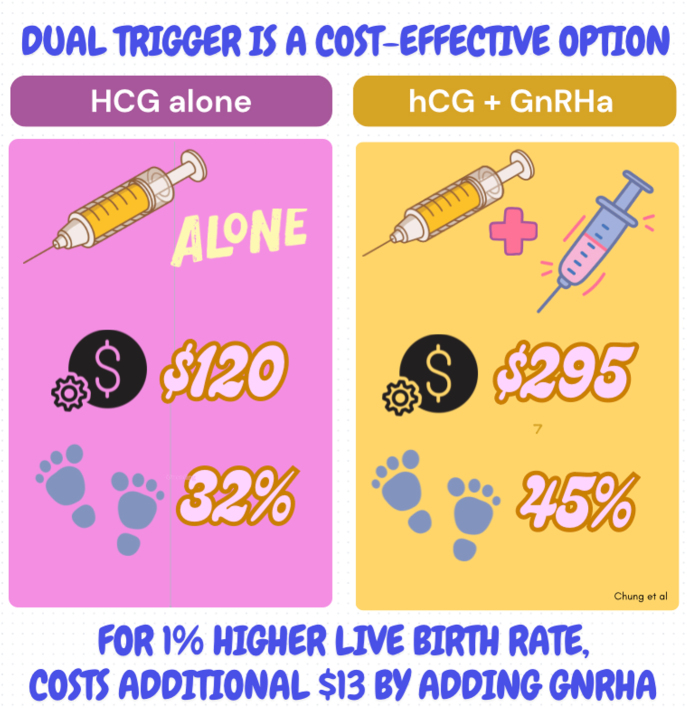
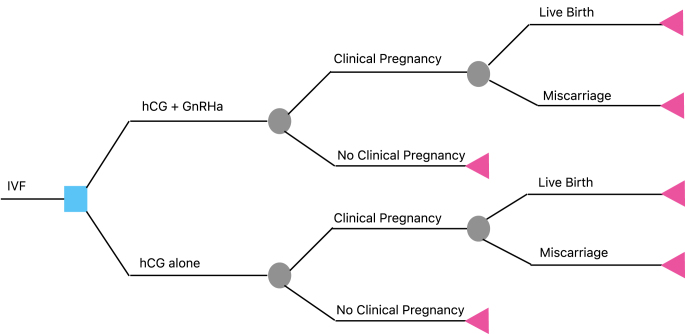
Lay summary: In this study, we wanted to explore if adding gonadotropin agonist (GnRHa) to the standard use of human chorionic gonadotropin (hCG) for triggering egg maturation in in vitro fertilization (IVF) could be a more cost-effective option. What that means: Using hCG alone: Traditionally, hCG is the most common hormone used to trigger eggs to mature fully so that they can be collected for fertilization. Adding GnRHa: GnRHa is another medication that mimics a natural hormone produced by the brain. Adding this as a co-trigger may do better than just using hCG alone, by leading to more mature eggs and increasing live birth rates (LBRs). However, concerns about added costs and inconvenience remain. To address this, we created a cost model comparing LBRs and costs between the two strategies. Our analysis found that using this dual trigger increased LBRs by 13%, with a small cost increase of $175. For each 1% higher LBR, the added cost of using GnRHa + hCG was $13. Considering this minimal increase in cost relative to the overall high cost of IVF, using the dual trigger appears to be a cost-effective strategy to improve success rates for patients.




 京公网安备 11010802042870号
京ICP备2023020795号-1
京公网安备 11010802042870号
京ICP备2023020795号-1

 分享
分享

 求助内容:
求助内容: 应助结果提醒方式:
 扫码关注我们
