Comparative study of anti-SARS-CoV-2 receptor-binding domain total antibody titer before and after heterologous booster with mRNA-based COVID-19 vaccine.
{"title":"Comparative study of anti-SARS-CoV-2 receptor-binding domain total antibody titer before and after heterologous booster with mRNA-based COVID-19 vaccine.","authors":"Qatrunnada Kamil, Widia Putri, Arianisah P Ayulinda, Imelda Maelani, Samsul Anwar, Ichsan Ichsan, Agung Pranata, Mudatsir Mudatsir, Maimun Syukri, Samsul Rizal, Razali Razali, Hamdani Hamdani, Rudi Kurniawan, Irwansyah Irwansyah, Sarwo E Sofyan, Harapan Harapan","doi":"10.52225/narra.v4i3.788","DOIUrl":null,"url":null,"abstract":"<p><p>The waning immunity following the COVID-19 vaccination become a significant concern and the immunological dynamics of vaccine-induced antibodies after vaccination need to be explored. The aim of this study was to compare anti-SARS-CoV-2 receptor-binding domain (RBD) antibody levels before and after a booster dose with heterologous COVID-19 vaccine and to identify factors influencing the levels after receiving the booster dose. A cross-sectional study was conducted in which individuals who received primary doses of CoronaVac and a booster dose with an mRNA-based vaccine were recruited using a purposive sampling technique. The titers of anti-SARS-CoV-2 RBD antibodies were measured using an enzyme-linked immunosorbent assay (ELISA), and plausible associated factors were collected using a questionnaire-assisted face-to-face interview. The Wilcoxon test was used to compare the titers before and after the booster dose, while the Kruskal-Wallis and Mann-Whitney tests, followed by multivariate linear regression, were used to assess the factors associated with RBD total antibody titers. The results showed that there was a significant increase of anti-SARS-CoV-2 RBD total antibody titers before and after receiving the booster dose (1,558.7 binding antibody units (BAU)/mL vs 140.6 BAU/mL, <i>p</i><0.001). The analysis revealed that age (<i>p</i>=0.555), sex (<i>p</i>=0.254), type of vaccine (<i>p</i>=0.914), presence of hypertension (<i>p</i>=0.541), diabetes (<i>p</i>=0.975), chronic obstructive pulmonary disease (COPD, <i>p</i>=0.620), and gout (<i>p</i>=0.364) were not associated with anti-SARS-CoV-2 RBD total antibody titers. However, the titers of anti-SARS-CoV-2 RBD total antibody were significantly different between those with and without hyperlipidemia (<i>p</i>=0.021). This study suggests that a booster dose with a heterologous COVID-19 vaccine could significantly enhance immune responses against COVID-19, and therefore, this strategy may be recommended as part of preventive measures to strengthen immunity against COVID-19.</p>","PeriodicalId":517416,"journal":{"name":"Narra J","volume":"4 3","pages":"e788"},"PeriodicalIF":0.0000,"publicationDate":"2024-12-01","publicationTypes":"Journal Article","fieldsOfStudy":null,"isOpenAccess":false,"openAccessPdf":"https://www.ncbi.nlm.nih.gov/pmc/articles/PMC11731810/pdf/","citationCount":"0","resultStr":null,"platform":"Semanticscholar","paperid":null,"PeriodicalName":"Narra J","FirstCategoryId":"1085","ListUrlMain":"https://doi.org/10.52225/narra.v4i3.788","RegionNum":0,"RegionCategory":null,"ArticlePicture":[],"TitleCN":null,"AbstractTextCN":null,"PMCID":null,"EPubDate":"2024/12/20 0:00:00","PubModel":"Epub","JCR":"","JCRName":"","Score":null,"Total":0}
引用次数: 0
Abstract
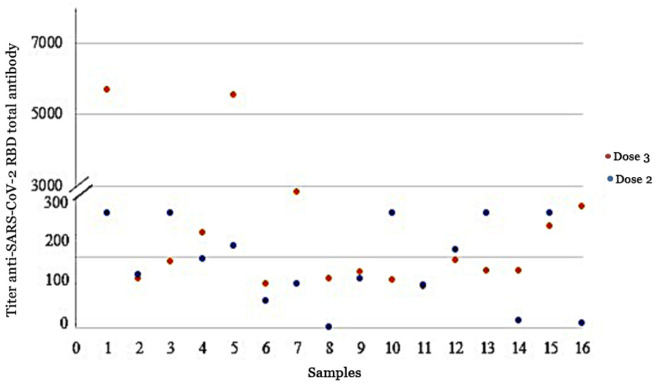
The waning immunity following the COVID-19 vaccination become a significant concern and the immunological dynamics of vaccine-induced antibodies after vaccination need to be explored. The aim of this study was to compare anti-SARS-CoV-2 receptor-binding domain (RBD) antibody levels before and after a booster dose with heterologous COVID-19 vaccine and to identify factors influencing the levels after receiving the booster dose. A cross-sectional study was conducted in which individuals who received primary doses of CoronaVac and a booster dose with an mRNA-based vaccine were recruited using a purposive sampling technique. The titers of anti-SARS-CoV-2 RBD antibodies were measured using an enzyme-linked immunosorbent assay (ELISA), and plausible associated factors were collected using a questionnaire-assisted face-to-face interview. The Wilcoxon test was used to compare the titers before and after the booster dose, while the Kruskal-Wallis and Mann-Whitney tests, followed by multivariate linear regression, were used to assess the factors associated with RBD total antibody titers. The results showed that there was a significant increase of anti-SARS-CoV-2 RBD total antibody titers before and after receiving the booster dose (1,558.7 binding antibody units (BAU)/mL vs 140.6 BAU/mL, p<0.001). The analysis revealed that age (p=0.555), sex (p=0.254), type of vaccine (p=0.914), presence of hypertension (p=0.541), diabetes (p=0.975), chronic obstructive pulmonary disease (COPD, p=0.620), and gout (p=0.364) were not associated with anti-SARS-CoV-2 RBD total antibody titers. However, the titers of anti-SARS-CoV-2 RBD total antibody were significantly different between those with and without hyperlipidemia (p=0.021). This study suggests that a booster dose with a heterologous COVID-19 vaccine could significantly enhance immune responses against COVID-19, and therefore, this strategy may be recommended as part of preventive measures to strengthen immunity against COVID-19.



 京公网安备 11010802042870号
京ICP备2023020795号-1
京公网安备 11010802042870号
京ICP备2023020795号-1

 分享
分享

 求助内容:
求助内容: 应助结果提醒方式:
 扫码关注我们
