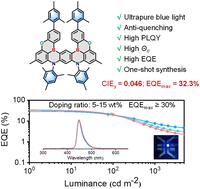
A mesityl-functionalized double-boron–nitrogen–oxygen-embedded multi-resonance framework achieves anti-quenching narrowband deep-blue electroluminescence with EQE over 30% and CIEy of 0.046†
Zhuixing Xue, Zhengqi Xiao, Yang Zou, Zhanxiang Chen, Jiahui Liu, Zhongyan Huang and Chuluo Yang
{"title":"A mesityl-functionalized double-boron–nitrogen–oxygen-embedded multi-resonance framework achieves anti-quenching narrowband deep-blue electroluminescence with EQE over 30% and CIEy of 0.046†","authors":"Zhuixing Xue, Zhengqi Xiao, Yang Zou, Zhanxiang Chen, Jiahui Liu, Zhongyan Huang and Chuluo Yang","doi":"10.1039/D4SC07503J","DOIUrl":null,"url":null,"abstract":"<p >Developing highly efficient deep-blue multi-resonance thermal activated delayed fluorescence (MR-TADF) materials for ultra-high-definition organic light-emitting diodes (OLEDs) displays that meet the stringent BT.2020 standard remains a significant challenge. In this study, we present a strategy to achieve high-performance deep-blue MR-TADF emitters by integrating a large π-conjugated double-boron-embedded MR skeleton with strategically positioned peripheral steric hindrance groups. The developed molecule, <strong>DMBNO</strong>, exhibits a narrow full-width at half maximum (FWHM) of 19 nm, with a deep-blue emission peak at 444 nm in diluted toluene solutions. Additionally, it achieves high photoluminescence quantum yield (PLQY) and a horizontal ratio of emitting dipole orientation (<em>θ</em><small><sub>∥</sub></small>) exceeding 90% in doped films. Notably, <strong>DMBNO</strong> demonstrates anti-quenching properties and effectively suppresses spectrum broadening. Consequently, OLEDs based on <strong>DMBNO</strong> achieve a high maximum external quantum efficiency (EQE<small><sub>max</sub></small>) of 32.3%, with an impressive Commission Internationale de l'Eclairage (CIE) <em>y</em>-coordinate of 0.046, fully satisfying the BT.2020 blue gamut at a high doping concentration of 10 wt%. These findings offer valuable insights into molecular design tactics for deep-blue MR-TADF emitters featuring high efficiency, ultra-pure color, and anti-quenching characteristics.</p>","PeriodicalId":9909,"journal":{"name":"Chemical Science","volume":" 8","pages":" 3655-3661"},"PeriodicalIF":7.4000,"publicationDate":"2025-01-22","publicationTypes":"Journal Article","fieldsOfStudy":null,"isOpenAccess":false,"openAccessPdf":"https://pubs.rsc.org/en/content/articlepdf/2025/sc/d4sc07503j?page=search","citationCount":"0","resultStr":null,"platform":"Semanticscholar","paperid":null,"PeriodicalName":"Chemical Science","FirstCategoryId":"92","ListUrlMain":"https://pubs.rsc.org/en/content/articlelanding/2025/sc/d4sc07503j","RegionNum":1,"RegionCategory":"化学","ArticlePicture":[],"TitleCN":null,"AbstractTextCN":null,"PMCID":null,"EPubDate":"","PubModel":"","JCR":"Q1","JCRName":"CHEMISTRY, MULTIDISCIPLINARY","Score":null,"Total":0}
引用次数: 0
Abstract
Developing highly efficient deep-blue multi-resonance thermal activated delayed fluorescence (MR-TADF) materials for ultra-high-definition organic light-emitting diodes (OLEDs) displays that meet the stringent BT.2020 standard remains a significant challenge. In this study, we present a strategy to achieve high-performance deep-blue MR-TADF emitters by integrating a large π-conjugated double-boron-embedded MR skeleton with strategically positioned peripheral steric hindrance groups. The developed molecule, DMBNO, exhibits a narrow full-width at half maximum (FWHM) of 19 nm, with a deep-blue emission peak at 444 nm in diluted toluene solutions. Additionally, it achieves high photoluminescence quantum yield (PLQY) and a horizontal ratio of emitting dipole orientation (θ∥) exceeding 90% in doped films. Notably, DMBNO demonstrates anti-quenching properties and effectively suppresses spectrum broadening. Consequently, OLEDs based on DMBNO achieve a high maximum external quantum efficiency (EQEmax) of 32.3%, with an impressive Commission Internationale de l'Eclairage (CIE) y-coordinate of 0.046, fully satisfying the BT.2020 blue gamut at a high doping concentration of 10 wt%. These findings offer valuable insights into molecular design tactics for deep-blue MR-TADF emitters featuring high efficiency, ultra-pure color, and anti-quenching characteristics.
期刊介绍:
Chemical Science is a journal that encompasses various disciplines within the chemical sciences. Its scope includes publishing ground-breaking research with significant implications for its respective field, as well as appealing to a wider audience in related areas. To be considered for publication, articles must showcase innovative and original advances in their field of study and be presented in a manner that is understandable to scientists from diverse backgrounds. However, the journal generally does not publish highly specialized research.




 京公网安备 11010802042870号
京ICP备2023020795号-1
京公网安备 11010802042870号
京ICP备2023020795号-1

 分享
分享
 求助内容:
求助内容: 应助结果提醒方式:
 扫码关注我们
